
How do cruise ships turn around?
The short answer
Cruise ships turn around in tight spaces using a combination of bow thrusters, which move the front of the ship sideways, and azimuth thrusters, which rotate 360° to steer and propel the ship. These systems allow precise movements without relying heavily on tugboats.
The long answer
Cruise ships are often called "cities on the sea" because of their massive size and population. The biggest cruises in the world are over 1,000 ft (305 m) in length and carry 5,000-7,000 passengers.
So when these sea-ties need to dock in narrow ports, how exactly do cruise ships turn around?
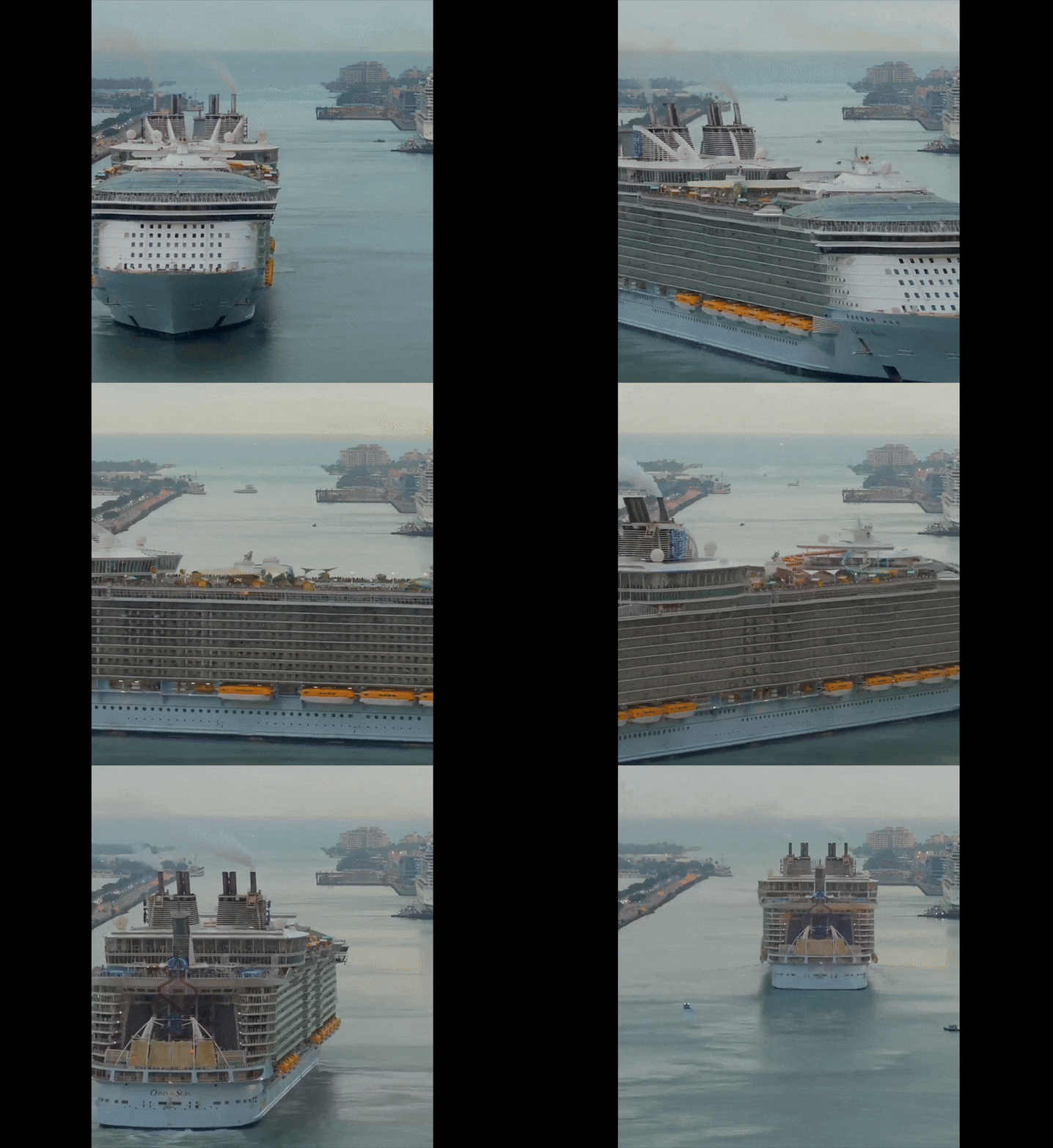
Source: Reddit
Cruise ships maneuver tight turns primarily thanks to two components: bow thrusters and azimuth thrusters.
Bow thrusters push the front of the ship from side to side
Bow thrusters are smaller propellors mounted sideways at the bow (front) of the ship. They are primarily used when the ship is going at low speeds in coastal waters or while entering or leaving a port, especially in challenging conditions like strong currents or high winds.
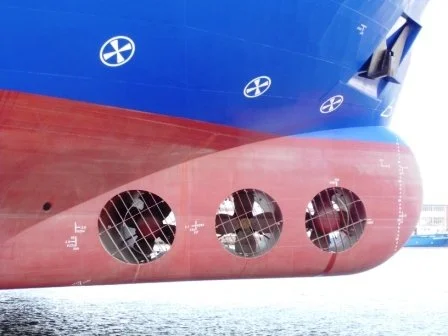
Three bow thrusters. The painted white "X"s are what you see when the boat is in the water to indicate there are thrusters.
"2012 09 03 Innovation 3-Querstrahler im-Bug 2kk DSCI0786" by Dr. Karl-Heinz Hochhaus is licensed under CC BY 3.0.
The bow thruster pulls in water from one side of the ship and expels it on the other, pushing the bow in the opposite direction. They can be operated in both directions, from port to starboard (left to right) and vice versa.
Because bow thrusters enable precise sideways movement when docking, they often reduce or eliminate the need for tugboats in port.
Azimuth thrusters can rotate 360° to propel and navigate ships
For a long time, ships were pushed through the water with fixed propellors and turned using rudders. Newer ships now use a combination of these systems with a type of rotating propeller called an azimuth thruster.
Azimuth thrusters are named after the term "azimuth," which refers to a horizontal angle measured from a cardinal direction, like 90° from north being east. But they're more commonly referred to as "azipods," for the same reason why tissue is often called Kleenex.
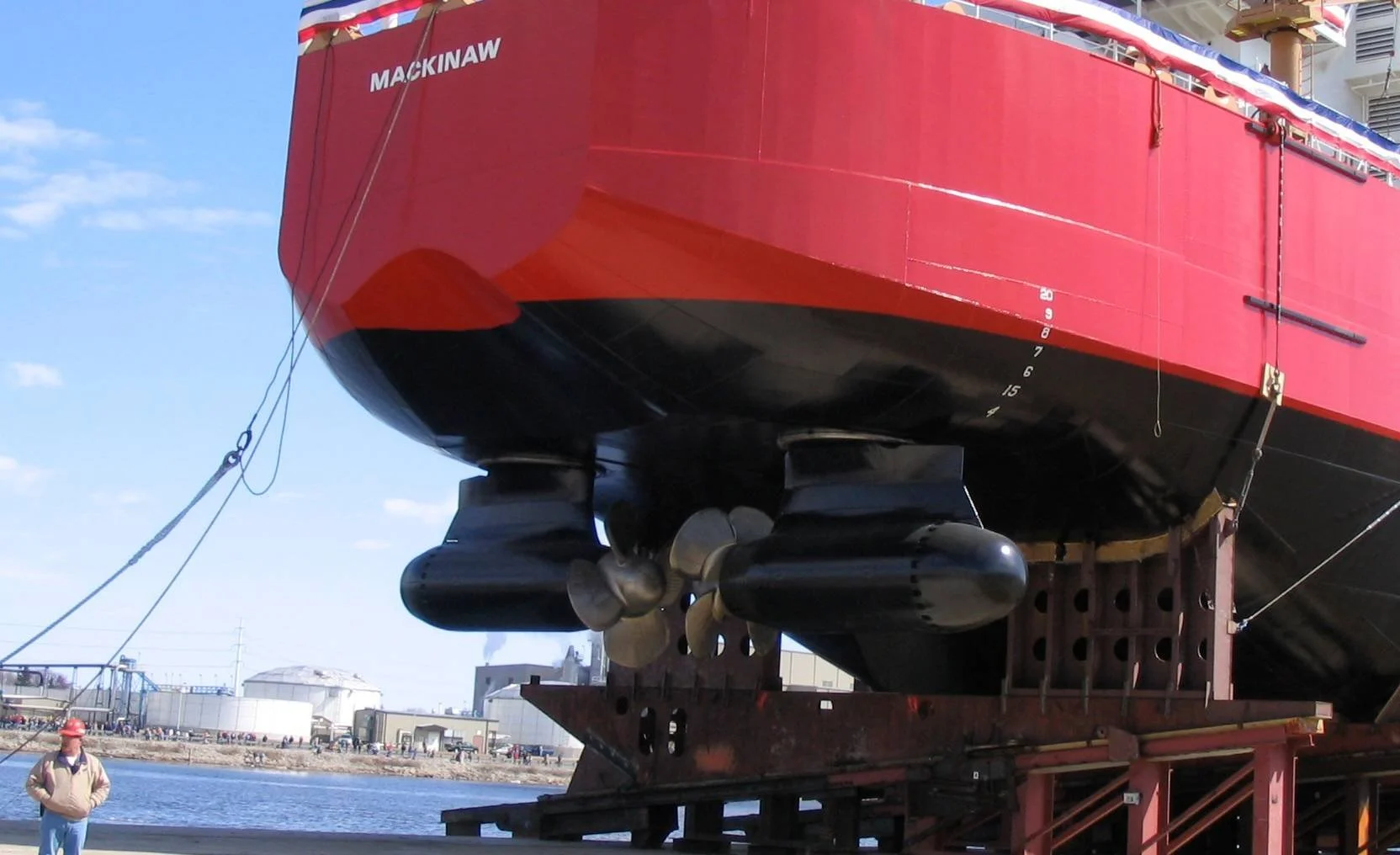
"A nice view of the azipods of the USCGC Mackinaw" (cropped) by Pete Markham is licensed under CC BY-SA 2.0.
Traditional propeller and rudder systems work well for navigation in open waters. However when big ships come into port, they may need to turn quickly and even reverse, which is typically where tugboats would come in.
With azipods, cruise ship captains can control each thruster independently to make precise turns and even "crabwalk" a ship sideways with the help of bow thrusters.
Azipods also differ from traditional propellors because they are typically positioned "backwards" so that they pull water instead of push it. This configuration allows the propellor to hit the water when it hasn't been disturbed by the pod structure, which makes the thrust more efficient.
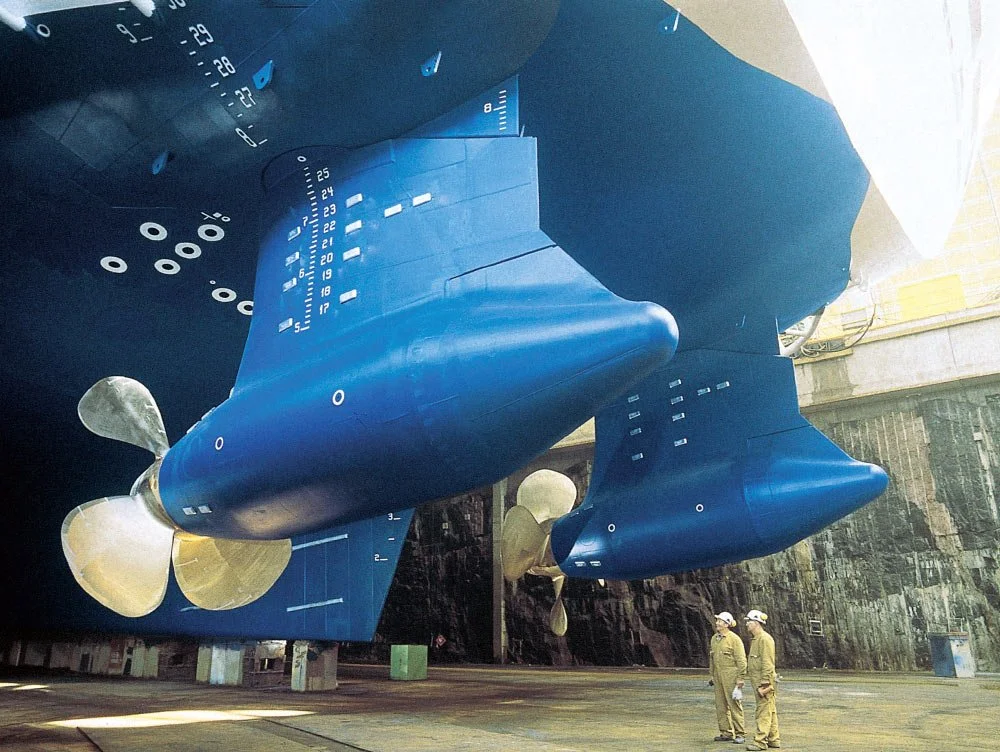
Source: Reddit
As you can see, the azipods on big ships are enormous. On the Queen Mary 2, the largest ocean liner ever built, each azipod weighs as much as a Boeing 747 and has a power output of 21.5 megawatts.
Curious about how the world works?
Today You Should Know is a free, weekly email newsletter designed to help you learn something new every Friday.
Subscribe today 👇
Check out some other curious questions:


Sources
Brady, M. (2025, May 21). How Do Ships Turn?. YouTube. https://www.youtube.com/watch?v=WfCWhS9UOSE
Dragonetti, G. (2025, December 2). Understanding Bow Thrusters on Ships. CruiseInd. https://www.cruiseind.com/understanding-bow-thrusters-on-ships/
Kaushik, M. (2024, January 30). The Essential Guide to Bow Thruster Construction and Functionality. Marine Insight. http://www.marineinsight.com/tech/bow-thrusters-construction-and-working/
Rowlinson, A., Varis, J., & Irgens, O.-J. (2021, June 8). Podcast: 30 years of ABB’s revolutionary Azipod® propulsion system: ABB Decoded. ABB Decoded. https://global.abb/content/dam/abb/global/group/media/podcasts/decoded/s01/transcripts/ABB%20Decoded%20-%20Season%201%20-%20Episode%206%20-%2030%20years%20of%20ABB%E2%80%99s%20revolutionary%20Azipod%20propulsion%20system.pdf
Sethuraman, R. (2021, August 16). How Are Cruise Ships Powered?. Marine Insight. https://www.marineinsight.com/tech/cruise-ships-powered/
Thakkar, E. (2025, April 25). Just How Big is a Cruise Ship?. Cruise Hive. https://www.cruisehive.com/how-big-is-a-cruise-ship/66674
The Wall Street Journal. (2023, August 4). Captain Explains How He Docks the World’s Biggest Cruise Ship | WSJ Booked. YouTube. https://www.youtube.com/watch?v=9hfqVrVIsyU
Whiteford, S. (2021, October 1). How do Azimuth Thrusters work?. OneStep Power Solutions Inc. https://www.onesteppower.com/post/azimuth-thrusters



We Americans sure do like American things.