
Why does the sound of nails on a chalkboard give you chills?
The short answer
Nails on a chalkboard sound awful because our ears naturally amplify those frequencies. It's theorized that we evolved this sensitivity to better detect the warning calls of our primate ancestors.
The long answer
Hearing nails scraped on a chalkboard is a truly awful sound. For the masochists reading this, have a whirl and click on the video below.
Nails on a chalkboard is rated as one of the most hated sounds in the world (in case you were wondering, the sounds of vomiting, microphone feedback, and crying babies are the top three.) Let's dig into why researchers think this sound is so horrible to listen to.
One reason the sound of nails on a chalkboard feels so intense is that the human ear naturally amplifies those frequencies (thanks, ears). The graph below shows how our threshold for hearing mostly lowers as the frequency of a sound increases. Interestingly, we become the most sensitive to sounds between 2,000 and 5,000 Hz (see the bump between the red arrows).
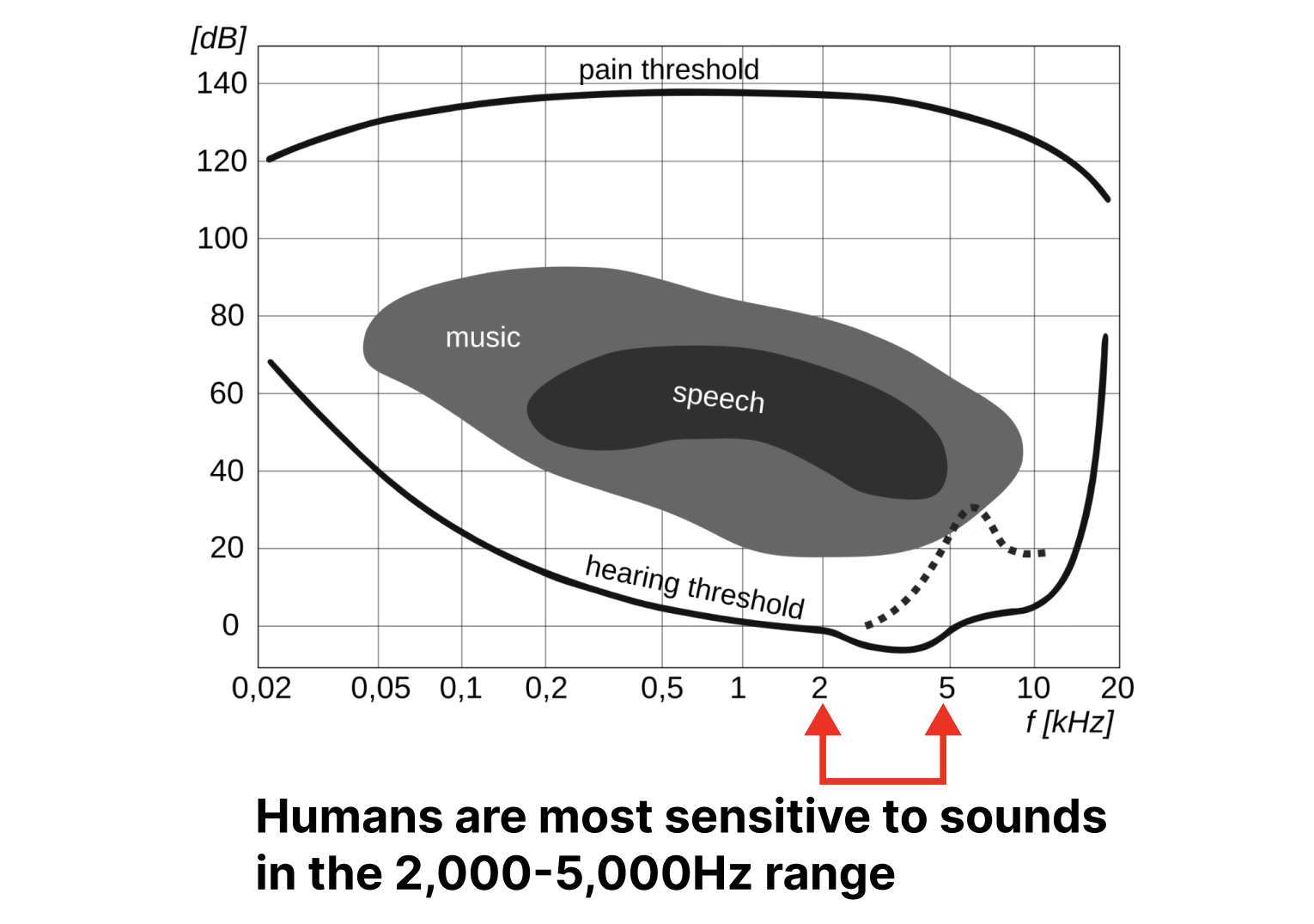
This graph shows how our hearing threshold changes depending on the frequency. The dashed line is for something unrelated.
"Hörfläche" (modified) is part of the public domain.
We're particularly sensitive to these frequencies because the shape of the outer ear boosts sound waves in that range. Why? Well, that's where we don't have all the answers, but we do have a theory.
As it turns out, the sound waves of nails on a chalkboard are strikingly similar to that of a chimpanzee scream. Both fall between 2,000-5,000 Hz.
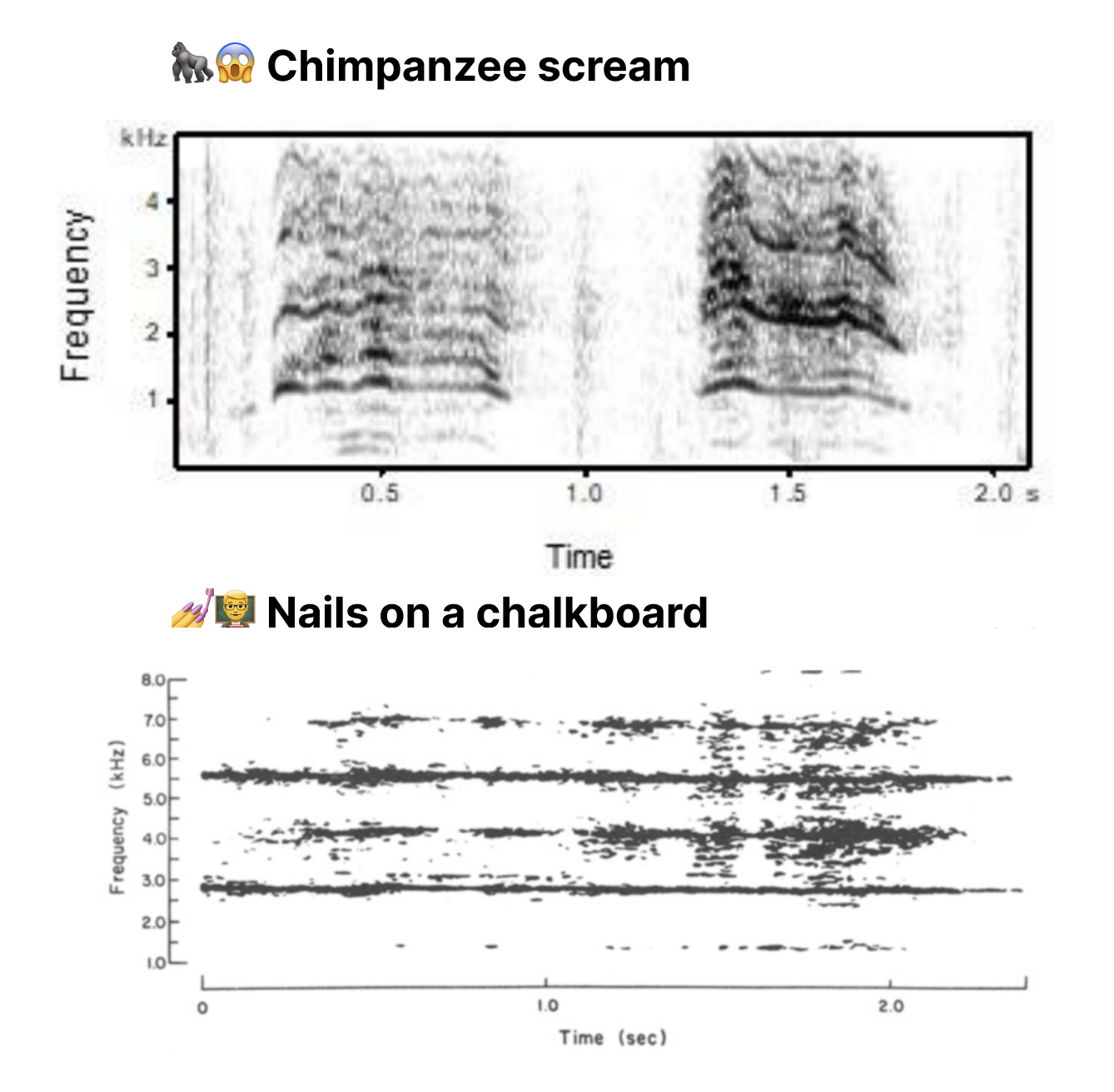
Spectrograms of a chimpanzee scream (top) and nails on a chalkboard (bottom). Technically that's a gorilla emoji, but today I learned there is no chimpanzee emoji.
Top: Nature | Bottom: Perception & Psychophysics
From an evolutionary standpoint, it makes sense that our ears would naturally resonate with the frequency of a chimpanzee scream. If we can hear our fellow chimpanzee call out to let us know about a potential threat, we can escape.
This primal theory gained more credibility when a 2012 fMRI study found that sounds in this range (specifically testing nails on a chalkboard) activated the amygdala, the part of the brain responsible for triggering our fight-or-flight fear response.
So the next time you hear nails being scraped on a chalkboard, you can be grateful that the only threat you face is simple auditory discomfort and not a lion threatening to eat you and your chimpanzee family.
Curious about how the world works?
Today You Should Know is a free, weekly email newsletter designed to help you learn something new every Friday.
Subscribe today 👇
Check out some other curious questions:


Sources
Cox, T. J. (2008). Scraping sounds and disgusting noises. Applied Acoustics, 69(12), 1195–1204. https://doi.org/10.1016/j.apacoust.2007.11.004
Eveleth, R. (2011, October 31). Why do we hate the sound of nails on a chalkboard?. Scienceline. https://scienceline.org/2011/10/why-do-we-hate-the-sound-of-nails-on-a-chalkboard/
Geggel, L. (2016, December 6). Fingernails on a chalkboard: Why this sound gives you the shivers. LiveScience. https://www.livescience.com/57106-why-fingernails-on-chalkboard-hurts.html
Girard-Buttoz, C., Zaccarella, E., Bortolato, T., Friederici, A. D., Wittig, R. M., & Crockford, C. (2022, May 16). SUPPLEMENTARY MATERIAL for Chimpanzees produce diverse vocal sequences with ordered and recombinatorial properties. Nature. https://pure.mpg.de/rest/items/item_3383804_7/component/file_3383815/content from https://www.nature.com/articles/s42003-022-03350-8
Halpern, D. L., Blake, R., & Hillenbrand, J. (1986). Psychoacoustics of a chilling sound. Perception & Psychophysics, 39(2), 77–80. https://doi.org/10.3758/bf03211488
Kumar, S., von Kriegstein, K., Friston, K., & Griffiths, T. D. (2012). Features versus feelings: Dissociable representations of the acoustic features and valence of aversive sounds. The Journal of Neuroscience, 32(41), 14184–14192. https://doi.org/10.1523/jneurosci.1759-12.2012
Moran, M. (2006, October 6). Fingernails on a chalkboard garner Vanderbilt psychologist Ig Nobel Prize. Vanderbilt University. https://news.vanderbilt.edu/2006/10/06/fingernails-on-a-chalkboard-garner-vanderbilt-psychologist-ig-nobel-prize-58866/
Siegel, R., & Oehler, M. (2011, November 9). Why Nails On A Chalkboard Drives Us Crazy. NPR. https://www.npr.org/2011/11/09/142184389/why-nails-on-a-chalkboard-drives-us-crazy
Tijou, S. (2017, March 2). There’s now a word for nails on a blackboard - but it’s not in English. BBC News. https://www.bbc.com/news/newsbeat-39141780


We Americans sure do like American things.