
How does a thermos work?
The short answer
A thermos keeps hot drinks hot and cold drinks cold by blocking all three types of heat transfer: conduction, convection, and radiation. It does this with a vacuum between its double walls (which eliminates conduction and convection) and a silvered inner surface (which reflects infrared radiation).
The long answer
There's nothing quite as refreshing as an ice-cold drink on a hot day. Or as comforting as a steaming-hot one on a cold day. But what sorcery enables the thermos to keep our hot drinks hot and cold drinks cold?
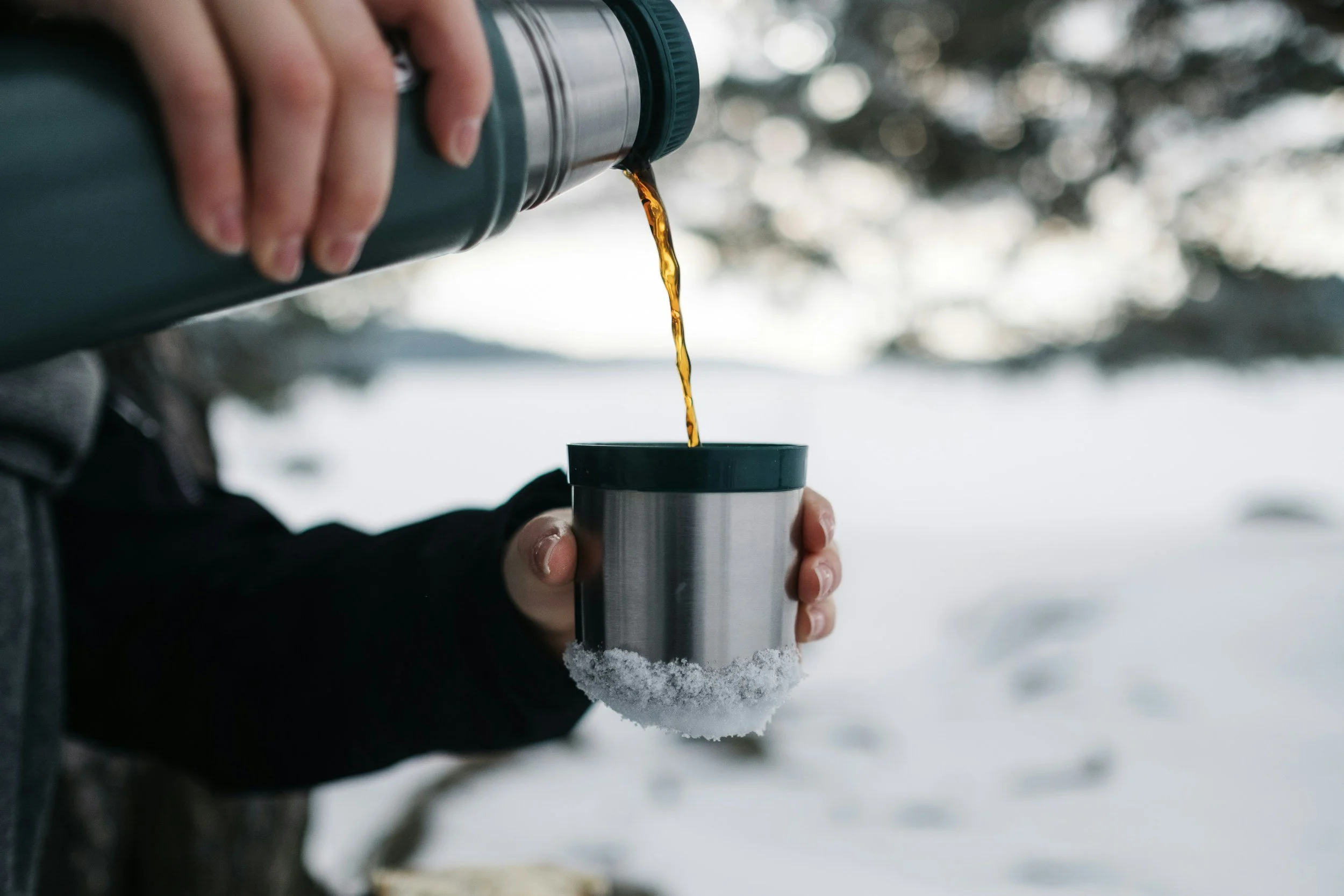
Side note: I learned that "thermos" (lowercased) is an example of genericization, or when a brand name becomes a household name and loses its trademark status. Other examples include aspirin, zipper, and escalator. The legal term for this is "genericide", which feels a bit dramatic to me, but I digress.
But let's get back to the question at hand: How does a thermos keep hot drinks hot and cold drinks cold?
Why do hot drinks cool down? Why do cold drinks warm up?
To understand how a thermos works, we first have to understand the principles of heat transfer. Consider a hot cup of coffee sitting on a desk, slowly becoming a room-temperature disappointment:

Diagram showing how a mug of hot coffee loses heat through radiation, convection, and conduction.
"Coffee cup flat" (modified) by gnokii is part of the public domain.
Heat escapes the coffee in three ways:
Conduction: Molecules in hot objects vibrate faster than those in cold objects. When the cup's hot molecules touch the cooler molecules of the desk, they transfer energy, causing the desk molecules to vibrate faster and warm up. Conduction is how heat flows between objects or materials that are touching.
Convection: Air molecules that touch the hot cup or liquid surface absorb heat, causing them to move faster, spread apart, and rise. Cooler air then rushes in to replace them, heats up, and rises as well, creating a continuous loop. Convection is how heat travels through liquids and gases via circulating currents.
Radiation: Hot objects also emit heat as infrared electromagnetic waves. This is why you can hold your hand near a hot cup and feel its warmth without touching it. Unlike conduction and convection, no matter (solid, liquid, gas) is needed to transfer heat this way.
Given enough time, a hot coffee will eventually reach room temperature. These same principles work in reverse for cold drinks: heat from the surrounding environment continuously transfers to the colder liquid, gradually warming it up.
How does a thermos work?
A thermos must slow heat transfer by conduction, convection, and radiation to keep hot drinks hot and cold drinks cold. It achieves this feat thanks to a vacuum and, to a lesser extent, an internal mirrored surface.
A vacuum is simply a space with lack of atoms. It's nearly impossible to create a "perfect vacuum," but you can get pretty darn close. A thermos has a double-walled inner container, often made of glass or stainless steel, with a vacuum between the walls. Without any atoms, heat loss by conduction and convection is essentially eliminated.
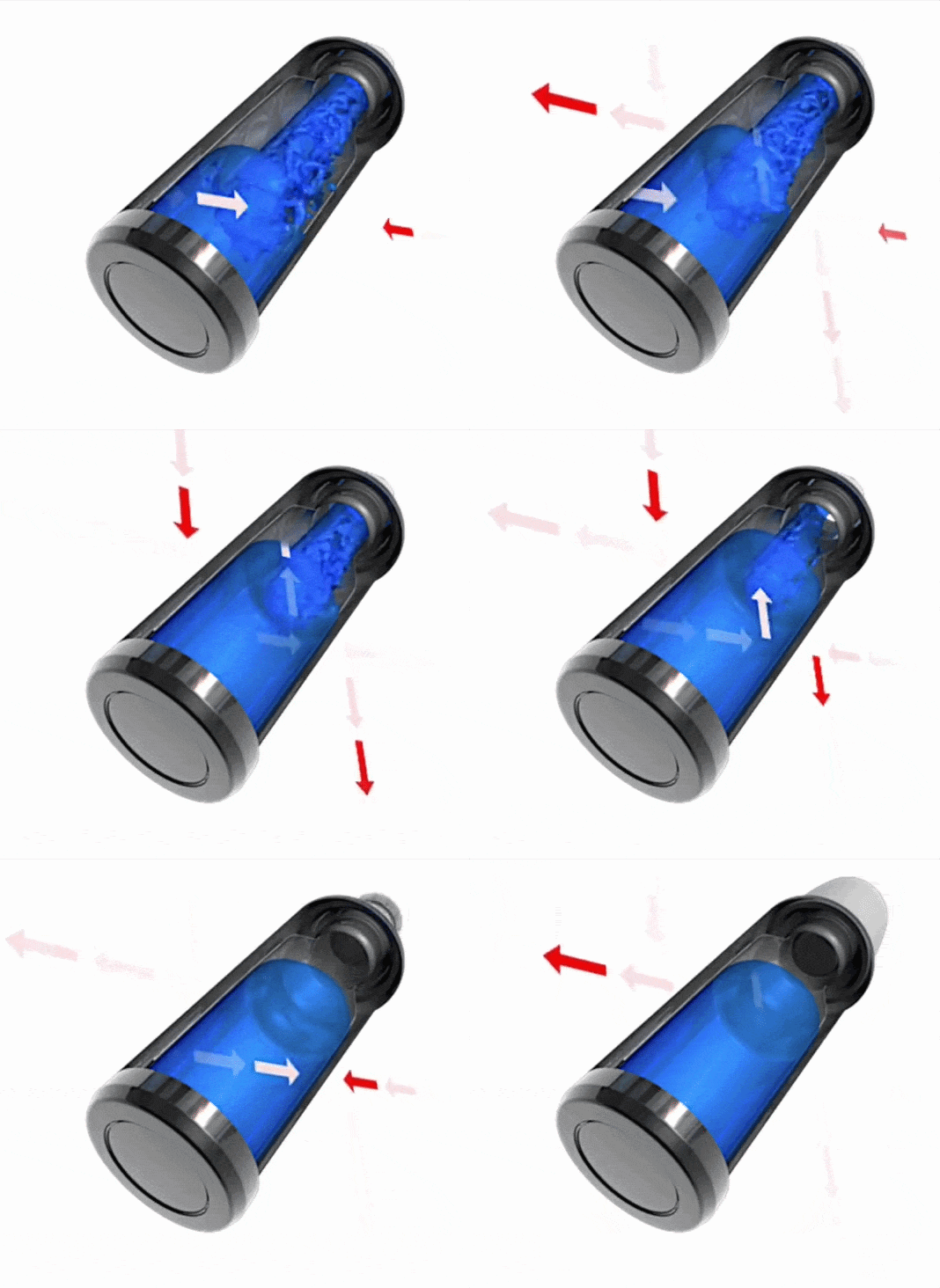
Source: Thermos Brand (Official US)
Many thermoses also use an insulated stopper or cap to reduce heat transfer through the top of the bottle.
The vacuum prevents heat loss through convection and conduction, but it's the reflective inner coating that minimizes the effects of radiation. In many designs, the inner surface is shiny or reflective, like a mirror, to reflect infrared radiation back inward.
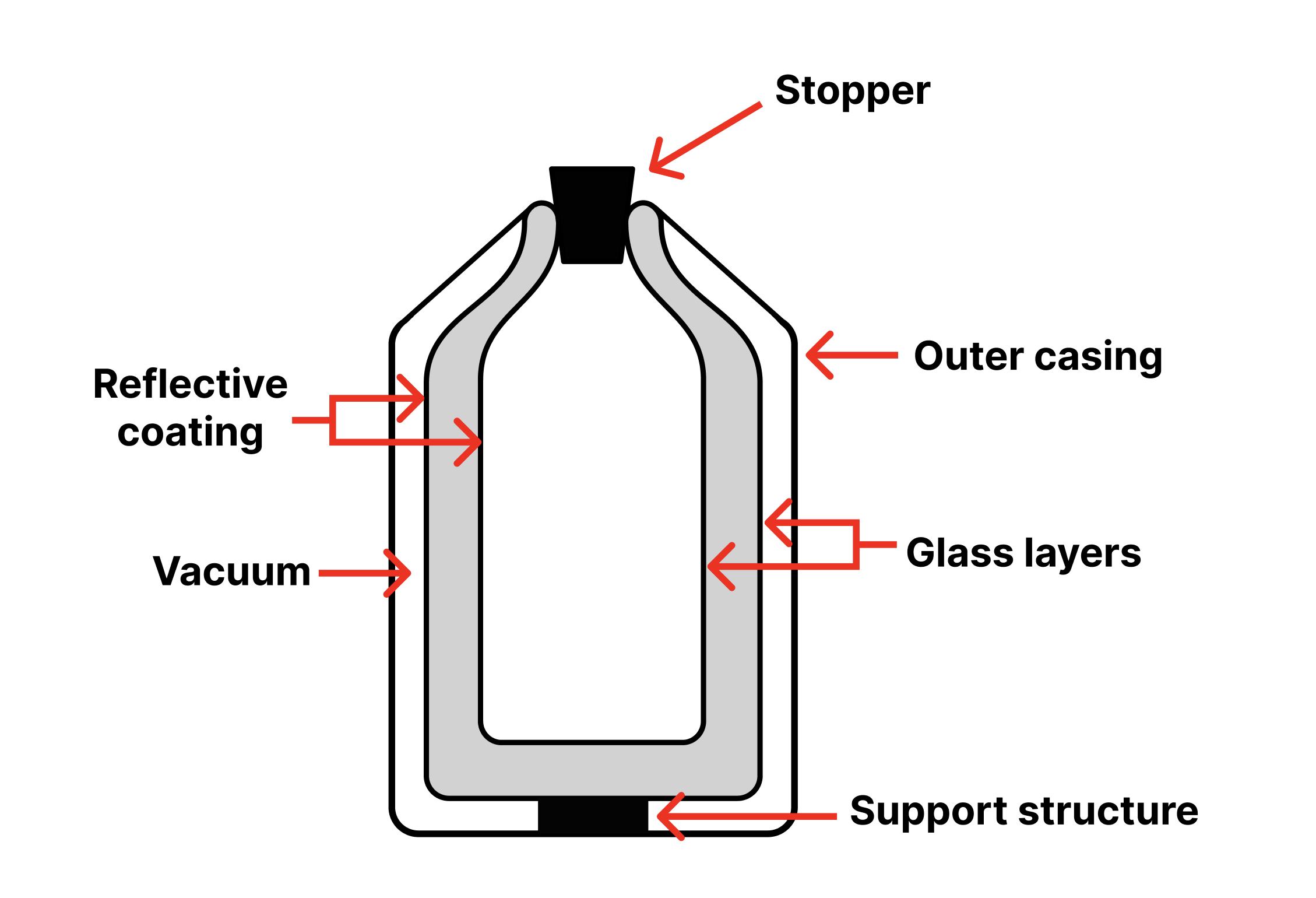
Diagram of a thermos container.
"Vacuum Dewar Flask" (modified) by Acdx is licensed under CC BY-SA 3.0.
So why do hot liquids in a thermos ever cool down (and vice versa for cold liquids)? It's because, at the end of the day, it's a bottle that we need to open. The cap is not sealed by a vacuum, so conduction and convection can cause heat to seep out from this point. Additionally, the glass bottle meets the outer casing walls near the cap, which provides a conduction path. While the heat transfer is minimal, it is not zero.
Curious about how the world works?
Today You Should Know is a free, weekly email newsletter designed to help you learn something new every Friday.
Subscribe today 👇
Check out some other curious questions:


Sources
BBC. (n.d.). Heat transfer - CCEA The vacuum flask. BBC. https://www.bbc.co.uk/bitesize/guides/z32nf82/revision/14
Brian, M. (n.d.). How Thermoses (Vacuum Flasks) Work. HowStuffWorks. https://home.howstuffworks.com/thermos2.htm
Let’s Talk Science. (n.d.). Introduction to Heat Transfer. Let’s Talk Science. https://letstalkscience.ca/educational-resources/backgrounders/introduction-heat-transfer
Woodford, C. (2022, March 24). Heat. Explain that Stuff. https://www.explainthatstuff.com/heat.html
Woodford, C. (2023, August 8). Vacuum flasks. Explain that Stuff. https://www.explainthatstuff.com/vacuumflasks.html



We Americans sure do like American things.