
What is the largest named number?
The short answer
The largest named number is arguably Rayo's number, which is defined as the smallest number that's bigger than any number you can define in a googol symbols or fewer using a specific mathematical language.
The long answer
We've named a lot of big numbers:
Million: 10⁶ or 1,000,000
Billion: 10⁹ or 1,000,000,000
Trillion: 10¹² or 1,000,000,000,000
Googol: 10¹⁰⁰ or 10,000,000,000,000,000,000,000,000,000,000,000,000,000,000,000,000,000,000,000,000,000,000,000,000,000,000,000,000,000,000,000,000,000
Googolplex: 10¹⁰⁰⁰⁰⁰⁰⁰⁰⁰⁰⁰⁰⁰⁰⁰⁰⁰⁰⁰⁰⁰⁰⁰⁰⁰⁰⁰⁰⁰⁰⁰⁰⁰⁰⁰⁰⁰⁰⁰⁰⁰⁰⁰⁰⁰⁰⁰⁰⁰⁰⁰⁰⁰⁰⁰⁰⁰⁰⁰⁰⁰⁰⁰⁰⁰⁰⁰⁰⁰⁰⁰⁰⁰⁰⁰⁰⁰⁰⁰⁰⁰⁰⁰⁰⁰⁰⁰⁰⁰⁰⁰⁰⁰⁰⁰⁰⁰⁰⁰⁰ (that's 10 to the power of googol 🤯)
But what is the biggest named number? Well, that's what two philosophy professors set out to find at an MIT-hosted mathematical, boxing-like championship in 2007.
What was the Big Number Duel?
The Large Number Championship (later referred to as the Big Number Duel) was held on Friday, January 26, 2007 by Professor Agustín "The Mexican Multiplier" Rayo and Professor Adam "Dr. Evil" Elga. They wanted to duel it out to discover who could write the largest number.
It was quite the spectacle. The room was packed with students, some even standing on chairs or peering through doorways to watch. Just look at the event poster!
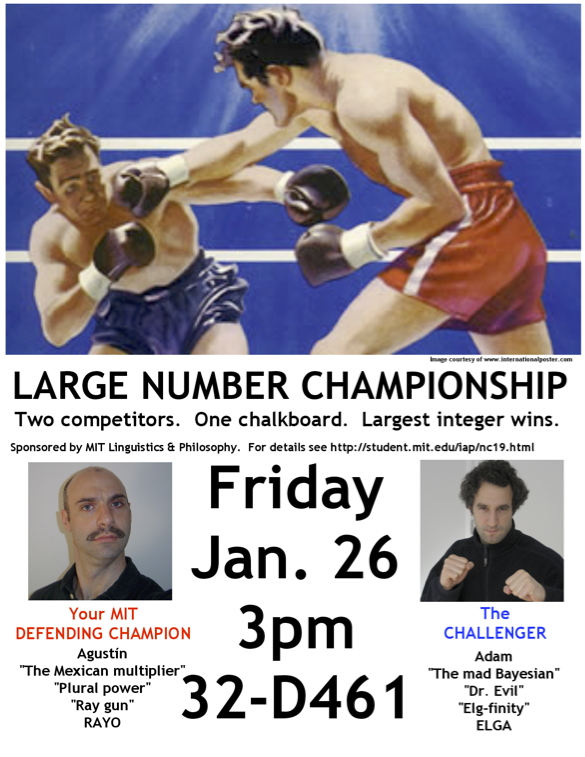
Original poster for the event. Source: Agustín Rayo's MIT blog
Here were the rules:
The contestants would take turns writing numbers on the board, and the last person to write down a valid entry would be the winner.
Only finite numbers were allowed.
Semantic vocabulary wouldn't be allowed. For example, Dr. Evil couldn't write, "The biggest number ever named by the Mexican Multiplier, plus one."
No "unsporting behavior." In other words, each new answer had to involve a new idea. So, the Mexican Multiplier couldn't just add a 0 to Dr. Evil's previous answer.
Rayo started the competition with writing a sequence of 30 or 40 ones:
111111111111111111111111111111
A pretty big number. But they were just getting started.
Elga thought for a bit and then approached the board with an eraser. He erased a line across all but the first two ones, leaving:
11!!!!!!!!!!!!!!!!!!!!!!!!!!!!
Elga read out his entry, "11 factorial, factorial, factorial, factorial...." A factorial is when you multiply the number by each of its preceding integers. So 5! = 5 x 4 x 3 x 2 x 1 = 120.
To get a sense of how big Elga's move was, note that 11! is 39,916,800 and 11!! is approximately 6 × 10²⁸⁶⁰⁷⁸¹⁷⁰. There was no question that Elga's number was much bigger than Rayo's.
The battle continued round by round, until they had the winning entry, which later became known as Rayo's number.
What is Rayo's number?
Rayo's number is arguably the biggest number ever named. It has no use or significance other than being incredibly large. In fact, it is literally uncomputable so we don't actually know its digits.
Here was Rayo's winning entry:
“The smallest number bigger than any number that can be named by an expression in the language of first-order set theory with a googol (10¹⁰⁰) symbols or less.”
If your first thought was, "Hey, I thought they weren't allowed to use semantics," you would be right. So, here's Rayo's number written out in formal mathematical notation:
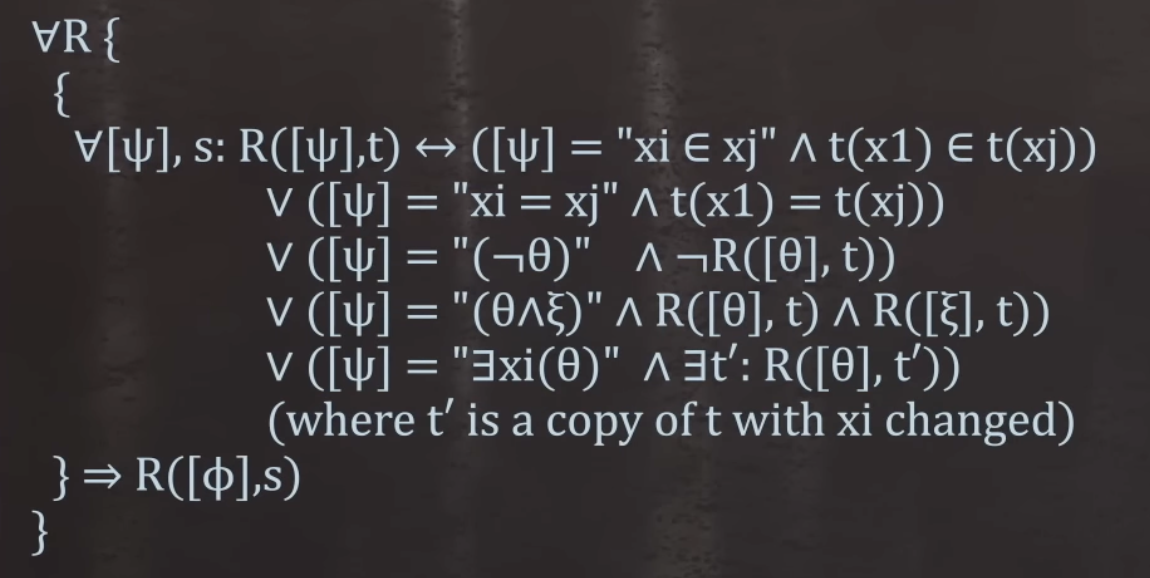
Rayo's number written out in formal mathematical notation. Source: Numberphile
Cool, cool, cool.
At this point, I should say that I will merely mention the concepts behind Rayo's number. I will not explain them because I don't understand them. But even if you can't read the hieroglyphic-like notation above, you can still get a taste for the brilliance and immensity of the number.
Rayo's number is the next biggest number expressed with googol or fewer symbols in first-order set theory. So what in the world is first-order set theory?
First-order set theory is essentially the language of mathematics. By "first" order, it means that you can only make statements about individual things, not sets or groups of things. The language includes variable symbols, like x, y, and z, along with special characters, like:
∀ = for all
∃ = there exists
∴ = therefore
Interestingly, first-order set theory is not efficient when it comes to small numbers. For example, it takes 63 characters to write the number two:
∃𝑥1∀𝑥2(𝑥2∈𝑥1↔(¬∃𝑥3(𝑥3∈𝑥2)∨∀𝑥3(𝑥3∈𝑥2↔¬∃𝑥4(𝑥4∈𝑥3))))
But for big numbers, first-order set theory is efficient because you can use functions to write out some mind-bogglingly big numbers in a relatively modest number of characters.
To put Rayo's number into perspective, let me introduce you to Graham's number: G₆₄. Graham's number involves arrow notation, ↑, where a single arrow means "to the power of". Just to lay the groundwork, here's how to build Graham's number:
3 ↑ 3 = 3³ = 273 ↑↑ 3 = 333 = ~7.6 trillion3 ↑↑↑ 3 = 3 stacked on top of itself ~7.6 trillion timesYou can see how we're about to blast off here. Next we get to G₁, which is a number that we use to build even bigger numbers.
G₁ = 3 ↑↑↑↑ 3 = 3 stacked on top of itself 3 ↑↑↑ 3 timesG₂ = 3 ↑...G₁ number of arrows...↑ 3...G₆₄ = Graham's number
If this was difficult to follow along, I highly recommend this Numberphile video to understand Graham's number.
Graham's number is incomprehensibly big. Like it'll-break-your-brain big. And yet, you could define Graham's number in a relatively modest amount of first-order set theory characters, making it smaller than Rayo's number.
And remember, Rayo's number allows for a googol number of symbols. So you could literally write Graham's number close to a googol number of times and it would still be valid.
Rayo's number is truly a BIG number.
I'll wrap this up by sharing a quote from MIT's student newspaper's coverage of the event.
“Dr. Evil clutched his heart as though it had been pierced by an arrow. Trembling, he fell to his knees on the floor of the crowded stuffy room, all eyes watching him. The Mexican Multiplier threw up his hands in victory, smiling, as Dr. Evil whispered, “I’ve been crushed.” The battle was finally over.”
Curious about how the world works?
Today You Should Know is a free, weekly email newsletter designed to help you learn something new every Friday.
Subscribe today 👇
Check out some other curious questions:



Sources
Grossack, C. (2020, May 24). How to write numbers in the language of first-order set theory. Mathematics Stack Exchange. https://math.stackexchange.com/questions/3689088/how-to-write-numbers-in-the-language-of-first-order-set-theory
Manzari, M. (2007, January 31). Profs Duke It Out in Big Number Duel. The Tech. https://web.archive.org/web/20080919124735/http://tech.mit.edu/V126/N64/64largenumber.html
Padilla, T. & Haran, B. (2020, April 12). The Daddy of Big Numbers (Rayo’s Number) - Numberphile. YouTube. https://www.youtube.com/watch?v=X3l0fPHZja8
Padilla, T., Parker, M., & Haran, B. (2012, April 4). Graham’s Number - Numberphile. YouTube. https://www.youtube.com/watch?v=XTeJ64KD5cg
Rayo, A. (2007). Big Number Duel. MIT. https://web.mit.edu/arayo/www/bignums.html
Saunders, T. (2023, June 15). What is the biggest number in the Universe?. BBC Science Focus Magazine. https://www.sciencefocus.com/science/what-is-the-biggest-number

We Americans sure do like American things.