
How are prints of paintings made?
The short answer
Prints of paintings are made through a process called giclée printing. An ultra-high resolution photo of the original is printed with archival inks on museum-grade paper.
The long answer
Artists spend hours and hours crafting their paintings. But an original is an original. They can't paint the exact same painting again. So how do they make prints of their painting that get as close as possible to their original?
In a word, giclée.
What is a giclée print?
Giclée (pronounced zhee-KLAY) prints are museum-quality reproductions of fine art made with a professional inkjet printer using pigment-based inks. The word "giclée" is a combination of two French words: “gicleur” (meaning “nozzle”), and “gicler” (meaning “to spray”). The art world sure does love their French words.
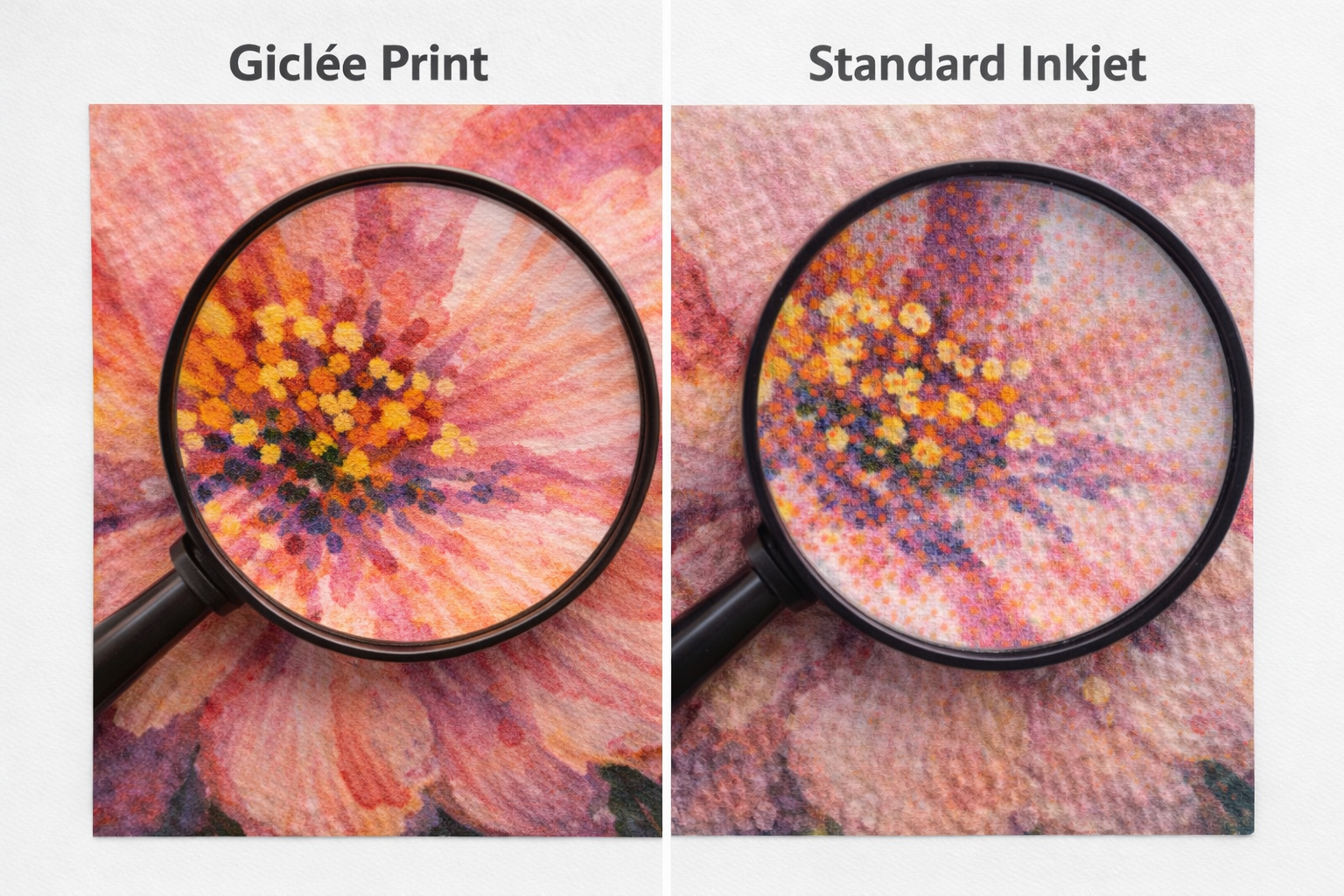
Source: Giclee London
The prints are renowned for their exceptional color accuracy, archival longevity, and rich detail. For a layperson, it can be difficult to discern between the original and the giclée print because every brushstroke and crisp detail is reproduced.
How do you make a giclée print?
Let's start with the elements required for a print to be a giclée print. Then I'll share the steps to make a work of printing art.
A giclée print requires an ultra-high quality digital image file of the original artwork, a professional inkjet printer using archival pigment inks, and heavyweight museum paper.
📸 Ultra-high quality digital image: Printers build an image from tiny droplets of ink, so the more dots per inch (DPI), the better. A typical digital image has a resolution of 72 DPI. For a giclée print, we need to bump those numbers up to at least 300 DPI.
🎨 Pigment inks: A key part of a giclée's permanence comes from using archival pigment inks that are resistant to fading. Pigment ink is made of solid pigment particles suspended in a liquid, whereas dye inks are colorant particles dissolved in water. With pigment ink, the color particles stay near the surface of the paper instead of soaking in, which helps the color last longer.
🖨️ Professional printer: To get the widest range of color, a giclée print needs to come from a professional printer with up to 12 ink cartridges. For context, your printer likely comes with the standard 4-color setup: Cyan, Magenta, Yellow, Black. Additional ink cartridges, like light cyan, light magenta, orange, green, or gray, are added to recreate a painting's wide range of colors.
📄 Archival-quality, acid-free paper: Giclée prints are typically printed on canvas, watercolor paper, or other heavyweight museum paper. Cheaper paper tends to be acidic because it contains lignin, a compound in wood that breaks down over time and releases acids. It's important that the paper is acid-free so that it doesn't turn brittle or yellow over time.
Now let's dive into how giclée prints are made, step-by-step. Also, I highly recommend this video, which gives a great overview of the process.
Step #1: Photograph the painting

Left: Ultra-high resolution camera taking pictures of small sections of a painting. Right: A computer screen monitoring the progress. Source: Amarins Lyklema
The painting is photographed in small grids to get the highest quality image. Dozens of overlapping shots may be taken to be stitched together later into an extremely sharp single image.
Step #2: Color correct the image
Next, the image is color-corrected so that every shade matches the original painting as closely as possible. The artist reviews at this stage to ensure everything is to their liking.
Step #3: Print
Finally, the printer gets to work using up to 12 pigment ink cartridges craft the print with millions of microscopic droplets. Limited-edition prints are typically signed, numbered, and receives its own certificate of authenticity.
What are other types of art prints?
Of course, we haven't always had fancy cameras, computers, and printers to produce giclée prints. Throughout history, artists have sought to produce reproductions of their artwork. Here are the main types of traditional printmaking techniques skilled artists have used to create prints.
Relief printing
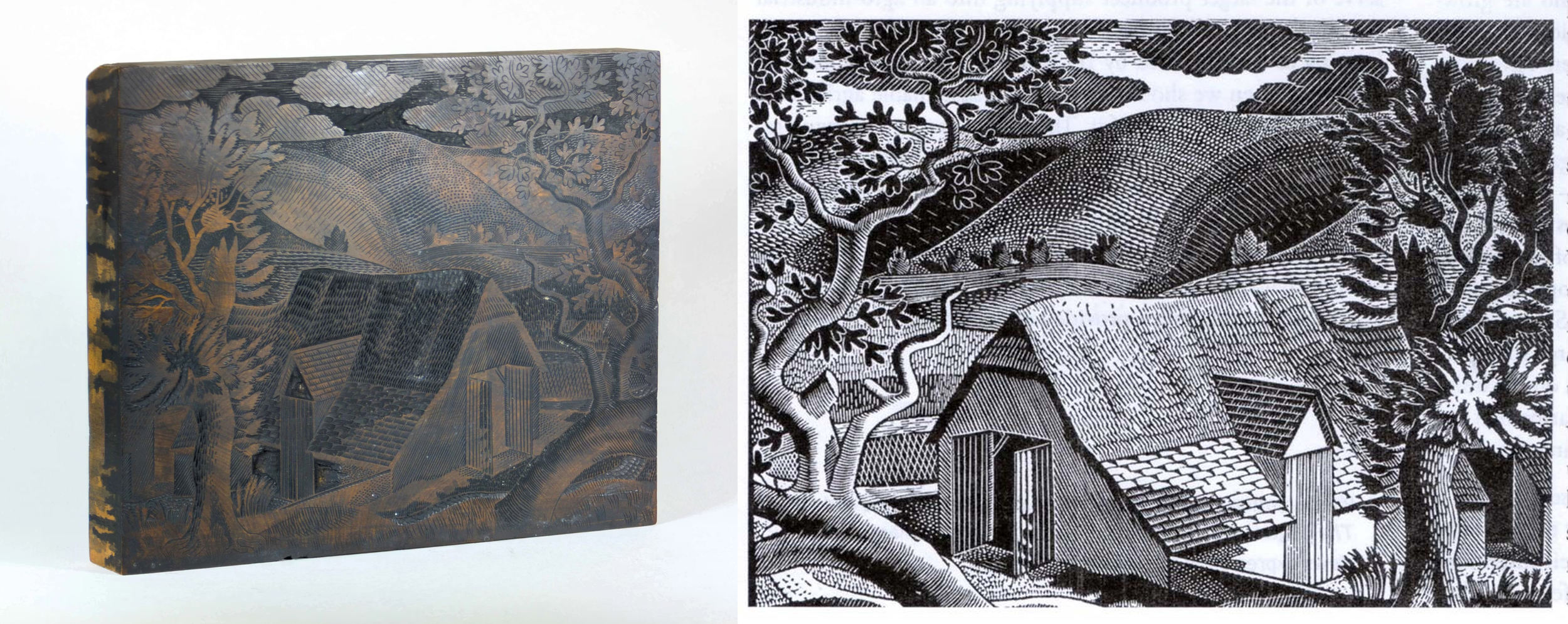
Left: Original woodblock of Sussex Landscape by Eric Ravilious (Source: The Art Newspaper). Right: Sussex Landscape by Eric Ravilious (Source: WikiArt)
Relief printing involves cutting away parts of the printing surface you don't want to be printed. The remaining raised areas pick up ink to make the print. These include woodcuts, linoleum cuts, letterpress, and stamping.
📹 VIDEO: Watch the woodcut and linoleum cut processes.
Intaglio printing

Left: Original copper engraving of Ecce Homo by Jan Norblin. Right: Print of Ecce Homo.
Intaglio printing is basically relief printing in reverse. The print comes from ink held in the grooves that have been carved. A metal plate is engraved, allowing for more rich detail than a material like wood. Ink is spread over the surface and wiped away, leaving behind ink in the etches. A press forces damp paper into the incisions, picking up the ink.
📹 VIDEO: Watch the intaglio process.
Planographic printing
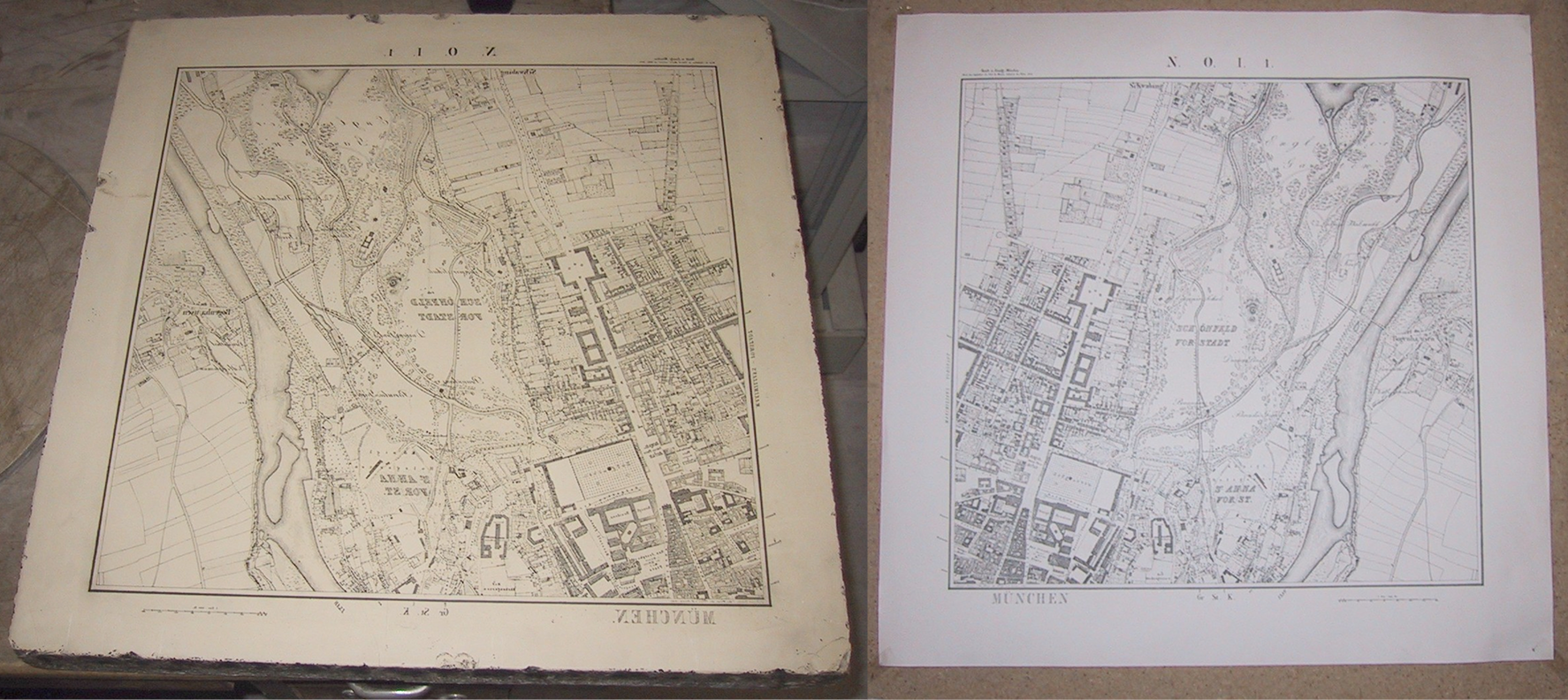
"Litography negative stone and positive paper" by Chris 73 is licensed under CC BY-SA 3.0.
With planographic printing, the image and surface area remain level. There's no etching or cutting involved at all. Lithography is the most common type of planographic printing. In lithography, the artist draws on a flat stone with a greasy crayon, which gets affixed through a chemical process based on the principle of water and oil not mixing.
📹 VIDEO: Watch the lithography process.
Stencil printing

Left: Stencil of Obey Giant by Shepard Fairey (Source: Worthpoint). Right: Print of Obey Giant by Shepard Fairey (Source: Artsy)
Stencil printing involves passing ink or paint through holes of cutout elements. Common types include hand stenciling and screenprinting.
📹 VIDEO: Watch the screenprinting process.
Curious about how the world works?
Today You Should Know is a free, weekly email newsletter designed to help you learn something new every Friday.
Subscribe today 👇
Check out some other curious questions:

Sources
The Art Institute of Chicago. (2021, December 23). Gauguin’s Process | Making Wood-Block Prints. YouTube. https://www.youtube.com/watch?v=eoVT2UZ_drs
Artwork Archive. (2016, January 5). Art Collector Chatter: Why You Need to Use Acid-Free Paper. Artwork Archive. https://www.artworkarchive.com/blog/art-collector-chatter-why-you-need-to-use-acid-free-paper
Brooklyn Editions. (2023, June 21). What is a Giclée Print? (& Why They’re Worth It). Brooklyn Editions. https://www.brooklyneditions.com/blog/what-is-a-giclee-print-and-why-theyre-worth-it
Hill, E. (2026, May 20). 9 Types of Printmaking You Need to Know. Artsy. https://www.artsy.net/article/editorial-nine-types-of-printmaking-you-need-to
Jain, A. (2023, September 1). Dye Ink vs. Pigment Ink: Understanding the Differences and Choosing the Right Ink for Your Printing Needs. Splashjet. https://splashjet-ink.com/dye-ink-vs-pigemnt-ink-the-differences/
Lyklema, A. (2025, September 28). Turning my Paintings into Museum-Quality Prints (Giclée Process). YouTube. https://www.youtube.com/watch?v=M9GT1QRRDKk
The Metropolitan Museum of Art. (2018, December 21). Lithograph. The Met. https://www.metmuseum.org/perspectives/materials-and-techniques-printmaking-lithograph
Mills, P. (2022, September 1). Everything You Need to Know About Giclee Prints. Artwork Archive. https://www.artworkarchive.com/blog/everything-you-need-to-know-about-giclee-prints
MoMA. (n.d.-a). Intaglio. MoMA. https://www.moma.org/collection/terms/intaglio
MoMA. (n.d.-b). Relief print. MoMA. https://www.moma.org/collection/terms/relief-print
National Galleries of Scotland. (n.d.). Planographic printmaking. National Galleries of Scotland. https://www.nationalgalleries.org/art-and-artists/glossary-terms/planographic-printmaking
National Museums Liverpool. (2020, June 8). How to make a lithographic print | National Museums Liverpool. YouTube. https://www.youtube.com/watch?v=G0So4M7Tbis
NireLeet. (2019, November 3). Learning about Printmaking . YouTube. https://www.youtube.com/watch?v=ns9_2SfhCtM
Sheffield Museums. (2013, July 5). Shortcuts - an introduction to linocut printmaking with James Green. YouTube. https://www.youtube.com/watch?v=3EJaQdUSyN0
Young, J. (n.d.). lithography. Britannica Kids. https://kids.britannica.com/students/article/lithography/275502



We Americans sure do like American things.