
Why do we feel secondhand embarrassment?
The short answer
Secondhand embarrassment happens because our brains are built for empathy: we can imagine another person’s awkwardness so vividly that we feel some of it ourselves.
The long answer
Secondhand embarrassment, or vicarious embarrassment, is the feeling of being embarrassed for another person, even if they're unaware of their own cringe-worthy mishap.
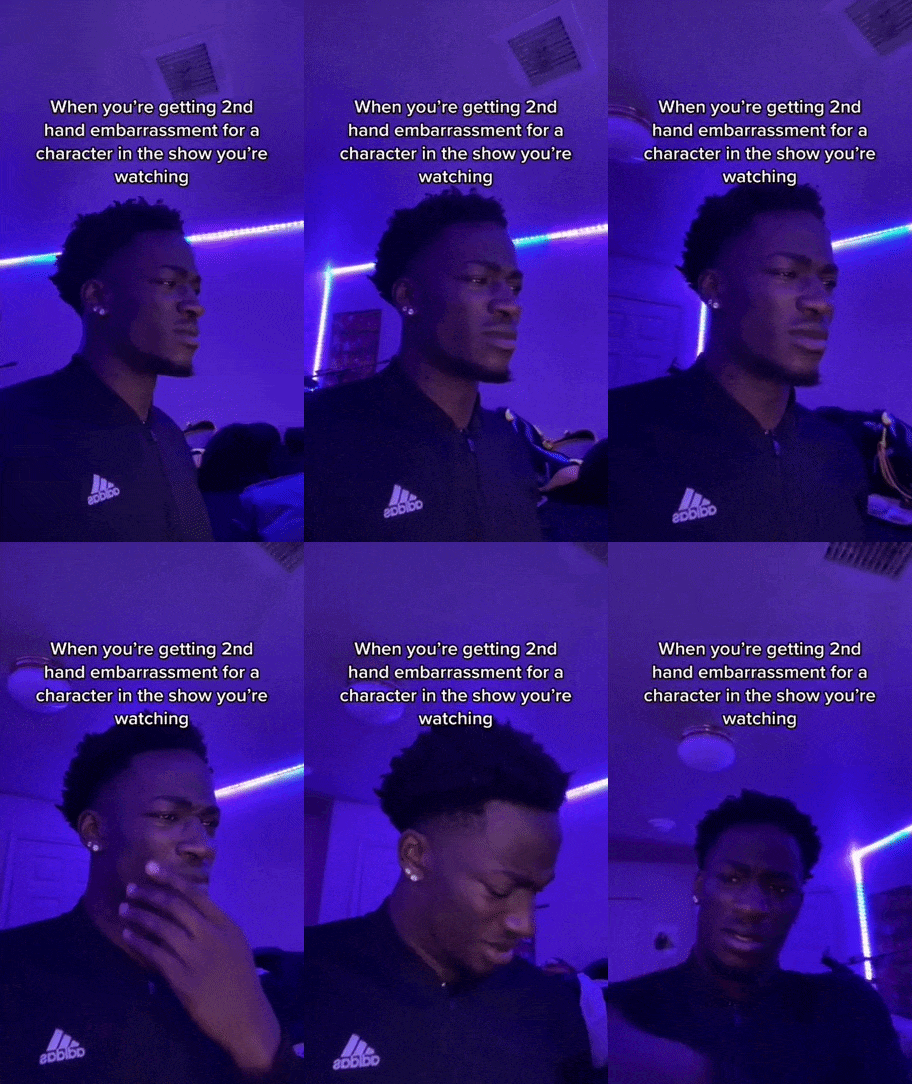
Source: TikTok
Secondhand embarrassment can feel just like regular embarrassment and cause us to look away, blush, cover our face, sweat, and generally feel awkward. For some people, secondhand embarrassment is so intense that they say it feels "painful" — but for what? It's not you going through the embarrassing moment.
To understand why we feel secondhand embarrassment, we first need to learn why we feel embarrassment at all.
Why do we feel embarrassment?
Like many emotions, embarrassment is an evolutionary feature designed to help us survive as social creatures. Embarrassment is one of a distinct set of self-conscious social emotions, including guilt, pride, and shame, that help us navigate how we’re seen by others.
Humans are social creatures that require group cooperation to survive. Therefore, our need to be liked is all about survival: If people like and respect us, we won't be banished from the community and risk dying alone.
Embarrassment is a negative emotion that occurs when we do something that endangers our reputation, making us less likely to put ourselves in that situation again. In fact, the physical signs of embarrassment — like blushing, sweating, and stammering — are thought to be a way to signal to others that we know we've made a mistake and don't intend to do it again.
Why do we feel secondhand embarrassment?
So if embarrassment helps us protect our own social image, why do we feel it for someone else? In that situation, our own reputation isn't at risk, yet we still feel bad.

Source: Pexels
It all comes down to empathy. Empathy, another key trait of social animals, is the ability to recognize and understand another person’s feelings or perspective. And it's crucial to maintaining a harmonious community: If we feel the pain of another, we'll be more likely to help them, and vice versa.
Secondhand embarrassment is strongly rooted in empathy. We're able to put ourselves in the shoes of someone experiencing (or about to experience) the pain of embarrassment, and so we suffer empathic embarrassment. A 2011 study found that people who are naturally more empathic tend to report more secondhand embarrassment than those who are less empathic.
Interestingly, watching someone else experience pain — whether physical or social — lights up the same areas of the brain. Brain imaging studies have found that the anterior cingulate cortex (ACC) and the anterior insula (AI) activate both when we feel physical pain ourselves and when we watch someone else get hurt or humiliated.
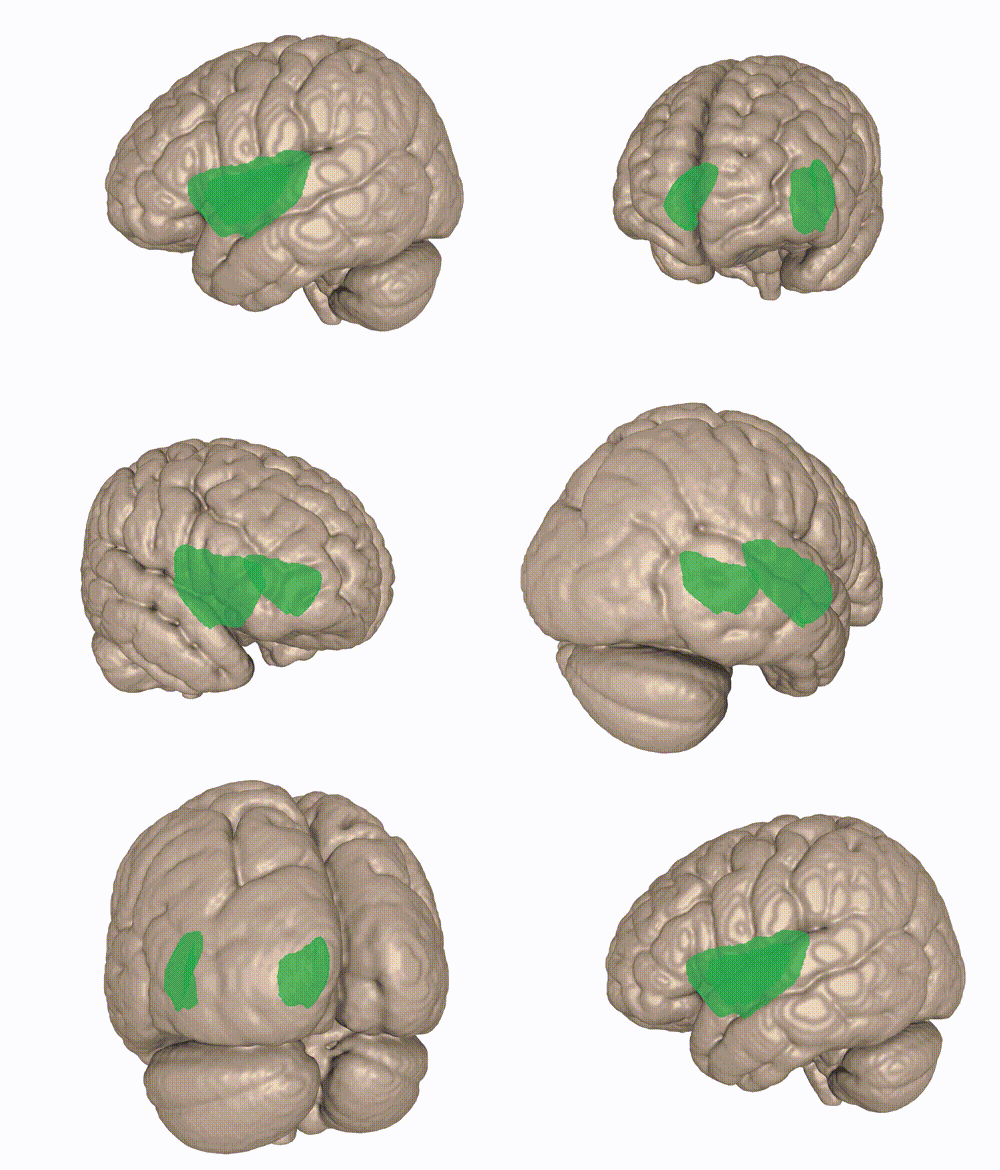
A 3D view of the insular cortex. Note: the ACC and AIC are neighboring regions, not technically located within the insular cortex.
"Insular cortex" by Daniel Sabinasz is licensed under CC BY-SA 4.0.
It really is painful to watch someone suffer embarrassment. And a 2015 study found that we experience more secondhand embarrassment if the embarrassed person is a close friend.
When we see our friend doing something cringe-worthy, a brain region associated with self-related thoughts activates. It's theorized that we feel heightened secondhand pain because our association with our friend could reflect poorly on us too.
Curious about how the world works?
Today You Should Know is a free, weekly email newsletter designed to help you learn something new every Friday.
Subscribe today 👇
Check out some other curious questions:



Sources
Jones, P. A. (2026, January 23). The Psychology Behind Why We Get Secondhand Embarrassment. Mental Floss. https://www.mentalfloss.com/science/psychology/why-do-we-get-secondhand-embarrassment
Krach, S., Cohrs, J. C., de Echeverría Loebell, N. C., Kircher, T., Sommer, J., Jansen, A., & Paulus, F. M. (2011). Your flaws are my pain: Linking empathy to vicarious embarrassment. PLoS ONE, 6(4). https://doi.org/10.1371/journal.pone.0018675
Müller-Pinzler, L., Rademacher, L., Paulus, F. M., & Krach, S. (2015). When your friends make you cringe: Social closeness modulates vicarious embarrassment-related neural activity. Social Cognitive and Affective Neuroscience, 11(3), 466–475. https://doi.org/10.1093/scan/nsv130
Thomson, J. (2021, May 13). Secondhand Cringe Makes Me Want To Die Inside. Refinery29. https://www.refinery29.com/en-gb/2021/04/10400168/secondhand-embarrassment


We Americans sure do like American things.