
How do contact lenses work?
The short answer
Contact lenses correct refractive errors, like nearsightedness, farsightedness, and astigmatism, by using precisely shaped lenses to bend incoming light so it lands on the retina instead of in front of or behind it.
The long answer
As someone with a mild aversion to putting things in my eyes, I've always admired those who wear contact lenses. How brave they must be!
Even more amazing than contact lens-wearers is the science behind contact lenses themselves. Let's start with a crash course on how the eye works and why some people need to wear vision-correcting glasses or lenses.
What we see is a reflection of light passing through our eyeball. Light first goes through the cornea, a clear, dome-shaped layer that protects the eye and helps us focus. Then some of this light enters the black pupil, with the iris (colored-part) controlling how much light comes in.
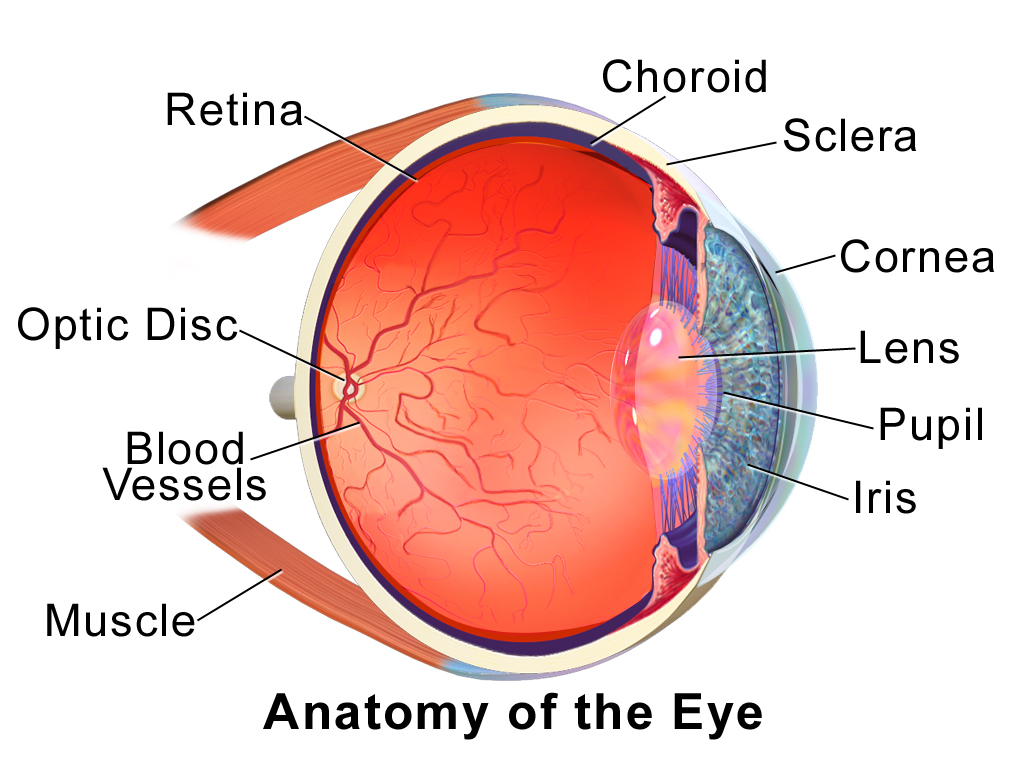
"Blausen 0388 EyeAnatomy 01" by BruceBlaus is licensed under CC BY 3.0.
Next the light goes through the lens, which works with the cornea to refract (bend) the light before it hits the retina, a light-sensitive tissue at the back of the eyeball. The retina converts light into electrical signals that get sent to the brain via the optic nerve, allowing you to see.
To see things in focus, the light must be refracted so that it gets correctly focused on the retina. If the light rays don't fall precisely on the retina, vision issues called refractive errors occur.
When light gets focused in front of the retina, this results in myopia (nearsightedness) wherein you can see near images but far images are blurry. When light gets focused behind the retina, this is hyperopia (farsightedness). And when light doesn't focus at one point at all, this is called astigmatism, resulting in distorted vision.
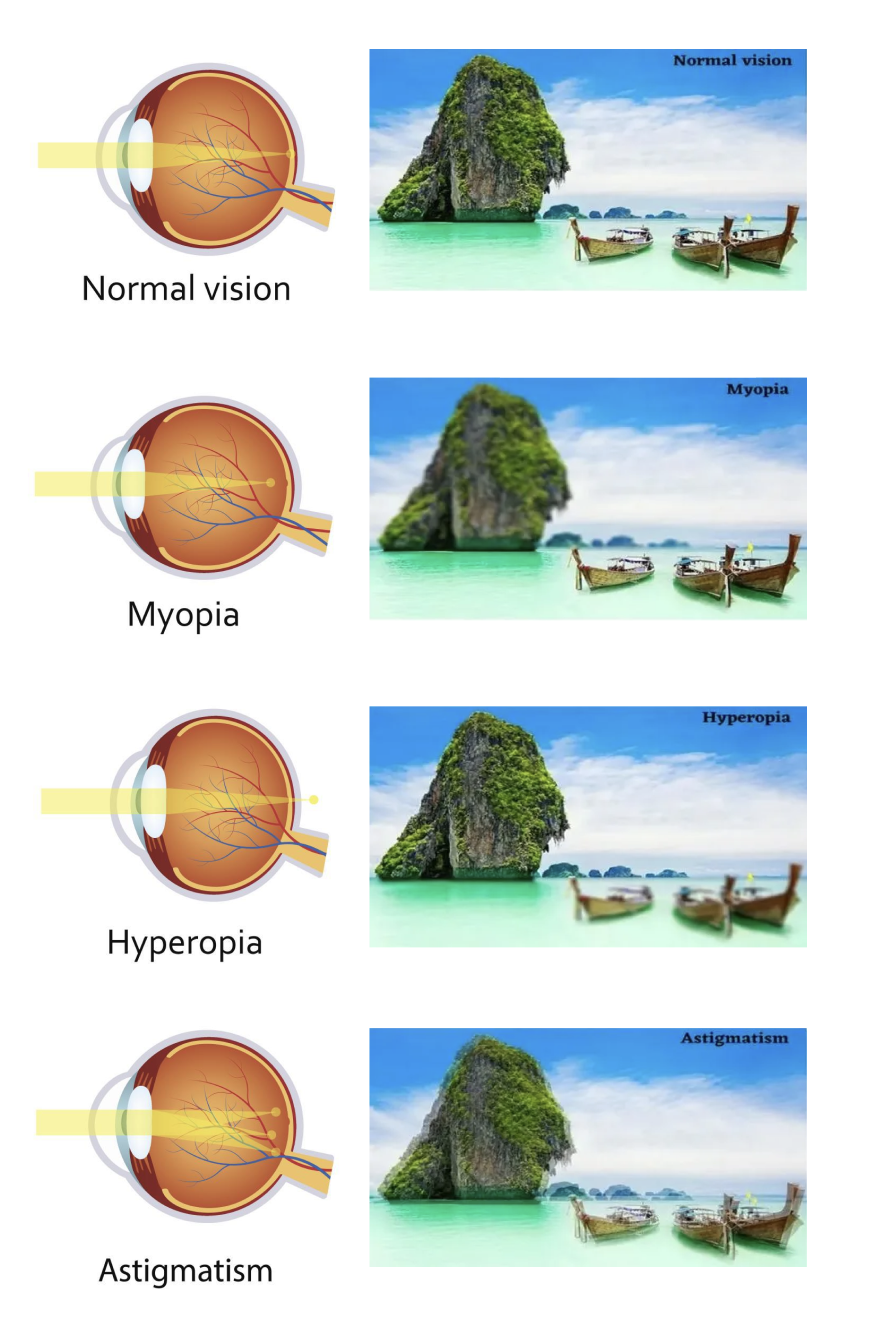
Generally speaking, myopia occurs when the eyeball is too long or the lens is too strong, hyperopia when the eyeball is too short or the lens is too weak, and astigmatism when the cornea is curved unevenly.
How do contact lenses work?
Contact lenses and prescription eyeglasses work the same way: they correct refractive errors with specially shaped lenses that bend light to focus precisely on the retina.
As light passes from air into a denser transparent material like glass, it slows down. When it enters at an angle, one side of the light wave slows before the other, causing the whole wave to pivot. This is refraction. Corrective lenses exploit this effect by using precisely shaped surfaces to steer incoming light rays onto the retina, compensating for the eye's own focusing errors.
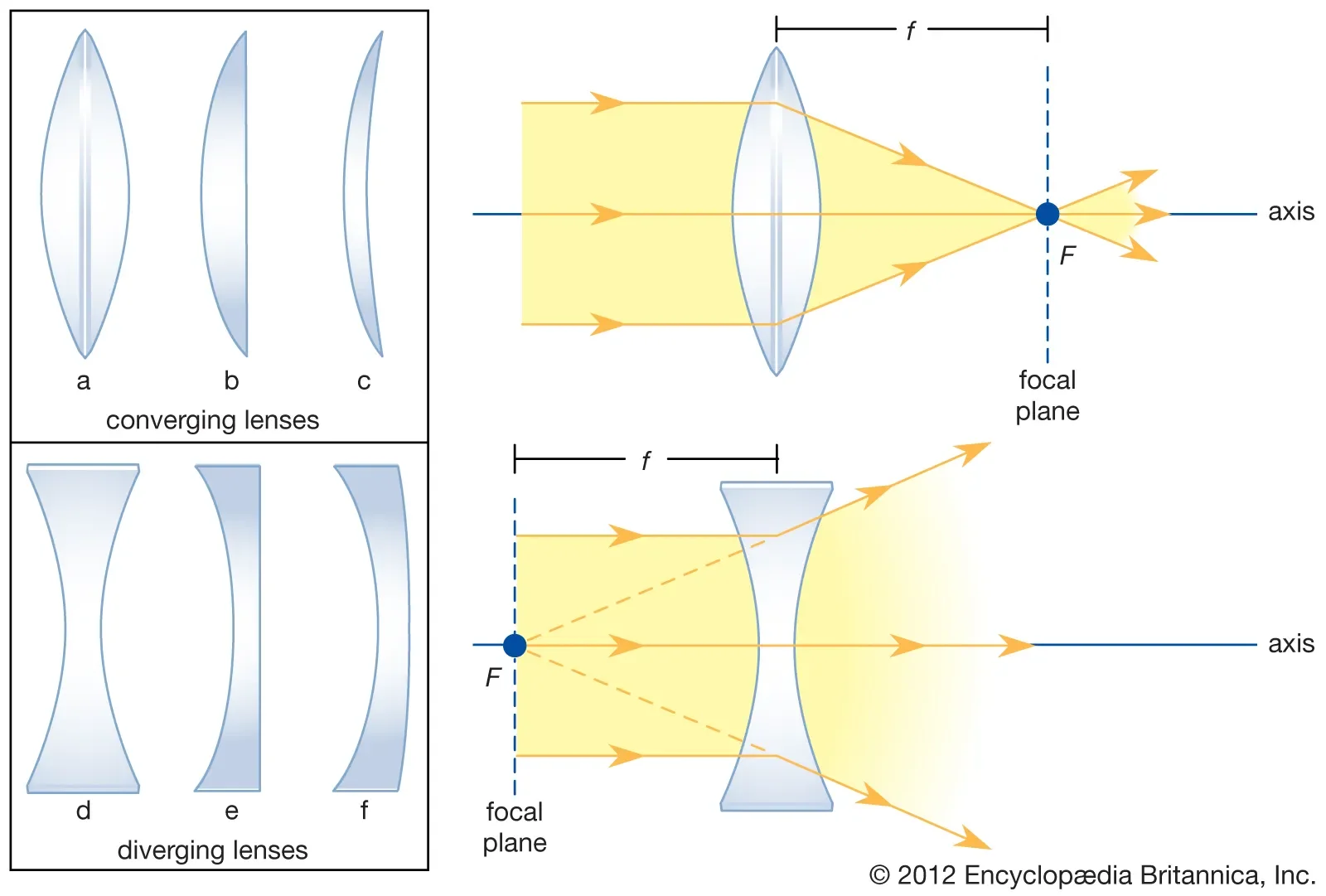
Source: Encyclopedia Britannica, Inc.
Contact lenses sit directly on the eye, and the shape of the lens determines how it bends light. Different refractive errors call for different lens shapes.
Myopia (nearsightedness) is corrected with a concave/diverging lens, which is thinner in the middle and thicker at the edges. This causes light rays to spread apart slightly before entering the eye, pushing the focal point back onto the retina.
Hyperopia (farsightedness) requires the opposite: a convex lens, which is thicker in the middle and thinner at the edges. It bends light rays inward, pulling the focal point forward to land on the retina rather than behind it.
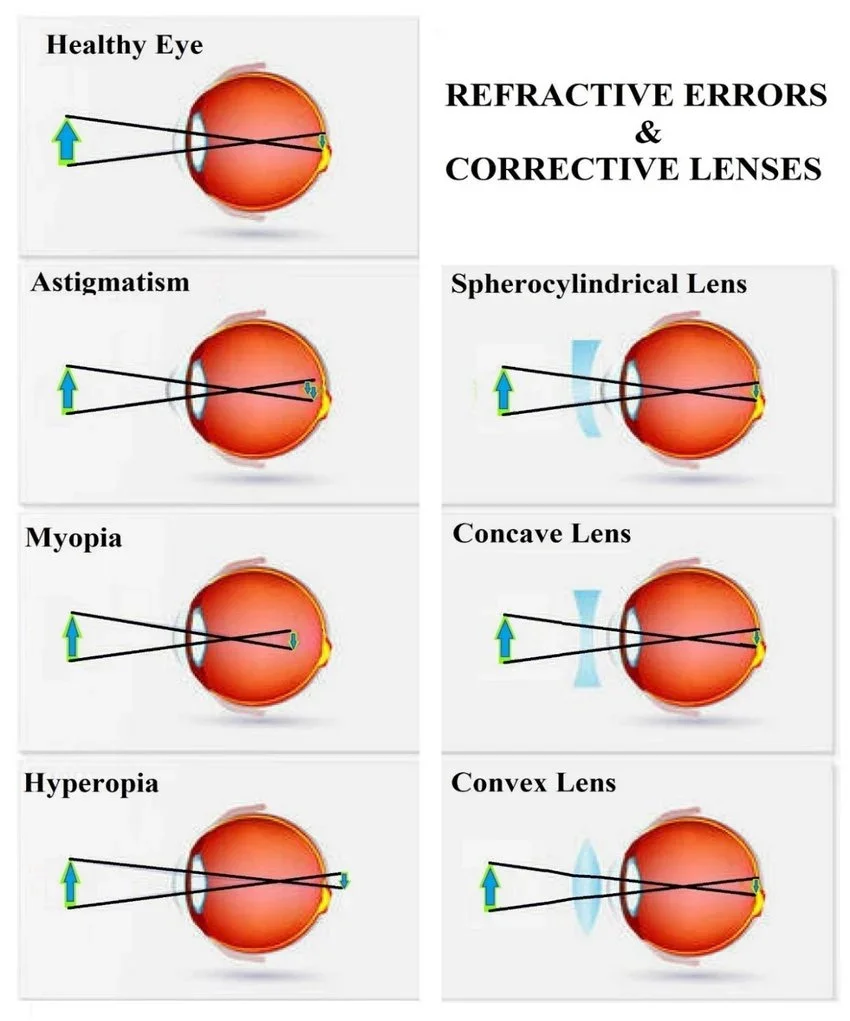
Source: ResearchGate
Astigmatism is corrected with a spherocylindrical lens (commonly called a toric lens), which combines two types of correction: a spherical component that addresses any underlying nearsightedness or farsightedness, and a cylindrical component that bends light more along one axis than the other to counteract the cornea's uneven curvature.
You might be wondering how a contact lens for astigmatism stays in place, since it's not uniformly shaped. Most toric lenses stabilize on the eye using a ballast, a design that makes the bottom of the lens thicker and heavier so gravity keeps it from rotating out of place.
🧠 Bonus brain points
Are contact lens and eyeglass prescriptions the same?
Despite using the same physics principles to correct refractive errors, the prescriptions for contact lenses and eyeglasses are slightly different. This is because eyeglasses sit a few millimeters away from your eyeballs, so the corrective power of the lenses needs to be adjusted to precisely bend light to hit your retina. Additionally, contact lens prescriptions require measurements of your eyeball diameter and base curve so that they sit snugly on your eye.
Curious about how the world works?
Today You Should Know is a free, weekly email newsletter designed to help you learn something new every Friday.
Subscribe today 👇
Check out some other curious questions:


Sources
1-800 Contacts. (2024, November 26). Difference between glasses and contacts prescription. 1-800 Contacts. https://www.1800contacts.com/eyesociety/glasses-versus-contact-lens-prescriptions
The Battu Eye Centre. (n.d.). Refractive Correction. The Battu Eye Centre. https://battueyecentre.com/home/index/61/refractive
Jade, P. (2026, March 18). Concave vs. Convex Lens: What’s the Difference? Mouqy Eyewear. https://www.mouqy.com/blog/difference-concave-convex-lenses
Lazarus, R. (2021, August 11). Contact Lenses for Astigmatism. Optometrists.org. https://www.optometrists.org/general-practice-optometry/optical/guide-to-contact-lenses/what-are-contact-lenses/contact-lenses-for-astigmatism/
Stereo Optical Company Inc. (2024, April 26). Refractive Errors. Stereo Optical. https://www.stereooptical.com/childrens-vision/refractive-errors/
SUNY Downstate Health Sciences University. (n.d.). Facts About The Cornea and Corneal Disease. SUNY Downstate Health Sciences University. https://www.downstate.edu/patient-care/find-treatment/areas-of-care/ophthalmology/eye-disorders/cornea.html
Tikkanen, A. (n.d.). optical axis. Encyclopædia Britannica, Inc. https://www.britannica.com/technology/lens-optics
U.S. Department of Health and Human Services. (2022, April 20). How the Eyes Work. National Eye Institute. https://www.nei.nih.gov/eye-health-information/healthy-vision/how-eyes-work


We Americans sure do like American things.