How does the Doppler effect work?
The short answer
The Doppler effect is when waves like sound or light seem to change frequency because the source or observer is moving. As the source of a wave (e.g. an ambulance siren) moves closer, its waves compress and create a higher frequency; as it moves away, the waves stretch out, resulting in a lower frequency.
The long answer
I love watching ducks swimming (especially when they go duck diving.)
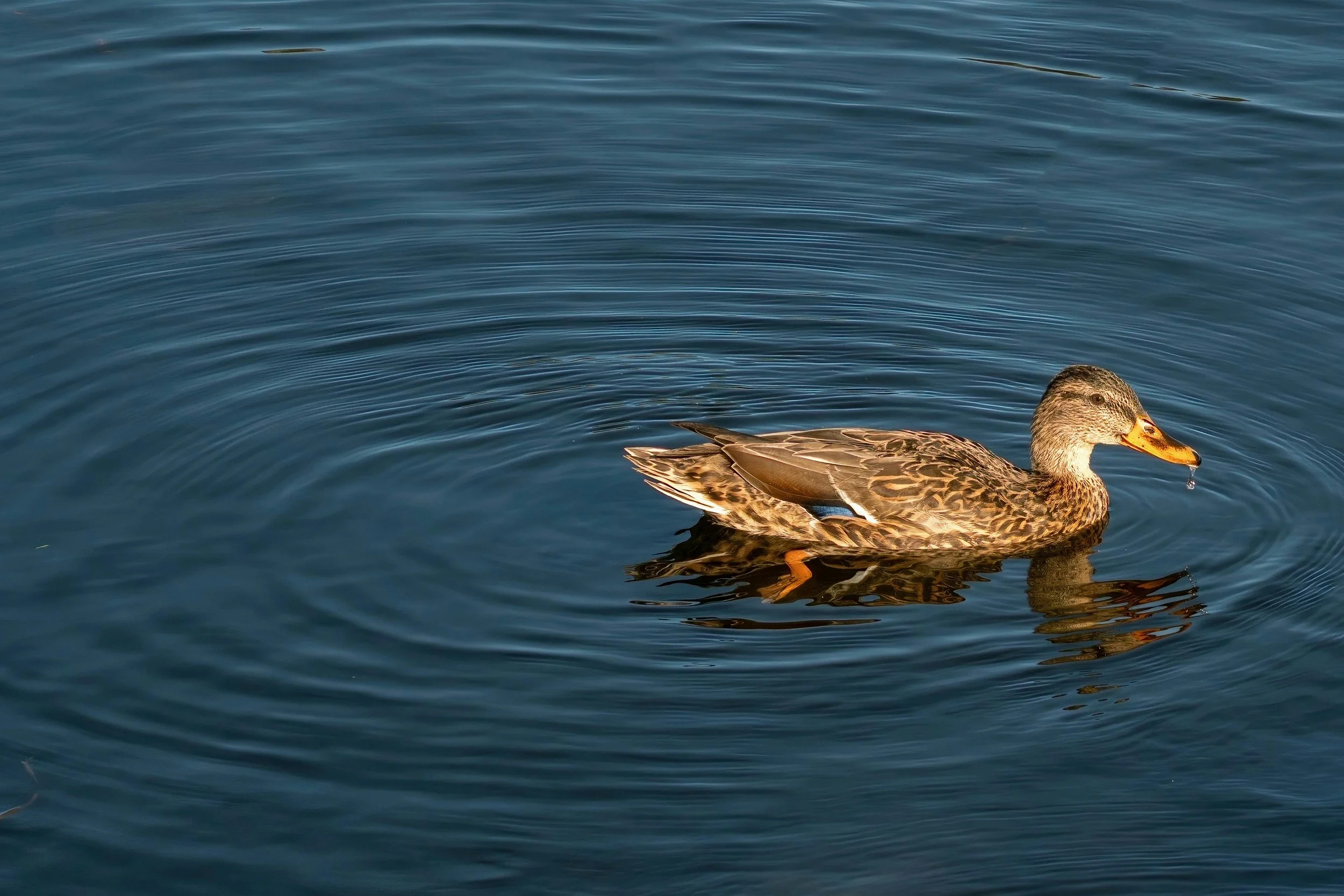
If you share my love of duck-watching, you've probably noticed that they cause water ripples. A duck bobbing in place creates ripples that go out evenly in all directions. But once they start to swim forward, the ripples get bunched up in the direction they're moving and spaced further apart in the opposite direction.
This is an example of the Doppler effect at work.
What is the Doppler effect?
The Doppler effect is a physics phenomenon where a wave’s frequency seems to change if the source or the observer is moving. It applies to any kind of wave: sound, light, and of course the water ripples created by a duck.
You've probably heard the Doppler effect being referenced more often with sound. For example, if a moving car honks its horn while it passes you, you're going to hear something like this:
The car horn sounds different as it passes you because of a change in the frequency of sound waves. Sound is made of vibrations that travel through air as waves. The frequency of these waves determines the pitch you hear. A higher frequency means a higher pitch, and vice versa.

"Dopplerfrequenz" by Charly Whisky is licensed under CC BY-SA 3.0.
When the car moves towards you and honks, the sound waves get compressed, creating a higher frequency hitting your ears. But as soon as the car passes by, the sound waves stretch out, resulted in a lower perceived pitch.
How is the Doppler effect used?
The Doppler effect has lots of applications in real-world technologies. Here are just a few:
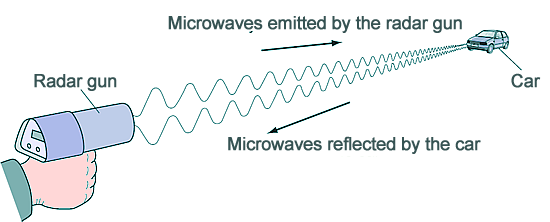
🚗💨 Radar speed guns
Source: Cyberphysics
A radar gun uses the Doppler effect by sending out radio waves towards an oncoming vehicle. As the vehicle moves toward the gun, the returning waves have a higher frequency than the original ones. The difference between these frequencies is used to calculate the speed of the vehicle, which is compared against the road’s speed limit.
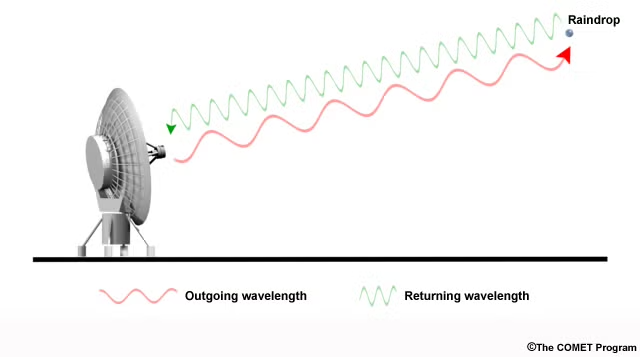
🌦️ Meteorology
Source: UCAR
Doppler weather radars work similarly by sending out radio waves that bounce off objects in the sky, like clouds or raindrops, and measuring changes in the frequency of the returning signal. If the objects are moving away from the radar, the frequency shifts lower. If it's coming closer, the frequency shifts higher. Meteorologists use this data to track the speed and direction of precipitation and wind in a storm.
🫀Medicine
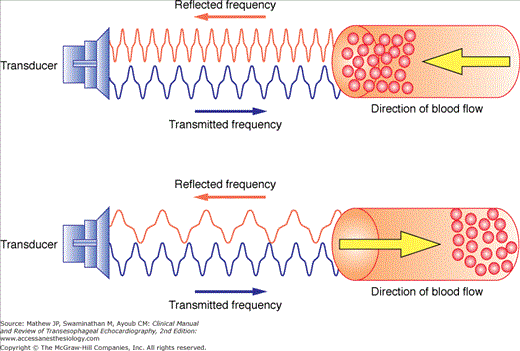
Source: Anaskey
The Doppler effect is used in healthcare with ultrasound tests, like an echocardiogram. In an echocardiogram, sound waves are transmitted into the heart, which bounce off of moving blood cells. The frequency difference of the returning sound waves indicates the speed and direction of blood flow.
🌌 Astronomy
We also discovered that the universe is expanding thanks to the Doppler effect. Visible light falls on the electromagnetic spectrum, with high frequencies resulting in violet/blue colors and low frequencies displaying red/orange colors.
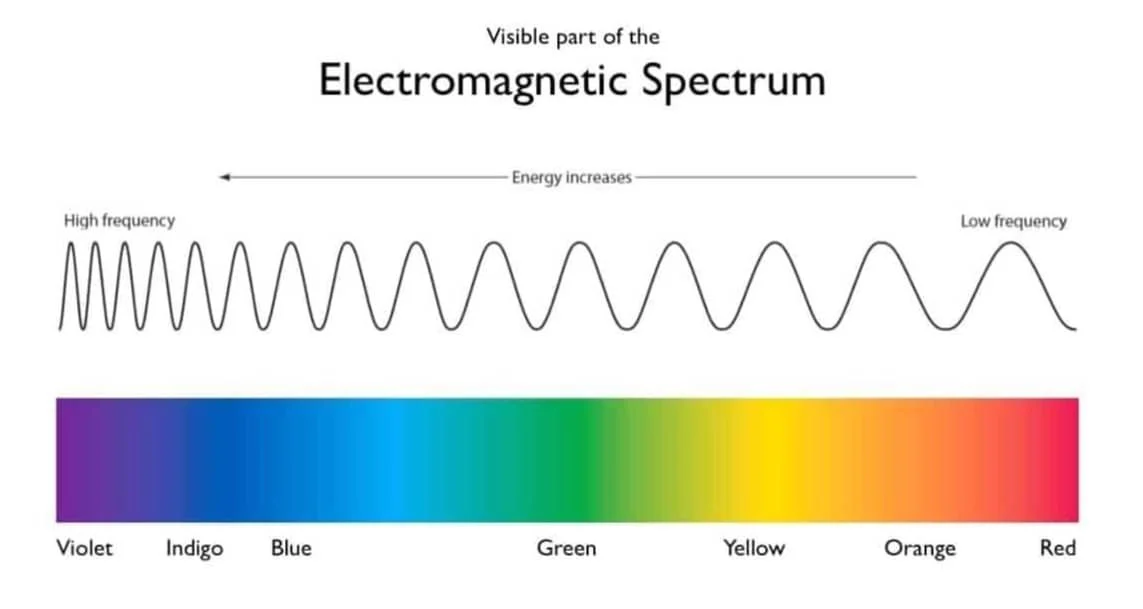
Source: ZME Science
And just like sound waves, light waves also produce a Doppler effect. When a star moves towards us, its wavelengths compress and appear slightly bluer. Conversely, when a star moves away from us, its light appears slightly redder. Astronomers call these effects blueshift and redshift, respectively.
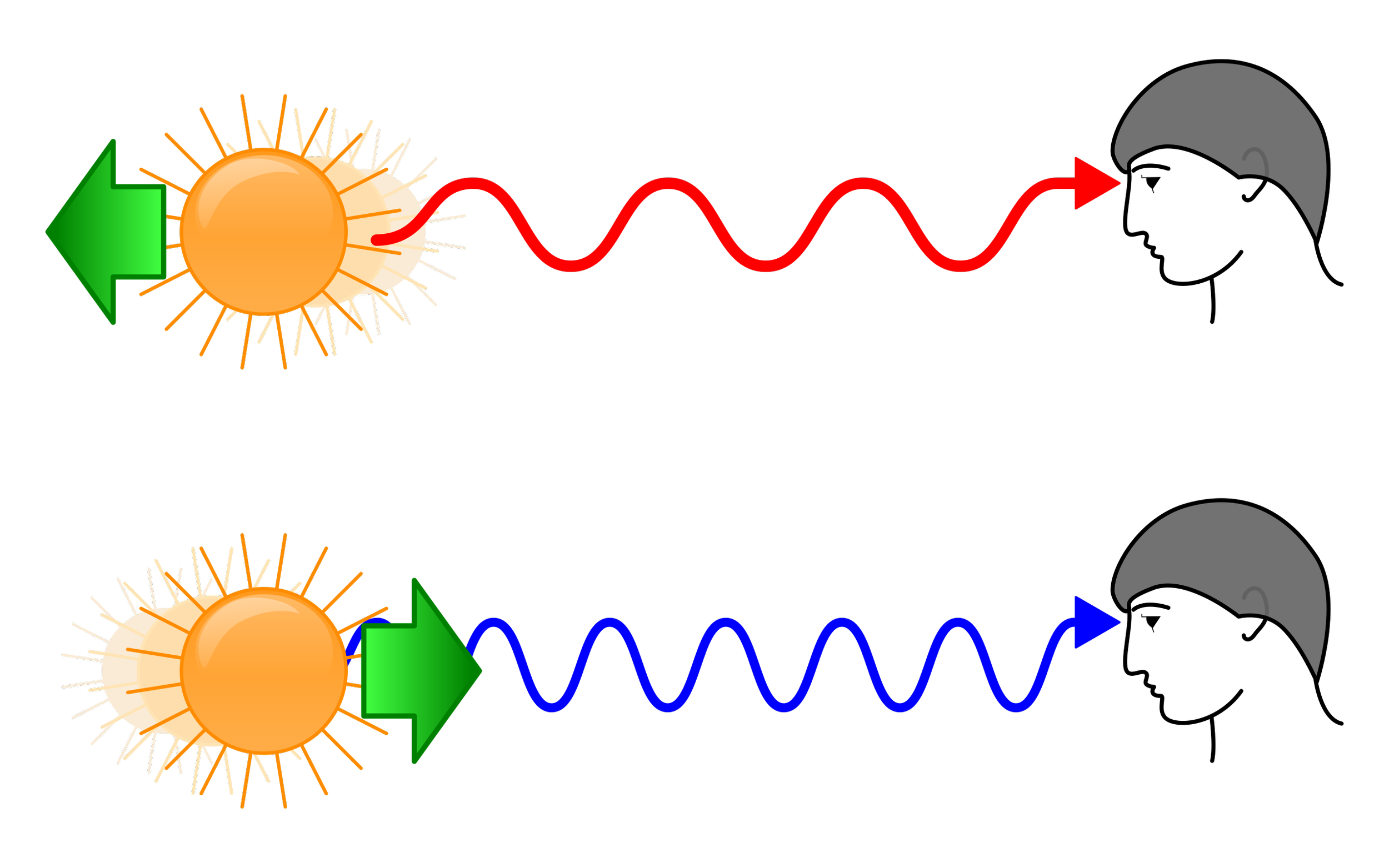
"Redshift blueshift" by Aleš Tošovský is licensed under CC BY-SA 3.0.
So how does that tell us the universe is expanding? By studying light from other galaxies, astronomers have noticed something: almost all galaxies are redshifted (i.e. they're moving away from us). And the farther away a galaxy is, the faster it's moving away from us.
Curious about how the world works?
Today You Should Know is a free, weekly email newsletter designed to help you learn something new every Friday.
Subscribe today 👇
Check out some other curious questions:

Sources
Alt Shift X. (2013, June 6). The Doppler Effect: what does motion do to waves?. YouTube. https://www.youtube.com/watch?v=h4OnBYrbCjY
Bettex, M. (2010, August 3). Explained: The Doppler effect. MIT News. https://news.mit.edu/2010/explained-doppler-0803
BYJU’S. (2023, May 29). Doppler Effect Explained. BYJUS. https://byjus.com/physics/doppler-effect/
Harris, W. (2024, September 5). How the Doppler Effect Works. HowStuffWorks. https://science.howstuffworks.com/science-vs-myth/everyday-myths/doppler-effect.htm



We Americans sure do like American things.