
What determines the color pattern of a cat?
The short answer
Cats inherit combinations of pigment genes (black or orange), dilution genes (for shades like gray or cream), spotting genes (for white patches), and pattern genes (for tabby stripes), which all combine to determine what a cat looks like.
The long answer
When a mom cat and a dad cat welcome a new litter of kittens to the world, it's unlikely that all their precious cherubs will be the same color and pattern.
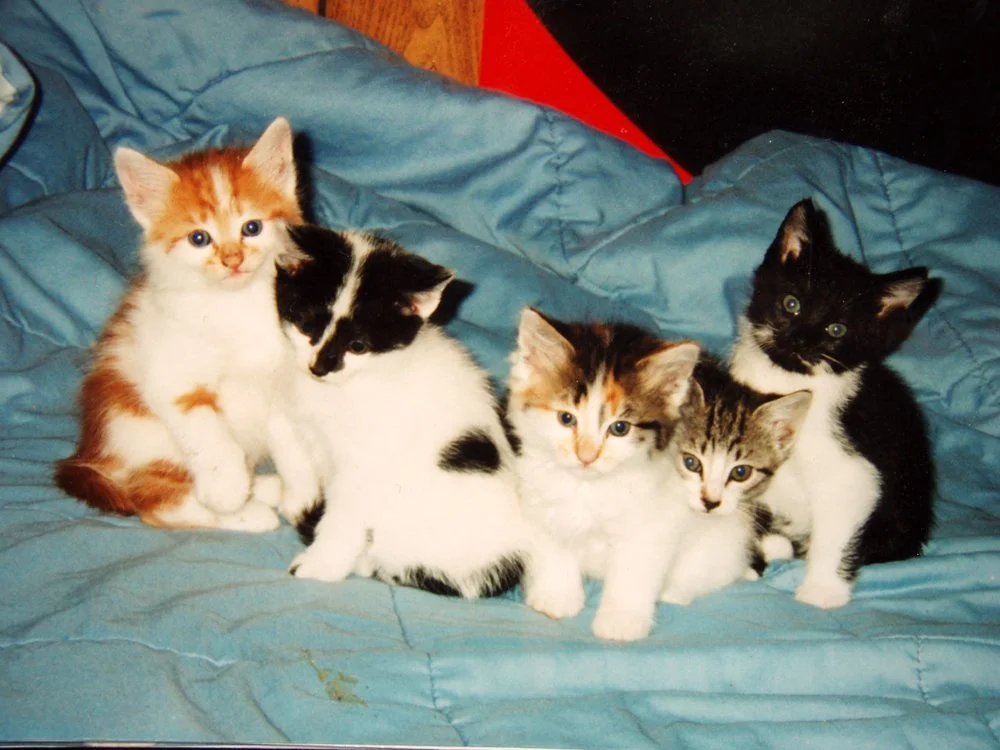
"Litter of five kittens" by Brocken Inaglory is licensed under CC BY-SA 4.0.
Genetics explains why different cats have different color patterns. For those of you who haven't brushed up on the topic in a while (me!), let's do a brief crash course.
A brief crash course in genetics
Genetics is the study of how traits are passed from parent to child. DNA is a molecule that contains the exact biological instructions for building and maintaining those traits, and every cell contains a full, condensed copy of those instructions in thread-like structures called chromosomes.
A gene (not to be confused with the other jean) is an individual section of DNA that carries specific instructions. There can be many different versions, or alleles, of the same gene. Like humans, cats inherit two alleles for each gene, one from each parent.
Note: Alleles are technically what determine an organism's traits, but since "gene" and "allele" often get used interchangeably, I'm generally going to stick with using "genes" to keep things simple.

All of an organism's genes make up its genotype, or complete genetic makeup. But the traits you can see are the phenotype. For example, you might carry the genes for both a long big toe and a short big toe (your genotype), but you physically present with a long big toe (your phenotype).
Some genes are dominant and others recessive. A recessive gene will only appear in the phenotype if it's paired with another recessive gene; while a dominant gene will be represented if it's paired with either another dominant or a recessive.
Let's jump into a cat-themed example of how genetic traits show up in offspring. Whether a cat has long hair or short hair is dictated by the dominant short-haired gene (L) and the recessive long-haired gene (l). We can use a tool called the Punnett square to show the odds of how two cats' genes will be passed down to their kittens:

In this example, the dad cat has two recessive copies of the long-hair gene, so he has long hair. But mom has one copy of the short-hair gene and one of the long-hair gene, so she appears with short hair. This makes the chances of their kittens having long hair or short hair 50-50.
Now that we have the basic fundamentals of genetics down, let's go feline-the-scenes of what determines cat color patterns.
What determines the color of a cat?
Cats come in a wide array of shades, but they originate from two colors: orange and black. How do we go from just two colors to such a wide array of cat hues? Genes, of course!
Black, chocolate, and cinnamon cats
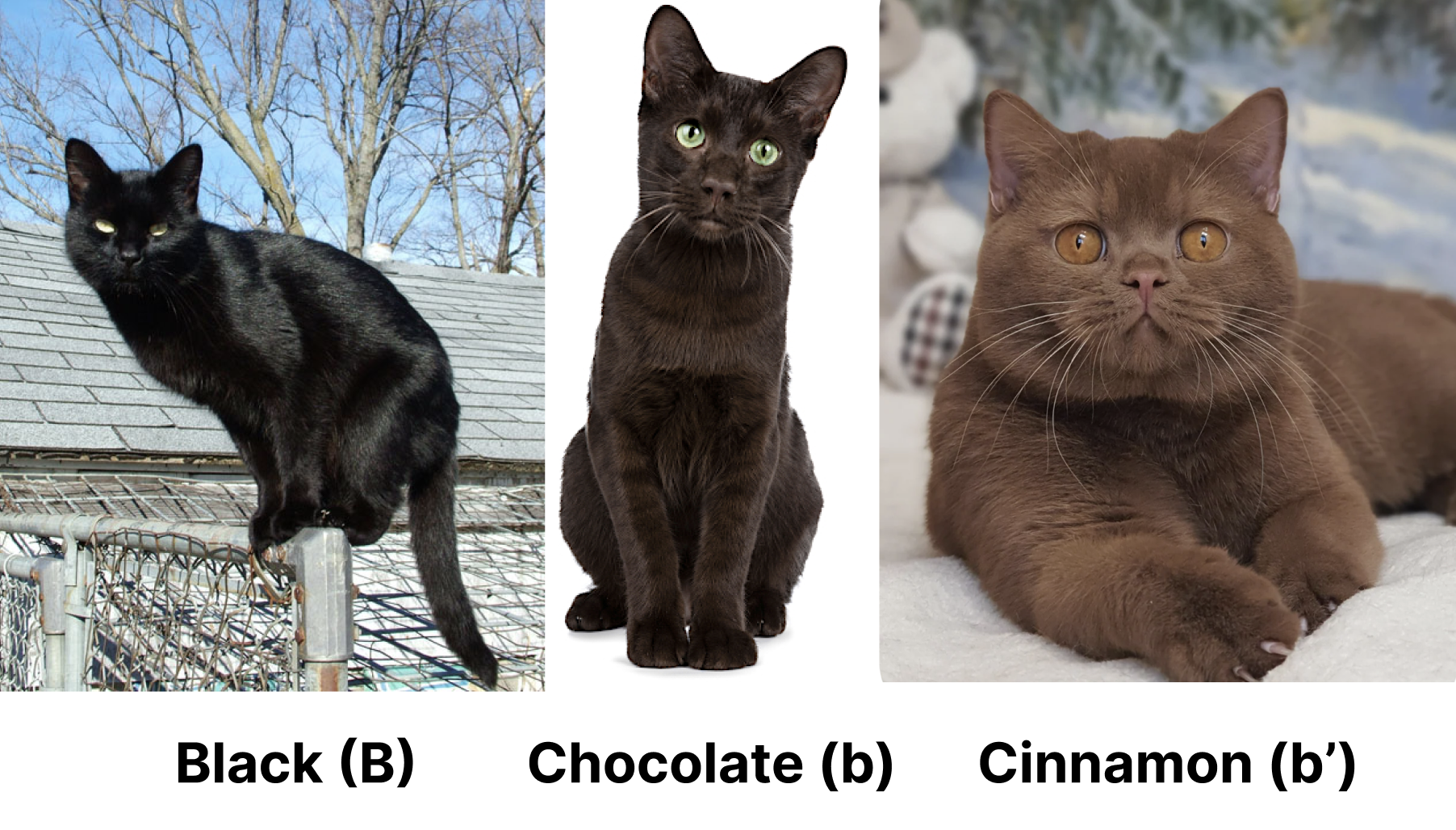
Cats can either carry the orange gene (O) or the black gene (B). But the black gene has recessive versions that result in a chocolate (b) or cinnamon (b') shade.Black is the most common cat color.
Fun fact: Because eumelanin, the pigment that produces black fur, is fairly fragile, black cats can "rust" if they spend a lot of time in sunlight.
Orange cats
An orange cat carries the dominant orange (O) gene, which researchers just discovered in 2025 to be a specific deletion near a gene called Arhgap36 that switches pigment production from black eumelanin to orange/red pheomelanin.
The orange color gene can only be carried on the X chromosome, making it a sex-linked gene. Female cats carry XX chromosomes, while males XY.

"Sex-linked cat colour genetics" by Rachmat Bontara is licensed under CC BY-SA 4.0.
A male cat will be orange if his mom passes down an orange gene. But for a female cat to be orange, she needs copies from both parents. This is why 80% of orange cats are males.
Note: A female cat can also be a mix of orange and black, but we'll get into that later.
Other solid colors (e.g. grey, cream, lilac)
So we've covered the basic colors of cats: black, chocolate, cinnamon, and orange. But cats also come in lighter shades, like grey, cream, and lilac, to name a few.
Lighter colors are the result of the recessive dilute gene (d). When a cat inherits two copies of the dilute gene, its base color appears lighter. The cat may also carry the dilute modifier gene (Dm), a dominant gene that makes their diluted color even lighter.
Now, please enjoy this grid of cats I had the pleasure of putting together for you:

First row: An orange fur color gene appears as cream with the dilute gene and apricot with the dilute modifier gene.
Second row: Black --> Gray/Blue --> Blue-based caramel.
Third row: Chocolate --> Lilac --> Lilac-based caramel.
Fourth row: Cinnamon --> Fawn --> Fawn-based caramel.
White cats
At this point, you might be thinking I totally forgot about white cats. But in the world of cat genetics, white is not a color.
When a cat is white, it has the dominant white gene (W), which overrides all other genes for pigmentation. That means a white cat has genes to be a non-white color, but it doesn't show. Interestingly, a white kitten will show a few hairs with the cat's non-white color, but it'll disappear after a few months.
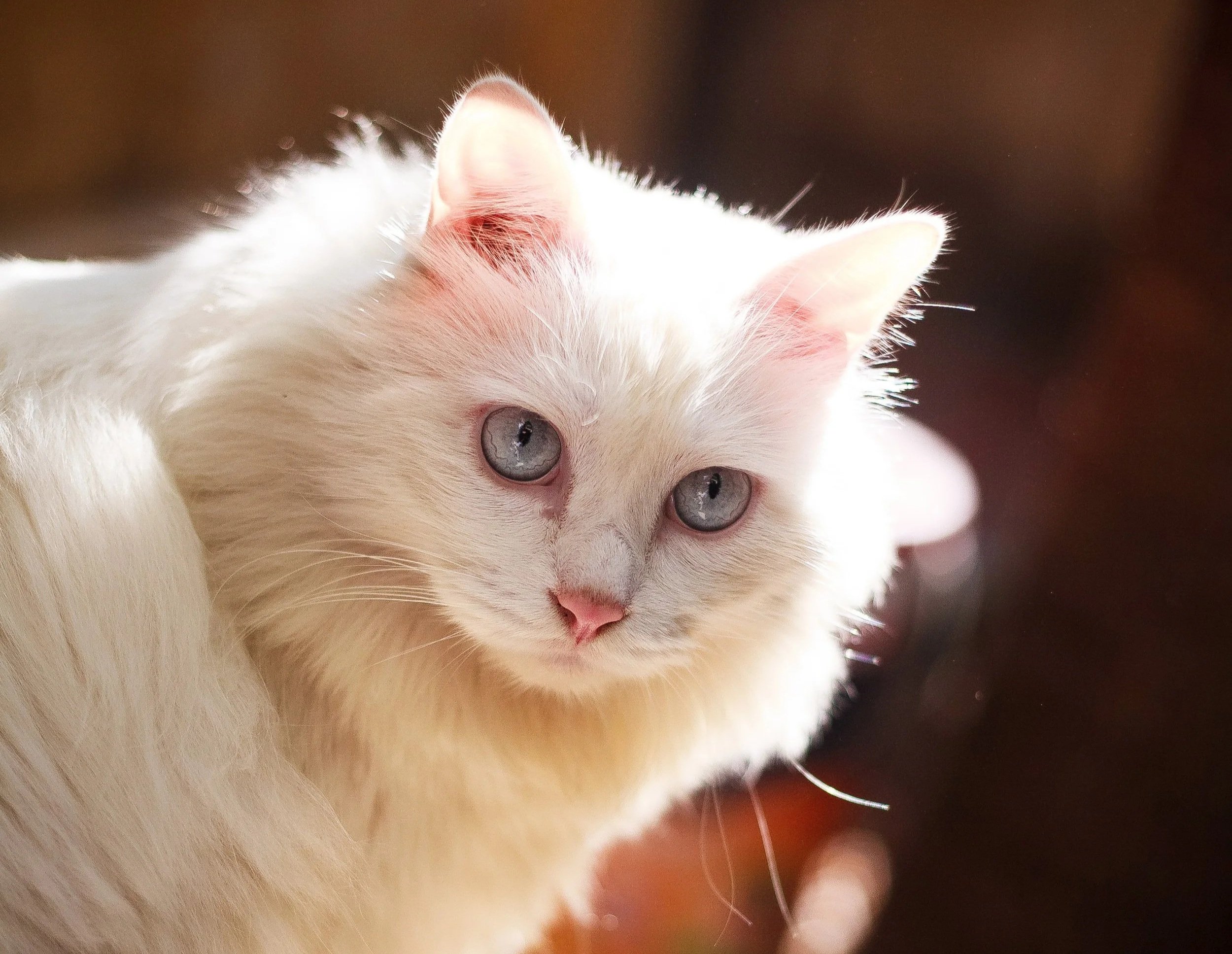
Hello, angel!
"A completely deaf, pure white blue-eyed cat" (cropped) by Vnt87 is licensed under CC BY-SA 4.0.
The white gene originates from a virus that infected an ancestor of cats and got its DNA permanently stuck inside the KIT gene. This is called an endogenous retrovirus, meaning it's now just a fixed part of a species' genome and passed down like any other gene.
The white gene disrupts pigment cells (melanocytes), causing not only white fur but often blue eyes and deafness too. White fur and blue eyes are the result of a lack of pigment, but what does pigment have to do with hearing?
A cat's inner ear structure contains melanocytes to help regulate ion balance in the fluid surrounding the sensory hair cells in the ear. When these melanocytes are disrupted during fetal development, the ion balance can be thrown off, degrading signal transmission to the brain and resulting in irreversible deafness.
A study that covered the incidence of deafness in white cats found that roughly 70% of white cats with two blue eyes, 40% of white cats with one blue eye, and 20% of white cats without blue eyes were deaf.
Why are some cats multiple colors?
Not every cat is a solid color. Some are mixes of black, orange, and white, often with built-in kitten mittens.
White-spotted cats
White spots are caused by several genes, some still unknown, but they are mainly caused by the dominant white-spotting gene (S).
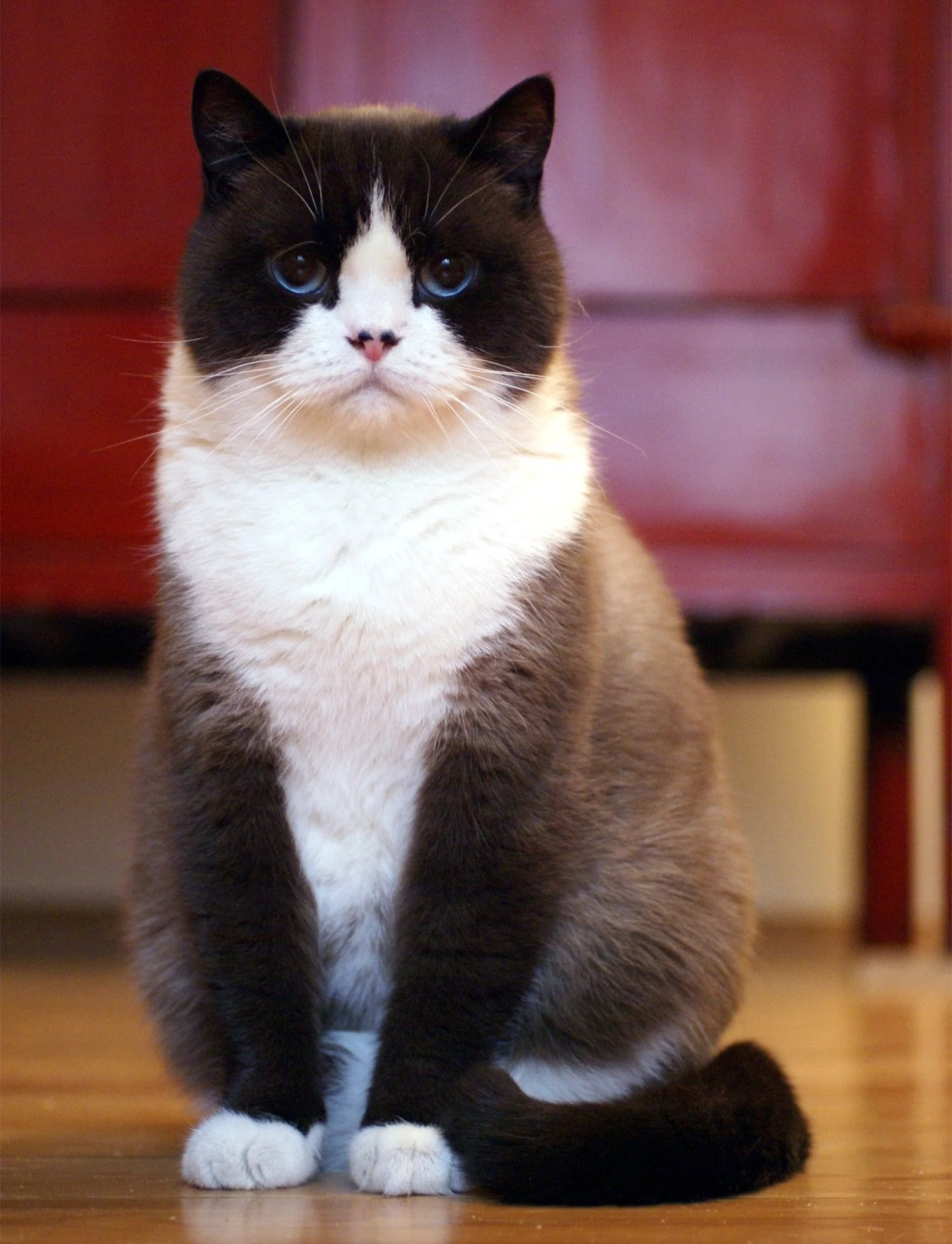
A bicolored cat with white spots (and mittens). "Www.pratulums-bkh.de seal-point-white (cropped)" by Pratulums BKH - www.pratulums-bkh.de is licensed under CC BY-SA 3.0.
The extent of white spotting depends on whether the cat has one or two copies of the S gene.
SS: White covering more than half the body.
Ss: White spotting on some areas like the feet, nose, chest, and belly.
ss: No white spotting.
White spotting patterns vary tremendously, but they usually follow a progression.
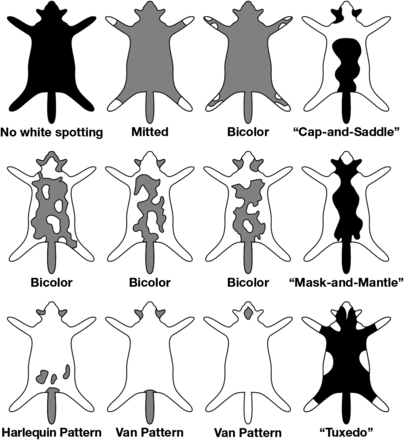
Common white-spotting patterns found in cats.
Source: G3 Genes|Genomes|Genetics
Cats with the least spotting typically have spots on their chest and belly. More spotting covers the entire belly, neck, and front feet. Cats with the most white spotting are white all the way up to their head and back, with the tail being the last area to have white spots.
Tortoiseshell or calico cats
Cats can also come in tortoiseshell (mix of black and orange) and calico (mix of black, orange, and white).
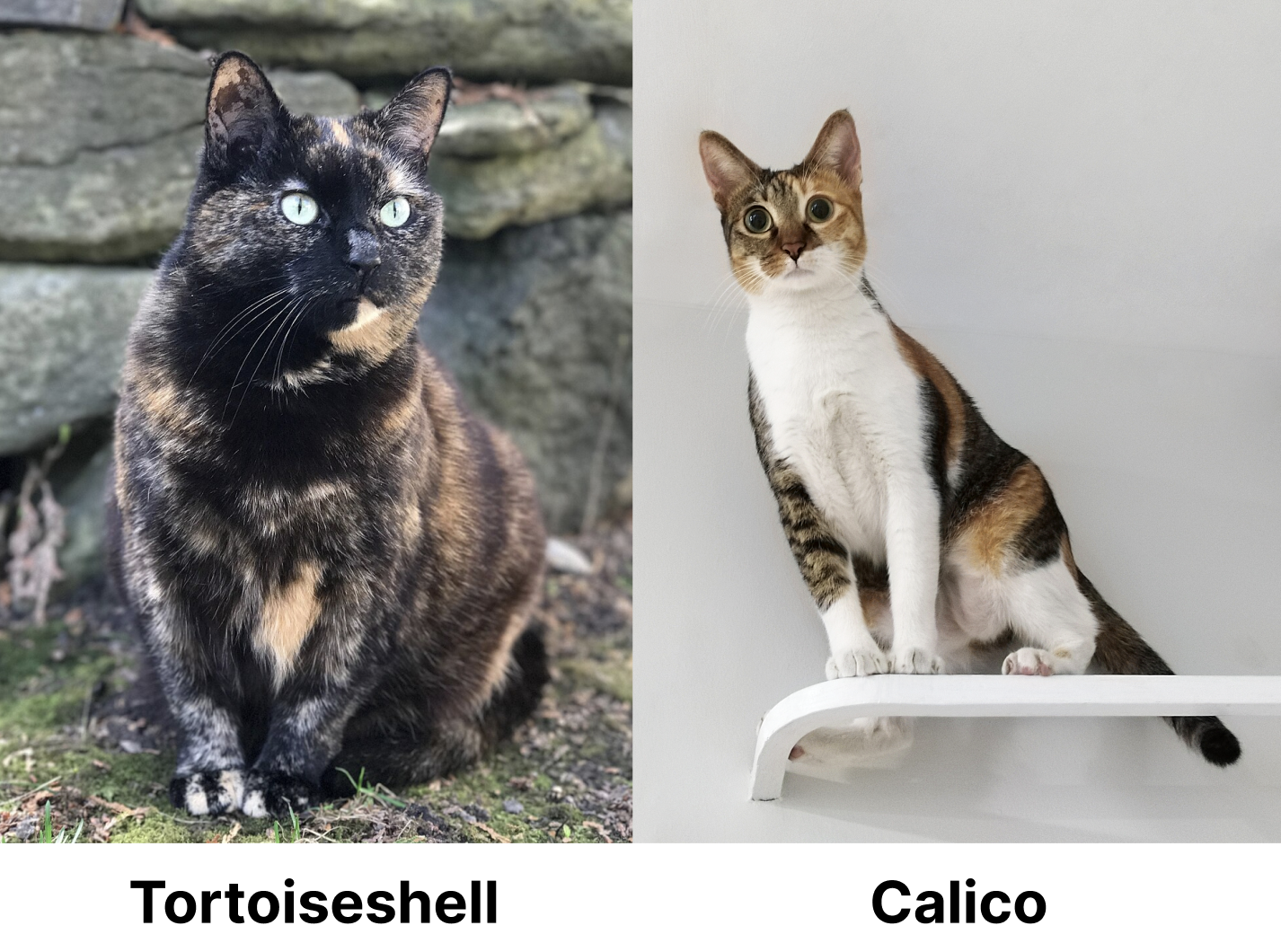
Left: "Short-haired tortoiseshell cat (cropped)" by Lucashawranke is licensed under CC BY-SA 4.0. Right: "Calico cat" by Yarzaryeni is licensed under CC BY-SA 4.0.
In both tortoiseshells and calicos, the cat will have an orange gene on one X chromosome and a black gene on another. If the cat has two non-spotting alleles (ss), they will be tortoiseshell. If they have Ss or SS genotypes, they will have the calico white spotting.
Only female cats can be tortoiseshell or calico, since it requires two X chromosomes. But, in rare cases, they can be male if the cat has an extra X chromosome (XXY), which results in sterility.
What makes a cat a tabby cat?
A tabby cat is characterized by having agouti hairs, composed of several bands of colors, that produce a ticked coat. Any color cat can be a tabby cat.
Tabby cats can also be identified by an "M" shaped mark on their forehead, dark "eyeliner," and having a chin and belly in a white or paler color.
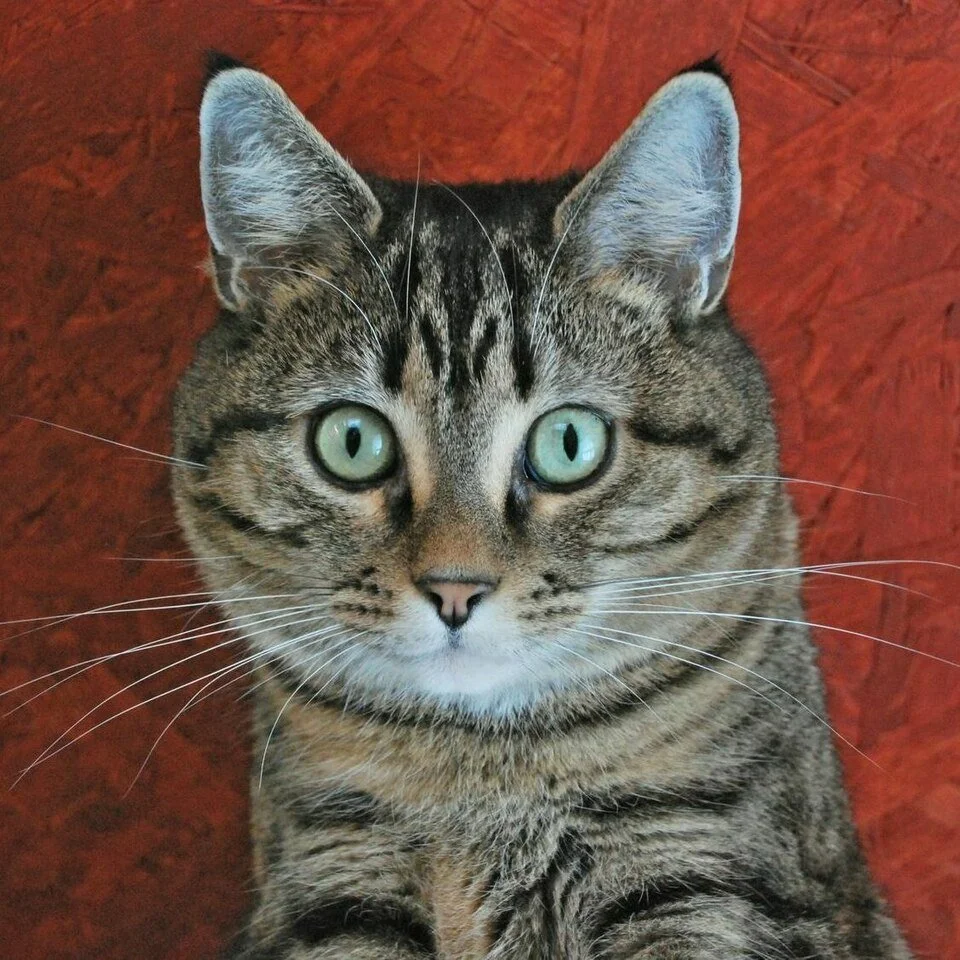
Tabby cat with characteristic agouti hairs, M-shaped forehead mark, and eyeliner fur.
"Katzepasstauf" by Bertramz is licensed under CC BY-SA 3.0.
The agouti coat is found in many species of wild animals, like squirrels and rabbits. It seems to have an evolutionary benefit of allowing animals to better blend into the background.
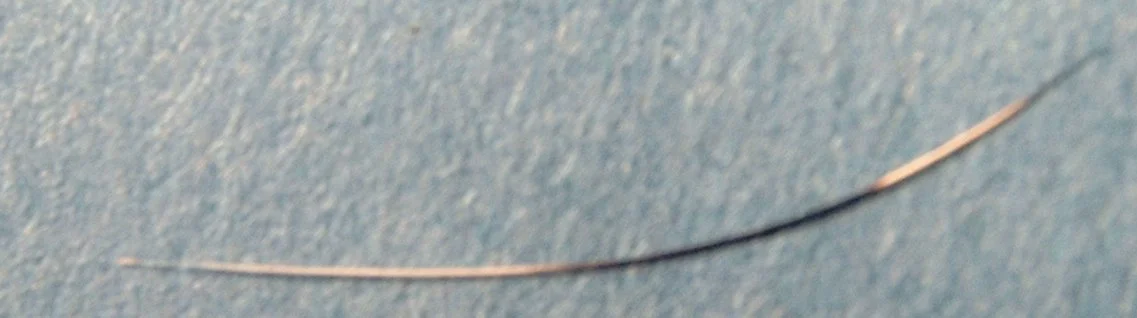
An agouti cat hair. "Haar1" by Kersti is licensed under CC BY-SA 3.0.
There are several different genes that determine whether a cat will be tabby and which tabby pattern the cat will have. There is a dominant agouti gene (A) and recessive non-agouti (a). That means two solid cats will result in solid kittens, but two tabby cats can also result in solid kittens.
There are many types of tabby patterns that are the result of the interaction of several different genes. I won't be going into all these details of these different patterns, but this article does a good job explaining tabby pattern genetic differences.
Fun fact: All orange cats are tabbies. The orange gene is epistatic, meaning it masks other genes and always overrules the non-agouti gene. So a cat with aa non-agouti genes will still appear tabby.
Curious about how the world works?
Today You Should Know is a free, weekly email newsletter designed to help you learn something new every Friday.
Subscribe today 👇
Check out some other curious questions:



Sources
Belvoir Media Group, LLC. (2017, June 12). The Odds of Deafness in White Cats. CatWatch. https://www.catwatchnewsletter.com/health/disease/the-odds-of-deafness-in-white-cats/
CrashCourse. (2024). Intro to Genetics: Why Your Cat Looks Like That: Crash Course Biology #31. YouTube. Retrieved July 18, 2026, from https://www.youtube.com/watch?v=YnJPbphsoMY.
David, V. A., Menotti-Raymond, M., Wallace, A. C., Roelke, M., Kehler, J., Leighty, R., Eizirik, E., Hannah, S. S., Nelson, G., Schäffer, A. A., Connelly, C. J., O’Brien, S. J., & Ryugo, D. K. (2014). Endogenous Retrovirus Insertion in the KIT Oncogene Determines White and White spotting in Domestic Cats . G3 Genes|Genomes|Genetics, 4(10), 1881–1891. https://doi.org/10.1534/g3.114.013425
Doebelin, C. (2020a, September 2). Cat coat: tabby and genetics. The Little Carnivore. https://thelittlecarnivore.com/en/blog/cat-coat-tabby-patterns-genetics
Doebelin, C. (2020b, December 2). Cat coat: white cats and white spotting. The Little Carnivore. https://thelittlecarnivore.com/en/blog/cat-coat-white-cats-deaf-white-spotting
Genomia. (n.d.). Testing of cats: Locus W. Genomia. https://www.genomia.cz/en/test/locus-w/
Helmenstine, A. (2023, November 29). Allele Definition and Examples. Science Notes. https://sciencenotes.org/allele-definition-and-examples/
Italia, E. (2020, August 24). Cat Genetics: A Progressive Look at Coat Colors & Patterns. LizsKittyBootCamp. https://lizskittybootcamp.com/2020/08/24/cat-genetics-a-progressive-look-at-coat-colors-patterns/
Strain, G. M. (2015). The genetics of deafness in domestic animals. Frontiers in Veterinary Science, 2. https://doi.org/10.3389/fvets.2015.00029
Toh, H., Au Yeung, W. K., Unoki, M., Matsumoto, Y., Miki, Y., Matsumura, Y., Baba, Y., Sado, T., Nakamura, Y., Matsuda, M., & Sasaki, H. (2025). A deletion at the X-linked ARHGAP36 gene locus is associated with the orange coloration of tortoiseshell and Calico Cats. Current Biology, 35(12). https://doi.org/10.1016/j.cub.2025.03.075
University of California. (n.d.). Basic Genetics as Revealed by Cats. University of California. https://ib.berkeley.edu/courses/ib162/Week3a.htm



.jpg)
.jpg)

_(cropped).jpg)

We Americans sure do like American things.