
What is GDP and what does it measure?
The short answer
GDP, or Gross Domestic Product, adds up everything bought and sold in a country's economy into one number meant to represent its economic health.
The long answer
The Great Depression was a truly awful time. Billions of dollars wiped out in the stock market crash. Massive bank failures causing people to lose their life savings. Global unemployment reached 30 million by 1932.
But exactly how bad was it? At the time, economists didn't have many metrics to track the situation or tell whether it was improving. So they were kind of flying blind.
That's where Simon Kuznets comes in. Kuznets developed the Gross Domestic Product (GDP) to quantify the economic activity in a country.

Left: Simon Kuznets. Right: "Unemployed men queued outside a depression soup kitchen opened in Chicago by Al Capone, 02-1931 - NARA" is part of the public domain.
GDP has since become the most closely-watched economic indicator to report on the apparent health of an economy. The theory is simple: If the value of goods and services goes up, the economy is doing well. If the value is dropping, the economy is in trouble.
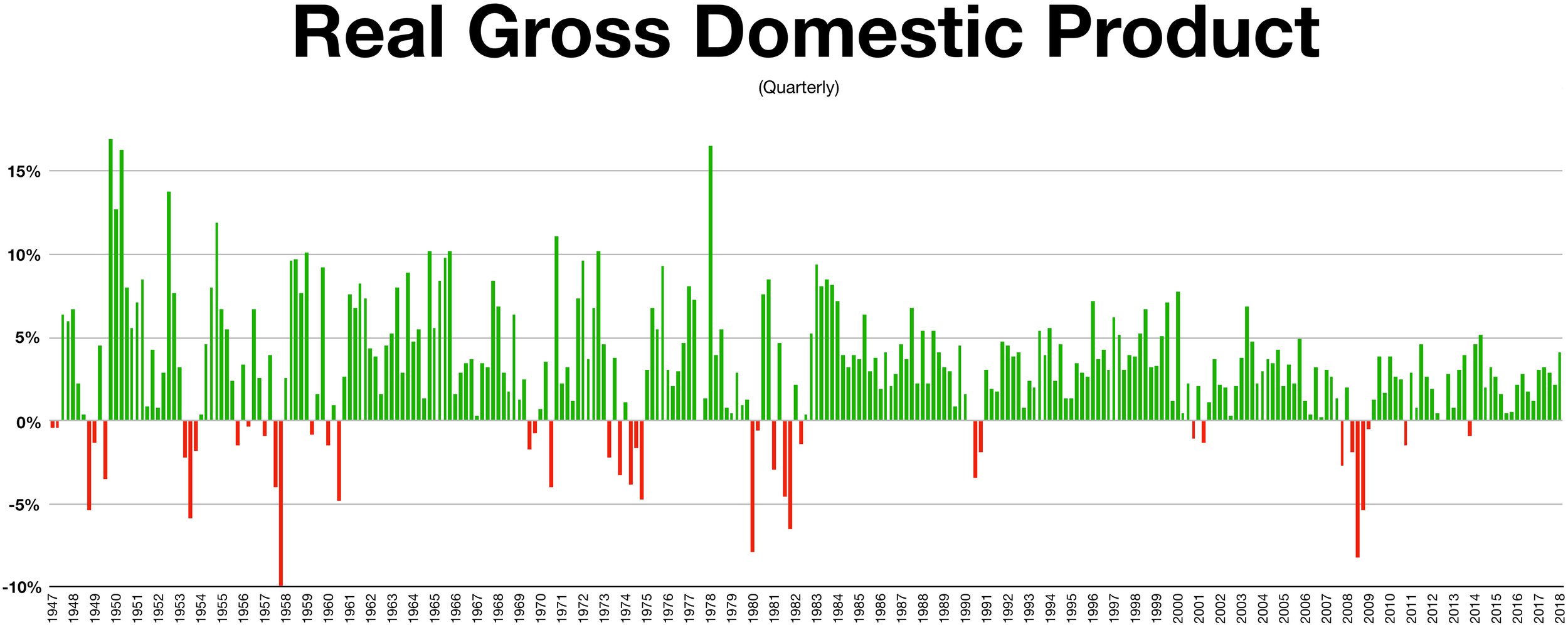
The Real GDP of the U.S. from 1947-2018 (quarterly).
"Quarterly gross domestic product" by Wikideas1 is part of the public domain.
A growing GDP suggests that employment is likely to increase, since businesses hire more people to keep up with rising demand. A shrinking GDP means money is changing hands less often and could result in layoffs. In fact, a recession is often defined as having two consecutive quarters of negative GDP growth.
Let's go a little deeper and break down exactly what GDP measures (and why many economists argue it shouldn't be our singular focus).
How is GDP measured?
GDP is pretty simple. It adds up the total ("Gross") value of goods and services produced ("Product") in a country ("Domestic").
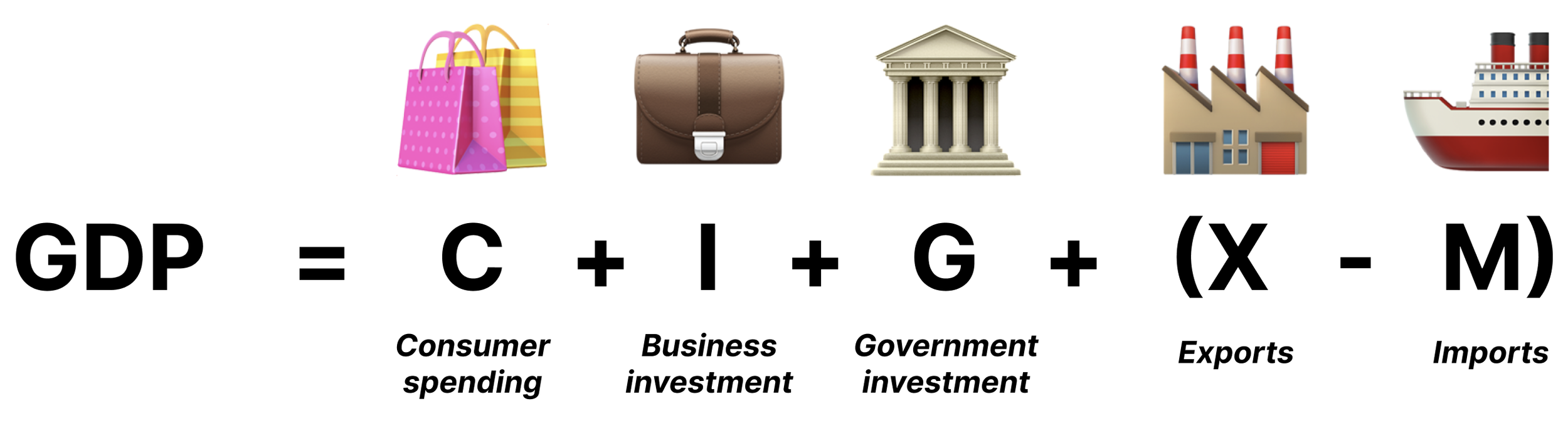
While there are a couple different ways to calculate GDP, the most common formula, C+I+G+(X-M), involves summing up the following:
Consumer spending (C)
Business investment (I)
Government investment (G)
And net exports, the difference between the value of exports (X) minus the value of imports (M)
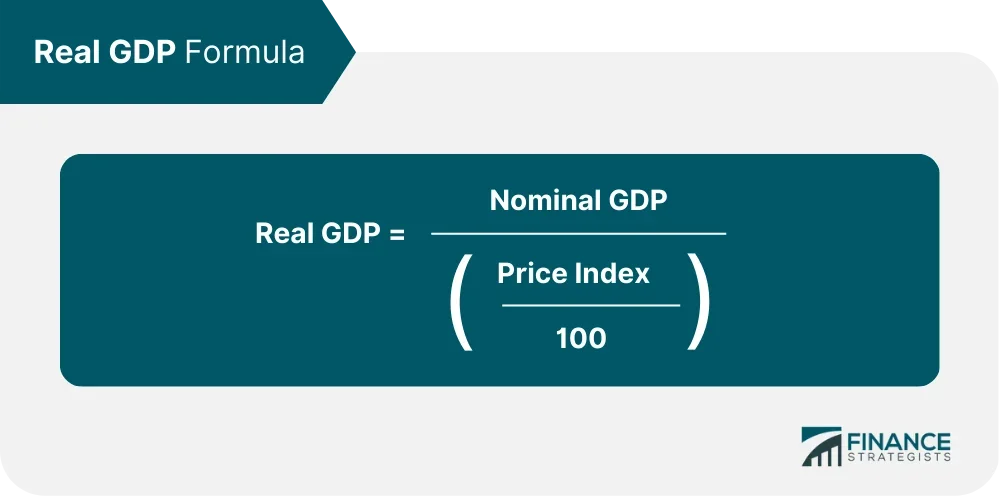
If you hang out with economists, you also might hear the term "real GDP" thrown around. That refers to an important adjustment made to GDP figures.
Source: Finance Strategists
Since GDP is measured at current prices, you can't compare two different time periods without making adjustments for inflation. So real GDP uses a formula to calculate whether a change in GDP is due to actual growth or simply because prices have increased.
What are the limitations of GDP?
Since its inception, maximizing the growth of GDP has arguably become the primary goal of many countries' economic and policy decisions.
GDP is a handy barometer, but it's not a perfect measure of economic growth. In fact, many economists argue that the all-consuming focus on GDP has been counterproductive to solving our biggest problems.
Limitation #1: GDP doesn't include all productive activity.
The aim of GDP is to capture the total value of all economic activity. But in reality, it misses some things.
For one, all bartering and informal (unreported) transactions are missed, which are more common in developing nations. Consider the street fruit vendor primarily making cash transactions or the car mechanic doing repairs in exchange for bookkeeping services.
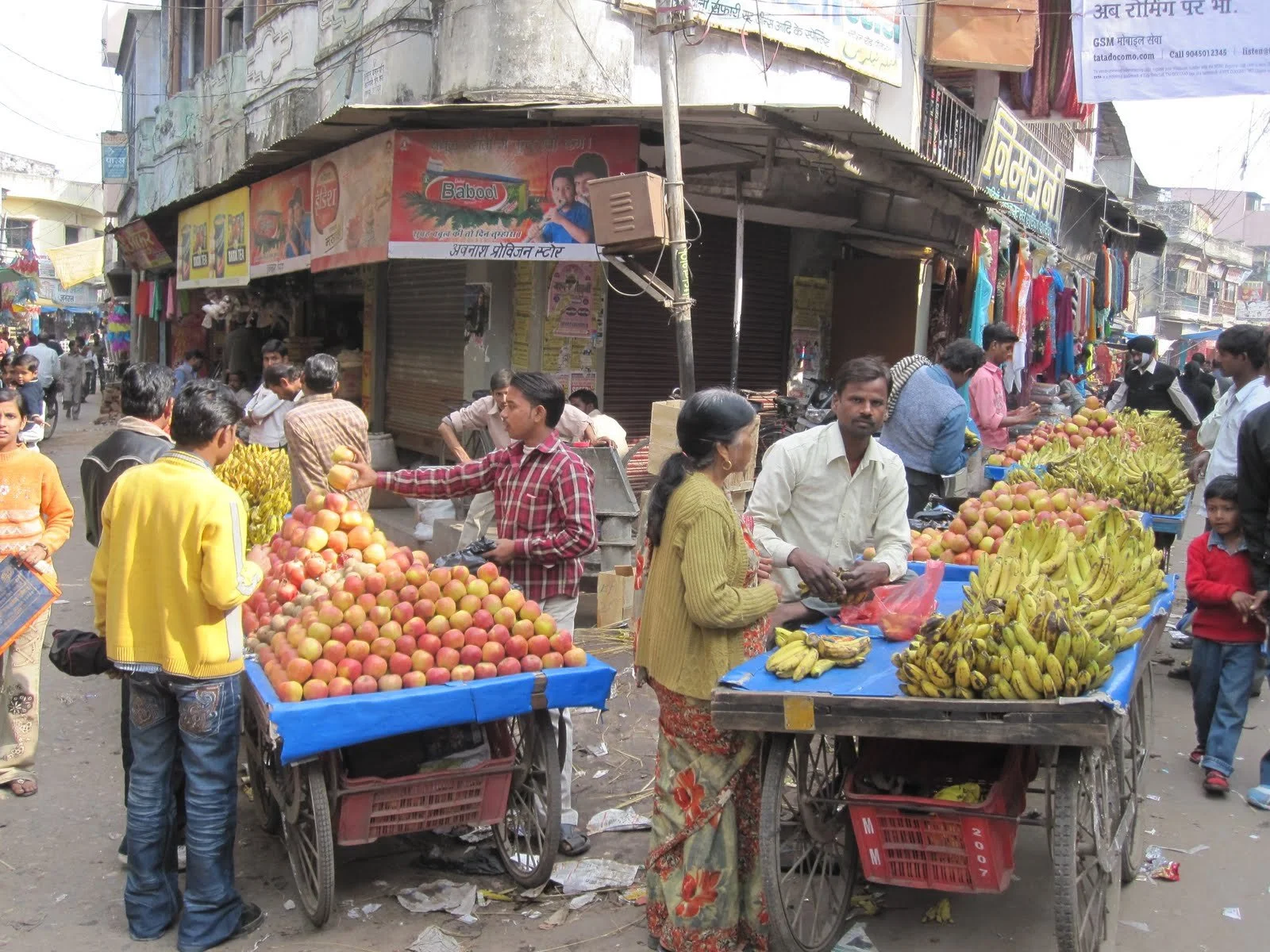
"A Busy road in Main Market" by Makks2010 is part of the public domain.
The informal economy is estimated to represent 35% of GDP in low- and middle- income countries, compared with 15% in advanced economies. Interestingly, the high GDP growth rates in the developing world are likely partially explained by informal transactions moving from cash to mobile payments.
GDP also doesn't take into account the value of unpaid labor, like caretaking, housework, or volunteer activities. So hiring a nanny counts, but being a stay-at-home parent doesn't. A 2025 study found that Americans spend an average of 234 hours doing unpaid caregiving activities. If this work was compensated at market rates, it would add up to more than $1.1 trillion.
While these activities are inherently difficult to track and measure, the bottom line is GDP is missing a lot of economic activity.
Limitation #2: There is no way to differentiate "good" vs. "bad" spending with GDP.
Economic policy is often designed with the end goal of maximizing GDP growth. But is that always good for society?
GDP totals up the value of goods and services regardless of whether something is "good" or "bad" spending. For example, government spending can increase because we need to clean up after an ecological disaster, like an oil spill. Spending can also go up because we're investing in better power grids for renewable energy. Investing in renewable energy is arguably better for society than cleaning up oil spills, yet both increase GDP.
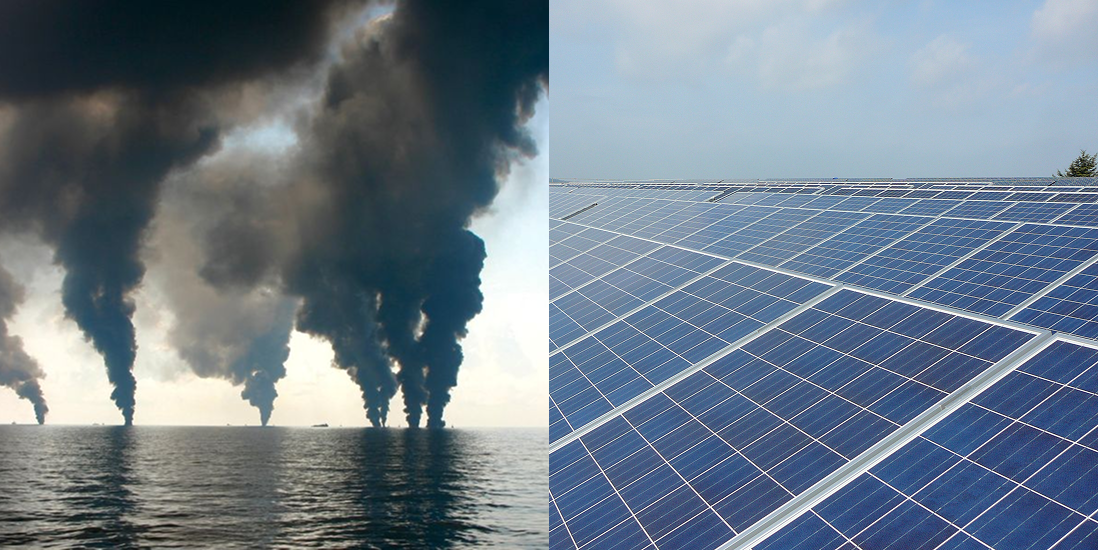
Left: "Deepwater Horizon oil spill UC Santa Barbara" by David Valentine is licensed under CC BY-SA 4.0. Right: "As solar firmengebaude" by ChristofferRiemer is licensed under CC BY 3.0.
Likewise, GDP cannot distinguish between increased consumer spending driven by more disposable income and spending driven by easier access to credit, like buy-now-pay-later services. Rising wages are good. Rising debt is not so good. But both are "good" for GDP growth.
If GDP positively correlates with events that negatively impact people's lives, there will be less political motivation to enact policies that avoid "bad" spending. Even Simon Kuznets, its chief architect, recognized that being singularly focused on GDP would lead to some poor outcomes: "The welfare of a nation can scarcely be inferred from a measurement of national income."
Limitation #3: GDP doesn't consider the value of preserving natural resources.
Another factor GDP misses is the value of our natural resources. Maintaining healthy ecosystems is vital for our current and future economic well-being, not to mention the value for the Earth generally. But GDP doesn't factor in natural resource preservation, so it's no surprise that as GDP per capita has risen, biocapacity per capita has dropped.
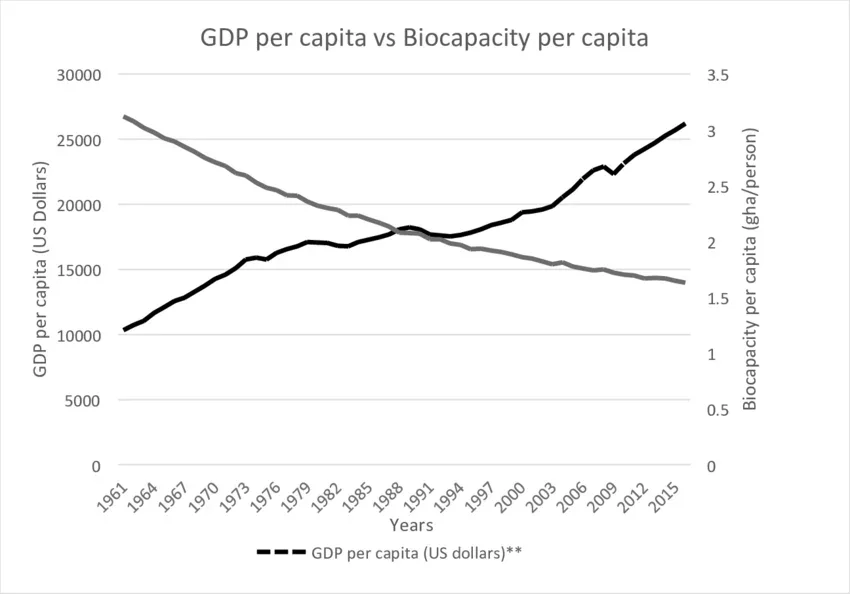
As the global GDP per capita has increased, the biocapacity per capita has decreased.
Source: Collapsing Gracefully: Making a Built Environment that is Fit for the Future (pp.1-16)
Think about it this way: If we were to catch and sell all the fish in the sea, GDP would go up dramatically. But that decision would collapse the fishing industry and permanently damage the ecosystem. The value of preserving natural resources is not baked into GDP.
Limitation #4: GDP doesn't account for the distribution of growth.
Lastly, while GDP tracks a country's overall economic growth, it doesn't reflect how this growth is being felt across its people. In the U.S., GDP has gone up with rising inequality.

As GDP has grown in the U.S., so has inequality. Source: Demos
From 1999-2008, most Americans saw a decline in income, adjusted for inflation, but GDP has continued to go up. The wealth has become more and more concentrated in the top earners, leaving behind the average person. In other words, GDP takes no consideration into how the wealth is distributed in a society.
What are some alternatives measurements to GDP?
So there are definitely issues with making GDP our singular economic and political barometer of progress. But most economists wouldn't argue to replace GDP, rather they might suggest using other tools to track our societal progress:
Green GDP: This takes traditional GDP and subtracts environmental costs (such as the value of using up natural resources or cleaning up pollution) and social costs (such as increased poverty and healthcare costs due to ecological damage).
Human Development Index (HDI): This index measures three key aspects of human life: life expectancy at birth, years of education, and a decent standard of living.
Genuine Progress Indicator (GPI): This measure takes traditional GDP, adjusts for income inequality, subtracts negative indicators (like costs of climate change and pollution, crime, and lost leisure time), and adds positive indicators (like the value of education and volunteering).
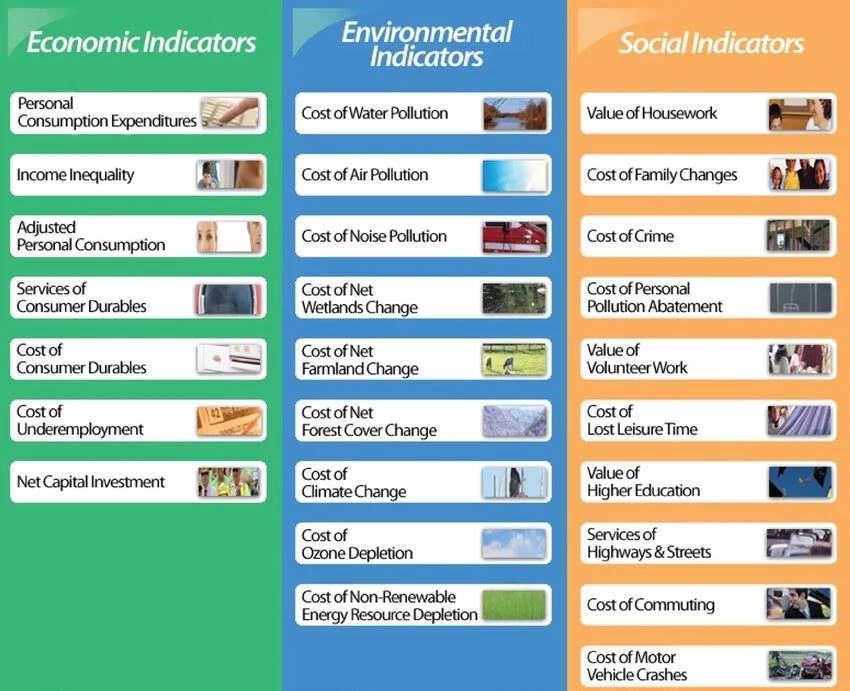
The 26 indicators that make up Maryland's first Genuine Progress Indicator.
Source: Physical, Ecological, and Societal Indicators for the National Climate Assessment
These metrics provide a significantly different way to view how we're doing as a society. GDP is a useful tool for tracking economic progress, but it's not the only one in our toolbox.
Curious about how the world works?
Today You Should Know is a free, weekly email newsletter designed to help you learn something new every Friday.
Subscribe today 👇
Check out some other curious questions:


Sources
Callen, T. (n.d.). Gross Domestic Product: An Economy’s All. International Monetary Fund. https://www.imf.org/en/Publications/fandd/issues/Series/Back-to-Basics/gross-domestic-product-GDP
Cha, J. M. (2013, January 29). What’s Missing From GDP? Dēmos. https://www.demos.org/research/whats-missing-gdp
Dēmos. (2011). Beyond GDP: New Measures for a New Economy. Dēmos. https://www.demos.org/sites/default/files/publications/BeyondGDP_0.pdf
International Monetary Fund. (2021, July 28). Five Things to Know about the Informal Economy. International Monetary Fund . https://www.imf.org/en/news/articles/2021/07/28/na-072821-five-things-to-know-about-the-informal-economy
Killelea, S. (2022, May 18). The Problem with GDP. Vision of Humanity. https://www.visionofhumanity.org/the-problem-with-gdp/
Leiden University. (n.d.). What is wrong with GDP?. Beyond GDP. https://beyond-gdp.world/beyond-gdp-basics/what-is-wrong-with-gdp
Mason, J., & Gallagher Robbins, K. (2026, June 25). Americans’ Unpaid Caregiving is Worth More Than $1 Trillion Each Year. National Partnership for Women & Families. https://nationalpartnership.org/americans-unpaid-caregiving-worth-1-trillion-annually-women-two-thirds-work/
Sherry, B. (n.d.). Global Great Depression. OER Project. https://www.oerproject.com/OER-Materials/OER-Media/HTML-Articles/Origins/Unit8/Global-Great-Depression
U.S. Bureau of Economic Analysis. (2025, June 3). The Expenditures Approach to Measuring GDP. U.S. Bureau of Economic Analysis. https://www.bea.gov/news/blog/2025-06-03/expenditures-approach-measuring-gdp
Vanham, P. (2021, December 13). A brief history of GDP - and what could come next. World Economic Forum. https://www.weforum.org/stories/2021/12/stakeholder-capitalism-episode-1-a-brief-history-of-gdp/



We Americans sure do like American things.