The short answer
The Unicode Consortium's Emoji Subcommittee accepts new emoji proposals from the public every year and evaluates them based on strict criteria, including how useful, recognizable, and broadly relevant the emoji would be.
The long answer
I'm going to take a wild guess that you've used an emoji today. But actually, the guess isn't that wild 😜 — 92% of the world’s online population uses emojis*.
Currently there are 3,953 emojis when all skin tone and gender variations are included. And more are added each year.
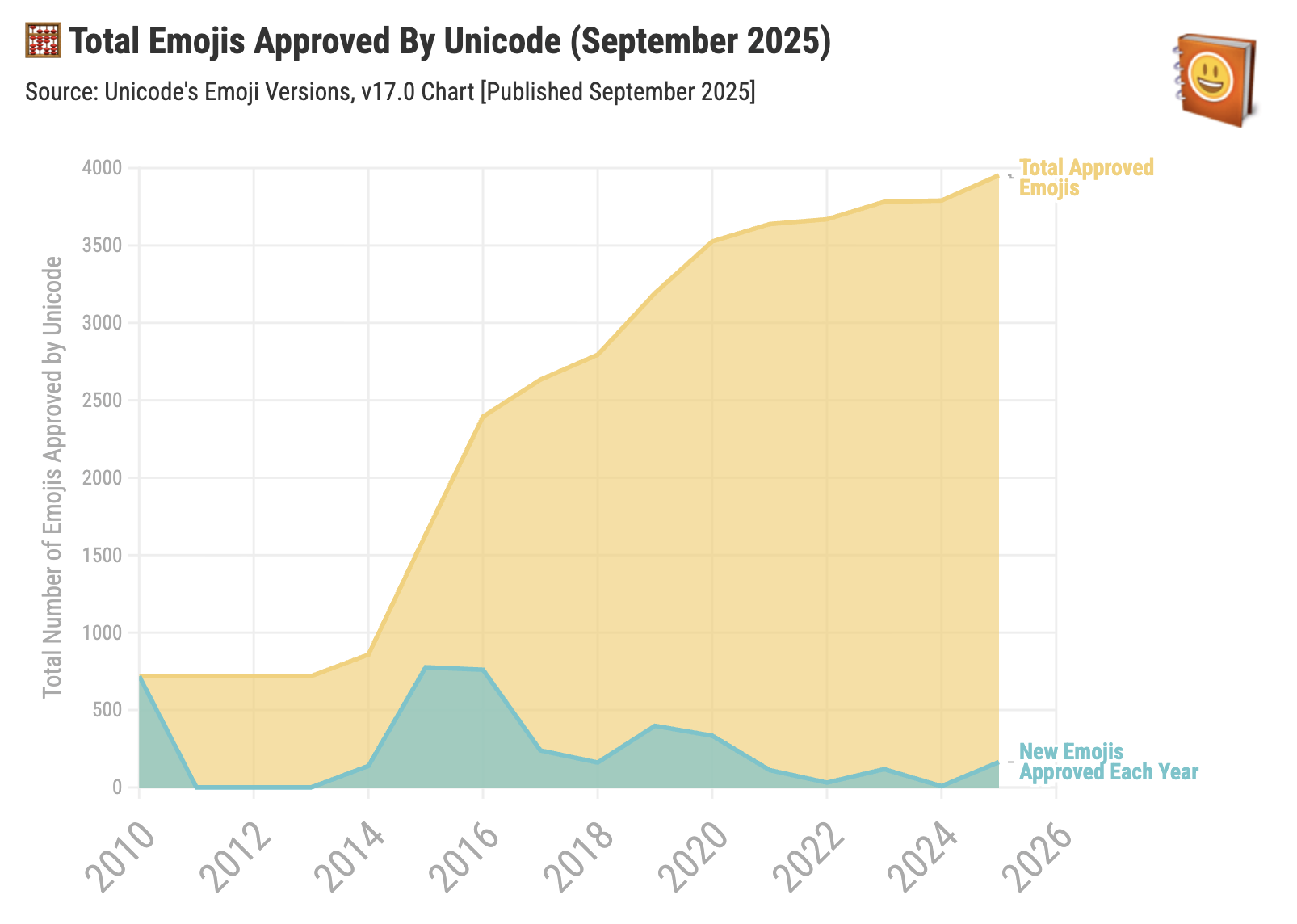
The total number of emojis surged between 2014-2016 when skin color and gender variations were introduced.
Source: Emojipedia
The central emoji authority is the Unicode Consortium, a non-profit organization based in Mountain View, California. The mission of the Unicode Consortium is to make text for every language work across all computers worldwide.
At this point, I'm going to give a short technical explainer on what Unicode is, but if you don't care or already know, feel free to skip ahead to the next section.
What is Unicode?
A computer stores everything as bits (short for binary digits), which we represent as 0s and 1s. But most humans would prefer to read things as words and not binary code, so we need a way to translate natural languages into bits and vice versa.
Character encoding is a set of rules that says, "For this arrangement of 0s and 1s, show me this character." Early on, many computers used ASCII, which is basically a small dictionary that maps numbers into characters.
This is how you write "emoji" in binary using ASCII:
01100101 01101101 01101111 01101010 01101001
ASCII uses 1 byte (8 bits) per character, which allows for 256 possible values. That's fine if you're using English letters (A-Z, a-z), digits (0-9), and basic punctation, but when people started sending text across the internet, things got messy.
If your computer used ASCII but you were exploring the worldwide web, non-English characters like è, ñ, ö, and ç would show up on your screen as �. We needed something bigger, better, and more unified than ASCII.
Enter Unicode: A single global standard that assigns each character a unique ID, called a code point. When text is stored, an encoding system like UTF-8 (the most common) turns those code points into bytes, usually 1 to 4 bytes per character. That’s far more flexible than ASCII.
| Character | Unicode | UTF-8 | Binary |
|---|---|---|---|
| A | U+0041 | 41 | 01000001 |
Unicode 17.0 defines 159,801 characters, supporting almost all scripts, punctuation marks, and symbols in use globally — including, of course, emojis.
What is an emoji? And how do new emojis get added?
Emojis may look like images, but they are simply just another character in Unicode's repertoire. Each emoji has an assigned code point:
😭 = U+1F62D
Some emojis are formed by combining multiple code points:
😮💨 = 😮 + 💨
👩🏽🔬 = 👩 + U+1F3FD (Medium Skin Tone) + 🔬
🏳️🌈 = 🏳️ + 🌈
Anyone can propose new emojis to be added to Unicode, but they must pass the strict scrutiny of the Unicode Consortium's Emoji Subcommittee. At a high level, the criteria for selecting a new emoji is that it:
Is easily interpreted in a small size
Adds new possibilities not already found in the existing emoji set
Is already used by large numbers of people
Your proposal (example) must include the proposed emoji's name, keywords, category, along with color and black & white images. You must provide reasoning and supporting evidence that your new emoji:
Can express multiple concepts
Example: 💪 can communicate strength or simply an elbow.
Can be used with other emojis to convey additional concepts
Example: 💦 🧼 👐 can mean "handwashing."
Breaks new ground
Example: Because there's already 🧹, a vacuum cleaner emoji wouldn't add much more substantive meaning.
Is legible and visually distinctive at a small size
Example: 🍺 is recognizable as not just beer, but a beer mug.
Has a high usage level
You must include screenshots from various sources, like Google Trends, to support your claim. Petitions, hashtags, or anecdotal evidence is not acceptable.
Completes an incomplete category (if applicable)
Example: 🦂 🦁 🦀 🏹 🏺 were added to complete the zodiac.
Adds compatibility with a popular existing system (if applicable)
Example: 🙄 was added to represent ◔_◔, a popular emoticon on many web bulletin boards.
There are also factors that could exclude your emoji, like if it's overly specific, just a fad, or too open-ended. Click here to read the full criteria.
How do vendors design emojis?
Once an emoji is approved by the Unicode Consortium and assigned its code point, different emoji vendors like Apple, Samsung, and Google create their own stylized version of the emoji.
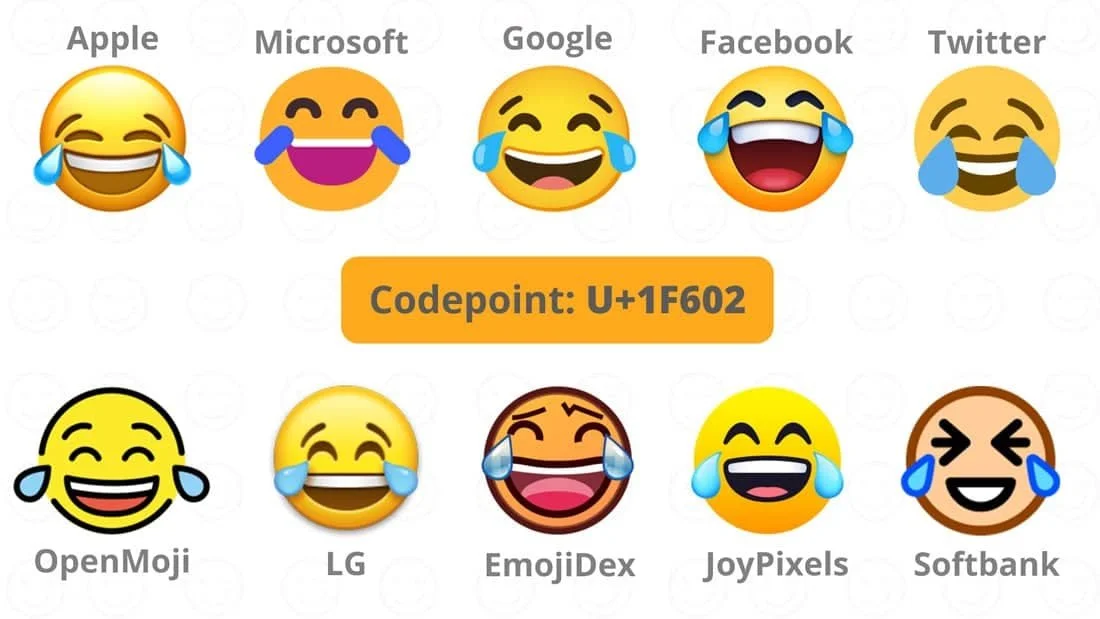
Source: Emojiall
According to one insider, each vendor predictably adheres to its own in-house design style. Apple is "the least collaborative and the most secretive," which makes sense given their corporate culture and their dominance in emoji usage.
But there is real value in having emojis look and feel similarly across platforms. In 2015, a research lab at the University of Minnesota conducted a survey to compare how people interpreted different emojis across five major platforms. Among their findings was a huge discrepancy in how Apple's Grinning Face with Smiling Eyes emoji was interpreted compared to other platforms' designs.

How survey participants assessed the emotional sentiment of different platforms' Grinning Face with Smiling Eyes emojis, circa 2015.
Source: GroupLens
This meant that there was significant potential for miscommunication when people used the same emoji across different platforms.

Source: GroupLens
Apple later updated its Grinning Face with Smiling Eyes emoji (😄) to look less like Grimacing Face (😬), but not before it went down in emoji history. Today, Emojipedia states a warning on the Beaming/Grinning Face with Smiling Eyes page:
“🚨 Appearance historically differs greatly across platforms. Use with caution.”
*Note: The Grammar Police is split on whether the plural of "emoji" is "emoji" or "emojis." But since I say "emojis" in my day-to-day life, that's how I've styled it here.
Curious about how the world works?
Today You Should Know is a free, weekly email newsletter designed to help you learn something new every Friday.
Subscribe today 👇
Check out some other curious questions:


Sources
Broni, K. (2025, September 9). What’s New In Unicode 17.0. Emojipedia. https://blog.emojipedia.org/whats-new-in-unicode-17-0/
Burge, J. (2015, June 17). Unicode 8: What, And When. Emojipedia. https://blog.emojipedia.org/unicode-8-what-and-when/
Burge, J. (2016, July 22). Gendered Emojis Coming In 2016. Emojipedia. https://blog.emojipedia.org/gendered-emojis-coming-in-2016/
Dictionary.com. (2018, February 28). 😄 Grinning Face With Smiling Eyes emoji. Dictionary.com. https://www.dictionary.com/culture/emoji/grinning-face-with-smiling-eyes-emoji
Emojipedia. (n.d.). FAQ. Emojipedia. https://emojipedia.org/faq
Insider Tech. (2019, August 3). Why It Takes Years To Create Emoji. YouTube. https://www.youtube.com/watch?v=U8aZmwHw1Mk
Martin, R., & Davis, M. (2015, October 25). Who Decides Which Emojis Get The Thumbs Up?. NPR. https://www.npr.org/sections/alltechconsidered/2015/10/25/451642332/who-decides-which-emojis-get-the-thumbs-up
Miller, H. (2016, April 5). Investigating the Potential for Miscommunication Using Emoji. GroupLens. https://grouplens.org/blog/investigating-the-potential-for-miscommunication-using-emoji/
Ozel, M. (2020, April 27). Mindful Design: Everything You Did and Didn’t Want to Know About Emoji Design. Face the FACS. https://melindaozel.com/mindful-design-everything-you-did-and-didnt-want-to-know-about-emoji/
Sharma, S. (2023, February 15). Understanding the ASCII Table. Linux Handbook. https://linuxhandbook.com/ascii-table/
Tasker, P. (2021, January 12). How Unicode Works: What Every Developer Needs to Know About Strings and 🦄. Delicious Brains. https://deliciousbrains.com/how-unicode-works/
Unicode. (2025, August 1). Guidelines for Submitting Unicode® Emoji Proposals. Unicode. https://unicode.org/emoji/proposals.html
Unicode. (n.d.). Emoji Proposals Status. Unicode. https://unicode.org/emoji/emoji-proposals-status.html
W3Schools. (n.d.). HTML Unicode (UTF-8) Reference. W3Schools. https://www.w3schools.com/charsets/ref_html_utf8.asp

We Americans sure do like American things.