
The short answer
Blood pressure and tire pressure are both gauge pressure, but blood pressure is measured in mmHg because the first blood pressure devices used mercury. Tire pressure uses psi, kPa, or bar because those units come from engineering.
The long answer
Whether you've wearing a blood pressure cuff or filling your car tires with air, you need something to tell you the pressure. Specifically, you need to measure the gauge pressure, or the pressure of something relative to atmospheric pressure.
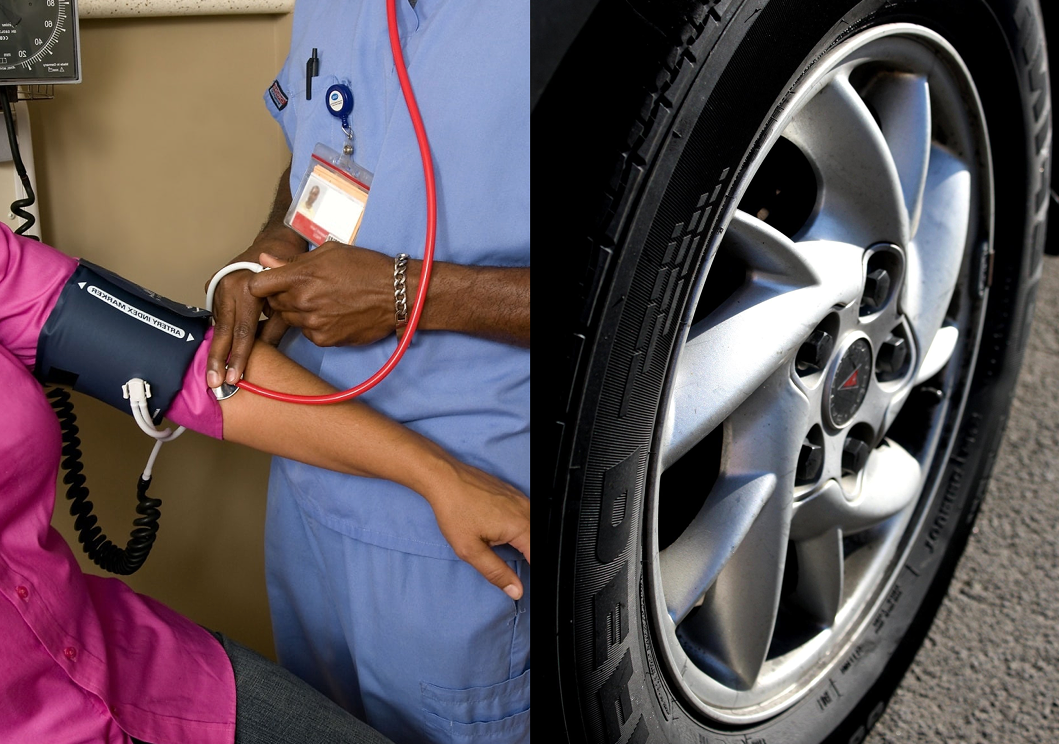
But despite blood pressure and tire pressure both requiring measurements of gauge pressure, we use strikingly different measurements. Blood pressure is measured in mmHg (millimeters of mercury), while tire pressure is measured in — depending on if your country uses the metric system — psi (pound-force per square inch), kPa (kilopascal), or bar (100 kPa).
Why is blood pressure measured in mmHg (mm of mercury)?
Blood pressure is how hard blood is pushing up against the walls of arteries, which deliver blood from the heart to the rest of the body. In a blood pressure measurement of 120/80, 120 refers to the systolic blood pressure and 80 refers to the diastolic blood pressure.
Systolic is the pressure when the heart beats to pump blood, whereas the diastolic is the pressure when your heart is in between beats.
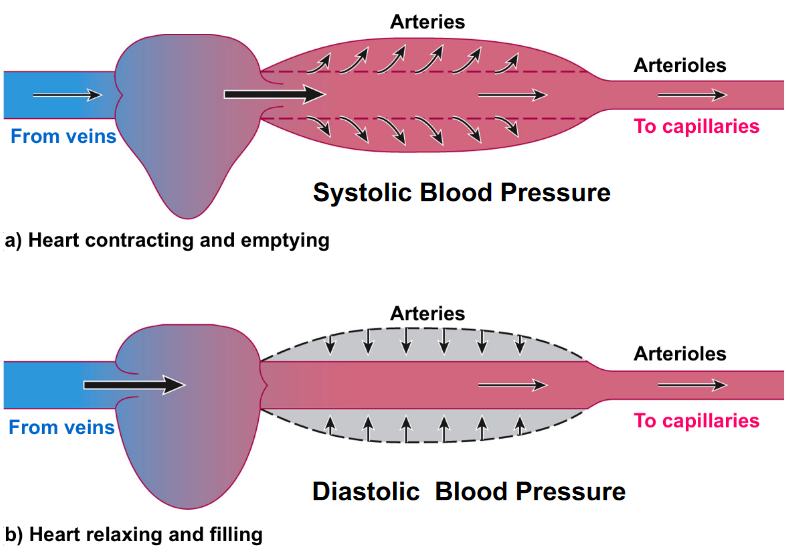
Source: Nanyang Technological University
Blood pressure is measured in millimeters of mercury (mmHg) because of the invention of the mercury sphygmomanometer. Other than being a delightfully difficult word to pronounce, a sphygmomanometer is the medical term for a blood pressure monitor.
A mercury sphygmomanometer, invented in 1896 by Italian physician Scipione Riva-Rocci, works by inflating a rubber arm cuff with air. The pressure of the inflated cuff pushes down on a reservoir of mercury, which rises up a glass tube. How high it rises is measured in millimeters, hence millimeters of mercury.
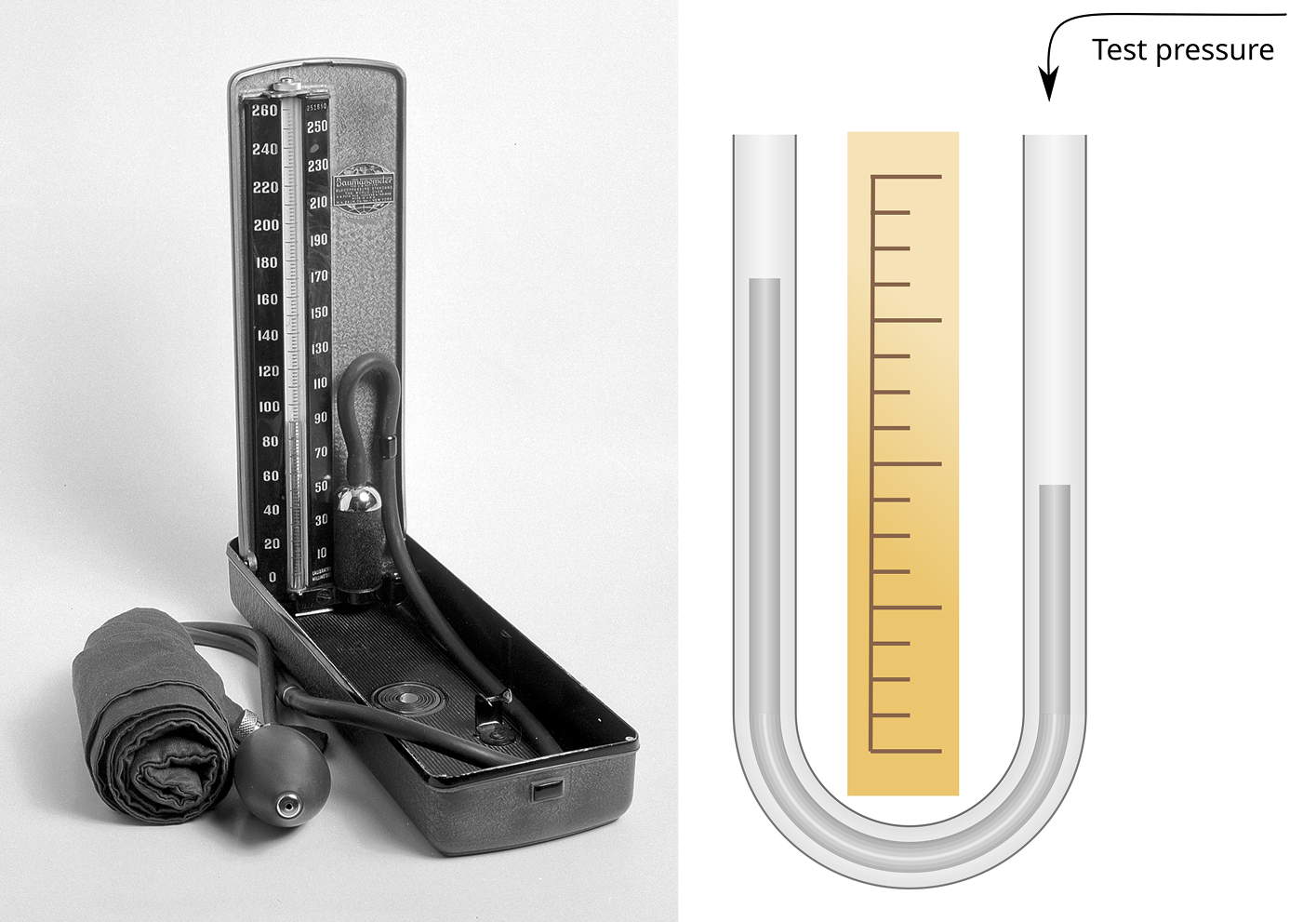
Left: A mercury sphygmomanometer. Right: A diagram showing how pressure from the cuff pushes mercury up a measurement column.
Left: ""Baumanometer"; instrument for measuring blood pressure. Wellcome L0011955" by Wellcome Collection is licensed under CC BY 4.0. Right: "Mercury pressure gauge" by SpinningSpark is licensed under CC BY-SA 3.0.
After inflating enough to squeeze the upper arm artery (brachial artery) shut, pressure is slowly released while listening with a stethoscope. The pressure reading at the first heart beat sound is the systolic pressure. The pressure without sound is the diastolic pressure.
Mercury is used because it's much denser than water, which means the sphygmomanometer only needs to be about 300mm tall to measure blood pressure. It's also easy to read because of the metallic color and it leaves no streaks in the glass.
While we have different metrics to measure pressure, mmHg continues to be the standard blood pressure reading to easily compare against historical data and because mercury sphygmomanometers continue to be used in many parts of the world today.
Why is tire pressure measured in psi, kPa, or bar?
Tire pressure is not measured in mmHg. Instead, you'll find your car and bike tires requiring readings in psi, kPa, or bar. These three units of pressure measure how much force the air inside the tire pushes against the tire's inner surface.
Psi is the standard, non-metric unit in the United States, bar is a metric unit (1 bar is close to sea-level atmospheric pressure), and kPa is the official SI metric used in science and engineering. A pascal is one newton of force spread evenly over one square meter, or the weight of a small apple.
| Measurement | Conversion |
|---|---|
| psi | 1 psi = 6,895 pascals 1 psi = 51.7 mmHg |
| bar | 1 bar = 100,000 pascals 1 bar = 750 mmHg |
| kPa | 1 kPa = 1,000 pascals 1 kPa = 7.5 mmHg |
The most common mechanical device used to measure tire pressure is a C-type Bourdon tube. A Bourdon tube, patented by French watchmaker and engineer Eugène Bourdon in 1849, is a curved, flattened metal tube that uncoils as the pressure inside it increases.
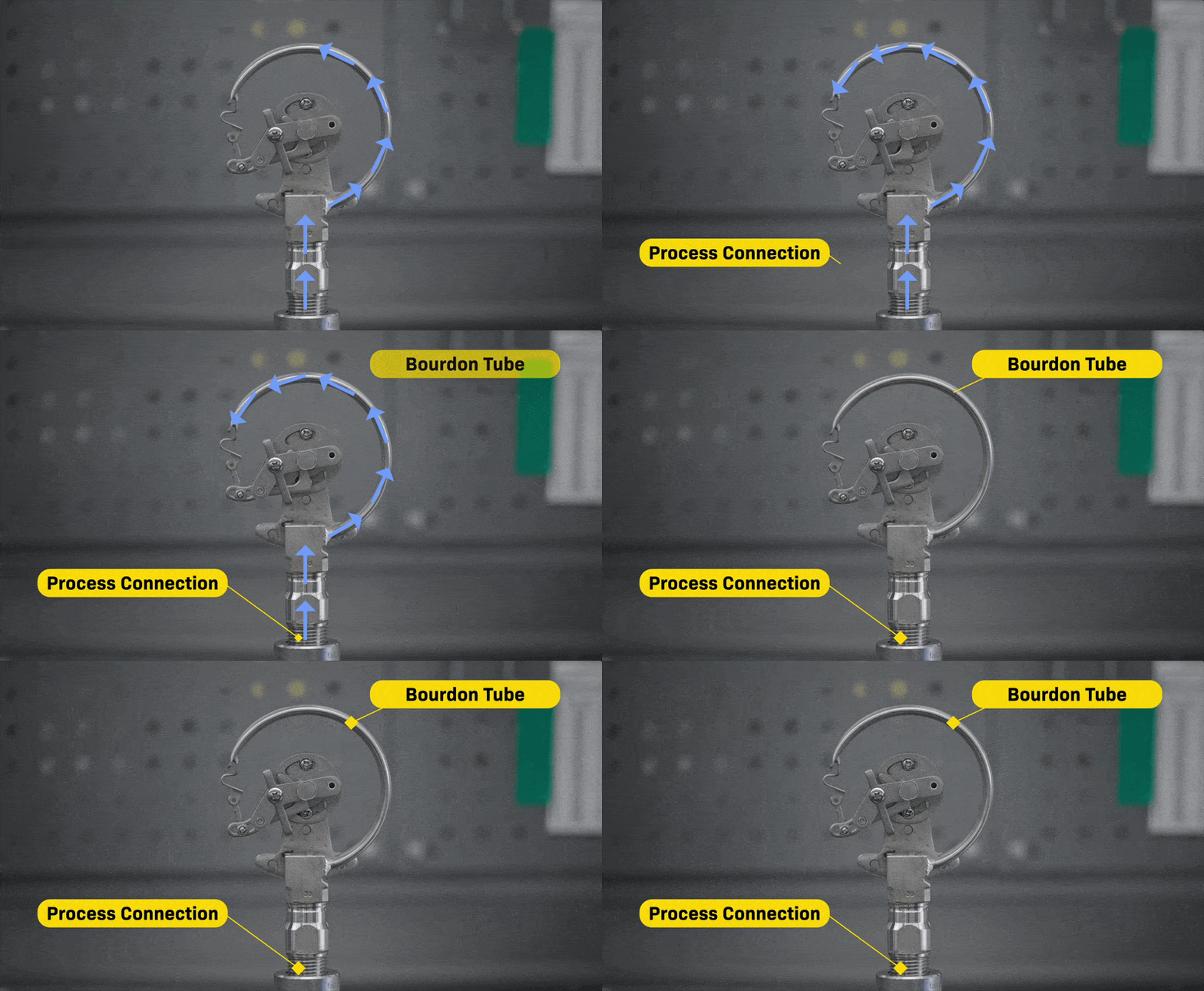
Source: Reotemp
The Bourdon tube works pretty much like a party horn. As the tube uncoils under pressure, the tube's tip moves a gearing mechanism that connects to a pointer, indicating the gauge pressure. The C-tube can withstand pressures of up to about 10,000 kPa / 100 bar / 1,450 psi.
Why are blood pressure and tire pressure measured differently?
So going back to the original question: Blood pressure and tire pressure both measure gauge pressure, or how far the pressure inside is above the surrounding air. But we use mmHg to measure blood pressure because the first blood pressure devices used mercury.
Tire pressure uses kPa, bar, and psi because those gauges came out of engineering, where pressure is naturally expressed as force per unit area. Tire pressures are also much higher than blood pressures, which makes those larger units more convenient than mmHg.
Curious about how the world works?
Today You Should Know is a free, weekly email newsletter designed to help you learn something new every Friday.
Subscribe today 👇
Check out some other curious questions:


Sources
Cohen, J. B., Padwal, R. S., Gutkin, M., Green, B. B., Bloch, M. J., Germino, F. W., Sica, D. A., Viera, A. J., Bluml, B. M., White, W. B., Taler, S. J., Yarows, S., Shimbo, D., & Townsend, R. R. (2019). History and justification of a national blood pressure measurement validated device listing. Hypertension, 73(2), 258–264. https://doi.org/10.1161/hypertensionaha.118.11990
Gill, J. (2025, October 26). Why Blood Pressure Readings Still Use mmHg. YouTube. https://www.youtube.com/shorts/HVYNVWDhKCU
Lunawat, P. (2026, May 30). What Is A Bourdon Tube Gauge?. ScienceABC. https://www.scienceabc.com/pure-sciences/what-is-a-bourdon-tube-gauge
Merck & Co, Inc. (n.d.). Measuring Blood Pressure. Merck. https://www.merckmanuals.com/home/multimedia/image/measuring-blood-pressure
OSCRiceUniversity. (n.d.). 51 Gauge Pressure, Absolute Pressure, and Pressure Measurement . OER at MSU Libraries. https://openbooks.lib.msu.edu/collegephysics/chapter/gauge-pressure-absolute-pressure-and-pressure-measurement/
Reotemp. (2024, May 28). How Do Pressure Gauges Work? | Bourdon Tubes FAQ . YouTube. https://www.youtube.com/watch?v=ozo_DbOhbTI
Tam, M. (2014, September 29). Health Check: what do my blood pressure numbers mean? . The Conversation. https://theconversation.com/health-check-what-do-my-blood-pressure-numbers-mean-29212
Toups, R. (2025, May 16). Pressure Gauges: History, How They Work, Calibration, Maintenance & Industry Applications. Michelli Weighing & Measurement. https://www.michelli.com/our-resources/insights/pressure-gauges-history-how-they-work-calibration-maintenance-industry-applications
TyreSafe. (2026, July 20). What is tyre pressure?. TyreSafe. https://www.tyresafe.org/tyre-advice/pressure/tyre-pressures-explained/



We Americans sure do like American things.