
Why are some plants pollinated by wind and others pollinated by insects?
The short answer
Insect pollination works best with ample sunlight and water (to fuel nectar production) with calm conditions. Wind pollination works best with the same species clustered together in open, windy areas.
The long answer
I was on a run this past spring when I noticed something strange — the cars were yellow.
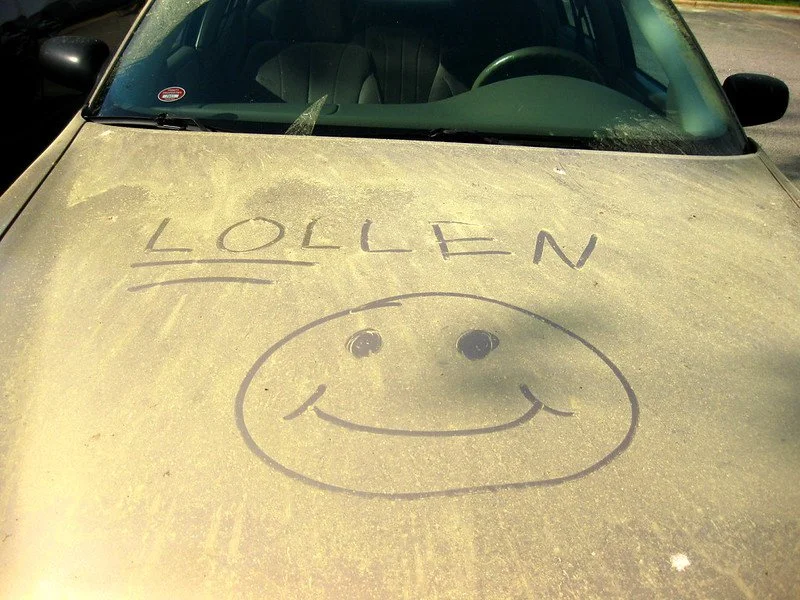
At least this person wanted to turn people's pollen frowns upside-down. 🙂
"Pollen Pollen Everywhere" by Scott Akerman is licensed under CC BY 2.0.
But why would a plant go through all the trouble of releasing pollen randomly into the wind when they have bees and other insects to do the job of pollinating? And why must wind-pollinated plants release so much pollen?
To start, pollination is the process by which plants sexually reproduce. Pollen carries the plant's version of sperm, which gets transferred to the stigma and fertilizes an egg. While the process can occur within the same plant (self-pollination), cross-pollination between other plants can result in stronger and more genetically diverse offspring.

Diagram showing how pollen grains from one plant can be passed, by insects (or another animals) or wind, to reach the stigma of another plant, fertilizing its ovules.
"Diagram showing pollination with flower and bee" (modified) by brgfx
But one plant can't uproot and walk over to another plant to get the party started. That's why plants rely on the wind and animals to deliver their pollen to another plant.
Note: While many types of animals assist with pollination, like birds, bats, and even some reptiles, insects are the most common. So while the proper term is "animal pollination", I'll be using "insect pollination" going forward.
What are the differences between insect- and wind-pollinated plants?
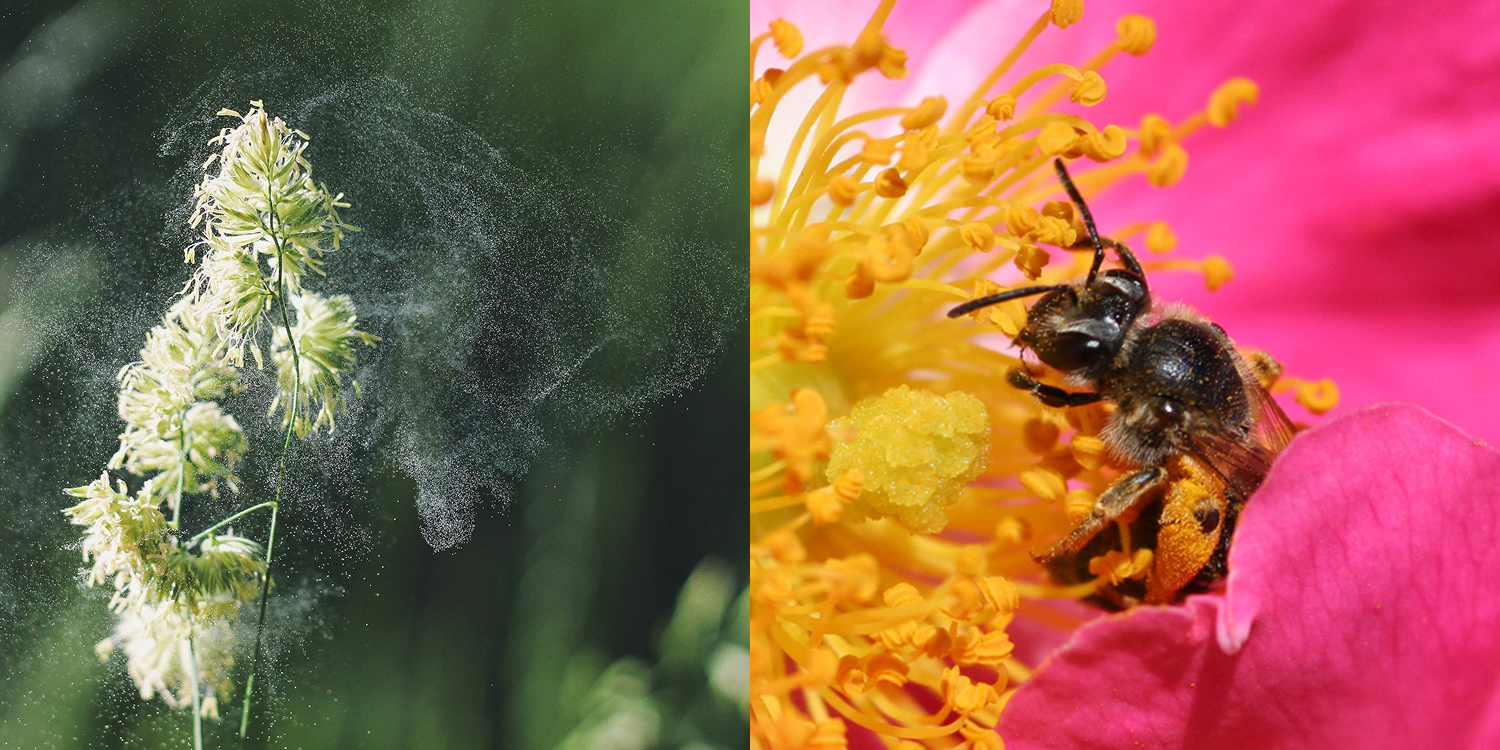
Left: "Pollen from Dactylis glomerata" (cropped) by Alex Jones is part of the public domain. Right: "Bee pollinating a rose" by Debivort is licensed under CC BY-SA 3.0.
Since wind and insect pollination are distinctly different strategies, plants have evolved distinctly different characteristics to ensure success.
Insect pollinators produce pollen that's slightly sticky, flowers that are fragrant and colorful to attract insects, and nectar to incentivize hungry bees. In short, they are catering to the insects they rely upon to spread their pollen.
Wind pollinators, on the other hand, serve no one but themselves. Their pollen is dust-like and released before their leaves grow too big, allowing it to sail through the wind uninterrupted.
To my allergy-prone friends who have wondered why wind-pollinated plants must make so much pollen: Wind pollinators are gambling. And since the wind is out of their control, they produce enormous amounts of pollen to hedge their bets. A single tree can produce billions of pollen grains.
Why did some plants evolve to use wind to pollinate?
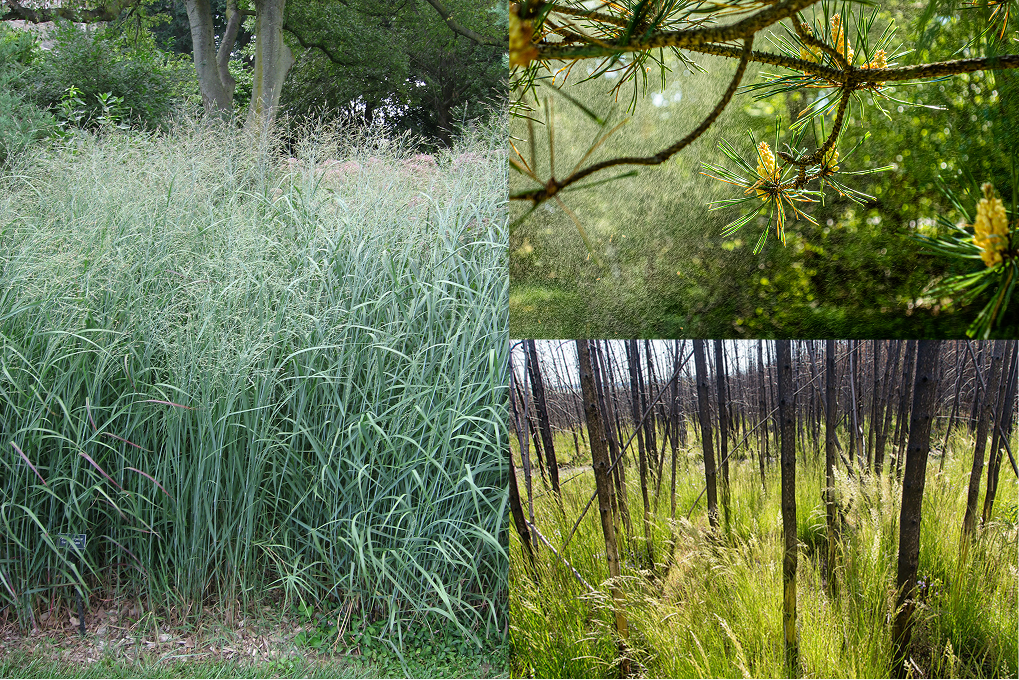
Wind-pollinated plants often grow in dense clusters (left: switchgrass), in drier and higher latitude locations (top right: pine tree) , and in places wind is free to blow, like post-wildfire ecosystems (bottom right: pinegrass).
Left: "PanicumVirgatum" by Chhe is part of the public domain. Top right: "Pine releasing pollen into the wind in Tuntorp 4" by W.carter is licensed under CC BY-SA 4.0. Bottom right: "Pinegrass (Calamagrostis rubescens) growing in the 2016 Maple Fire scar" by NPS / Neal Herbert is part of the public domain.
It's estimated that around 12% of flowering plants are wind pollinators. But what drew these plants to place their bets on the wind?
Wind is a good pollination strategy when...
The same species grows in dense clusters. Very little wind-carried pollen actually lands on the right target, but if your fellow grasses, pines, and cereal crops (e.g. corn, wheat) grow nearby, wind pollination can work well.
Wind is free to blow. Wind pollination won't work well if other plants get in your pollen's way. That's why wind pollinators are often found in open, high-altitude habitats and in early successional ecosystems (e.g. after a wildfire). Wind pollinators are often tall plants, whose flowers or cones are exposed.
The environment is dry or cold. High humidity and rain will cause pollen to clump together and drop to the ground before reaching another plant, so dry environments are advantageous to wind pollinators. Additionally, cold environments don't often have dependable insect or other animal populations, so wind is usually a better strategy (however some flowers bloom in the winter).
Energy production is a challenge. Insect pollinators need to produce nectar to attract willing insects to spread their pollen — but it comes at a great energy cost. Nectar production can use up to 37% of a plant's energy. So a plant might evolve to be a wind pollinator because they're in an environment where photosynthesis is harder, such as high-latitude places with shorter growing seasons, drought, or extreme weather.
Why did some plants evolve to use insects to pollinate?
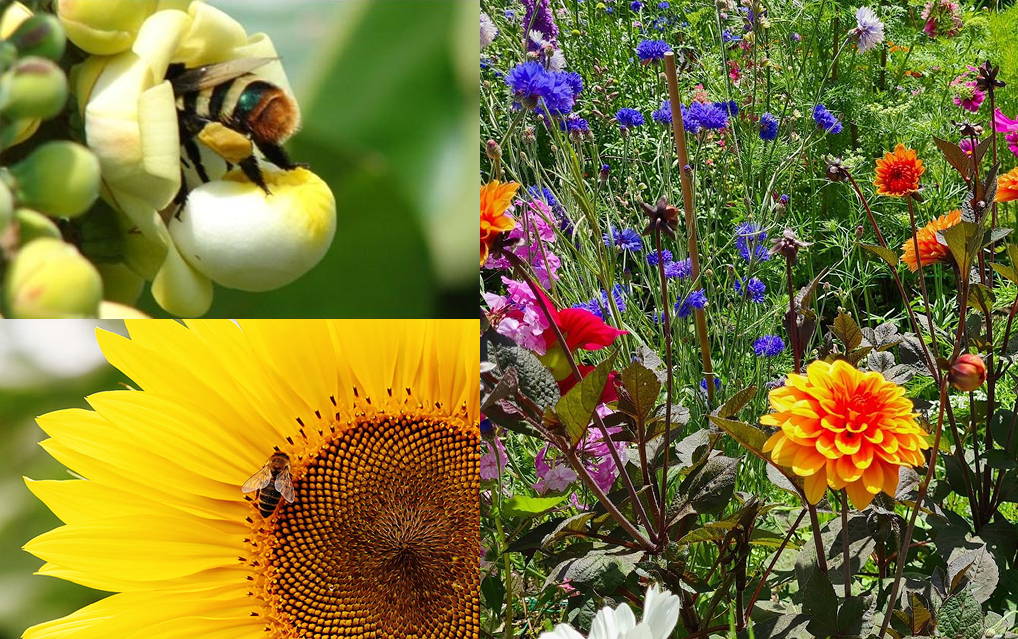
Insect-pollinated plants often grow in wet, warm environments (top left: Brazil nut tree flower), sunny locations that support ample photosynthesis (bottom left: sunflower), and in places where same species are spaced far apart (right).
Top left: “Eulaema meriana" by M. C. Cavalcante, F. F. Oliveira, M. M. Maués, and B. M. Freitas is licensed under CC BY 3.0. Bottom left: "closeup photography honeybee perched on yellow sunflower" by Pickpic. Right: Flowers From the Farm
Insect pollination is a good strategy when...
There is ample sunlight and water to aid in photosynthesis. Producing nectar takes up a ton of a plant's available energy. But if they can easily generate a surplus, that makes insect pollination a viable option.
They are spaced far apart from the same species. Insects act as "targeted carriers" for plants. Some of them are incredibly loyal to host plants during bloom. For example, a bee might fly from the same flower species to another, ignoring other plants along the way. So if you need a direct flight for your pollen, insect pollination is the way.
The habitat is not windy. If there's no wind, there's no wind pollination. A 2025 study found that insect pollinator abundance is three times higher in low wind speeds than in moderate wind conditions.
The soil is nutrient poor. While insect pollination requires abundant energy, it needs fewer nutrients than wind pollination. To produce billions of pollen grains, a plant requires high amounts of nitrogen and phosphorous. If soil is nutrient poor, insect pollination is likely a better choice.
The environment isn't prone to late frosts. Colder weather not only means less insect life; it also puts flowers at risk of a late frost that could kill the flowers attracting insects before successful pollination.
Curious about how the world works?
Today You Should Know is a free, weekly email newsletter designed to help you learn something new every Friday.
Subscribe today 👇
Check out some other curious questions:

Sources
Balfour, N. J., & Ratnieks, F. L. (2025). Wind alters plant-pollinator community structure, bee foraging rate & movements between plants. Behavioral Ecology, 36(4). https://doi.org/10.1093/beheco/araf067
Culley, T. M., Weller, S. G., & Sakai, A. K. (2002). The evolution of wind pollination in angiosperms. Trends in Ecology & Evolution, 17(8), 361–369. https://doi.org/10.1016/s0169-5347(02)02540-5
Fernando, D. (2021). Pollination. EBSCO. https://www.ebsco.com/research-starters/anatomy-and-physiology/pollination
Galen, C., Storks, L., Carpenter, E., Dearborn, J., Guyton, J., & O’Daniels, S. (2017, March). Pollination Mechanisms and Plant-Pollinator Relationships. MU Extension. https://extension.missouri.edu/publications/m402
Mader, E. (2020, September 29). Pollination by Wind and Animals. Sustainable Agriculture Research & Education. https://www.sare.org/publications/managing-alternative-pollinators/chapter-four-pollination-botany/pollination-by-wind-and-animals/
Snyder, M. (2009, April 20). Why Are Some Trees Pollinated by Wind And Some by Insects?. The Center for Northern Woodlands Education. https://northernwoodlands.org/articles/article/why_are_some_trees_pollinated_by_wind_and_some_by_insects
United States Department of Agriculture. (n.d.). Wind and Water Pollination. US Forest Service. https://www.fs.usda.gov/wildflowers/pollinators/wind.shtml



We Americans sure do like American things.