
Why do we repeat the funny thing we just heard while laughing?
The short answer
We repeat the funny thing that made us laugh because repeating it prolongs laughing's good feelings, it signals to the joker that we're on the same page, and it deepens the sense of connection that comes from laughing together.
The long answer
When was the last time you laughed so hard that you were crying or felt like you couldn't breathe? (Recently, I hope!) I bet someone repeated back the thing that kicked off the giggles which caused everyone to laugh even more.
Repeating the funny thing is an example of what laughter academics call "mode adoption," in which a humorous response positively builds on a previous moment of humor.
If you're not sure what I'm talking about, the Internet provides. Here's a news blooper of an anchor mispronouncing "magnitude" as "magniturd," prompting his colleagues to repeat back his flub:
Here are three key reasons why we respond to humor by repeating the thing that made us laugh.
Reason #1: It feels good to laugh and repeating makes the experience last longer.
If you think explaining a joke is unfunny, just wait until I explain humor.
We laugh for a lot of reasons, but a common theory of why we find things funny boils down to the incongruity-resolution theory of humor. In other words, jokes work because they defy our expectations.
First there is the setup of a joke, which leads our brain to expect certain things. Then the joke-teller delivers the punchline, which seems out of place. The listener's brain tries to resolve this incongruity, and, when it does, it triggers an "aha" moment of relief and amusement.
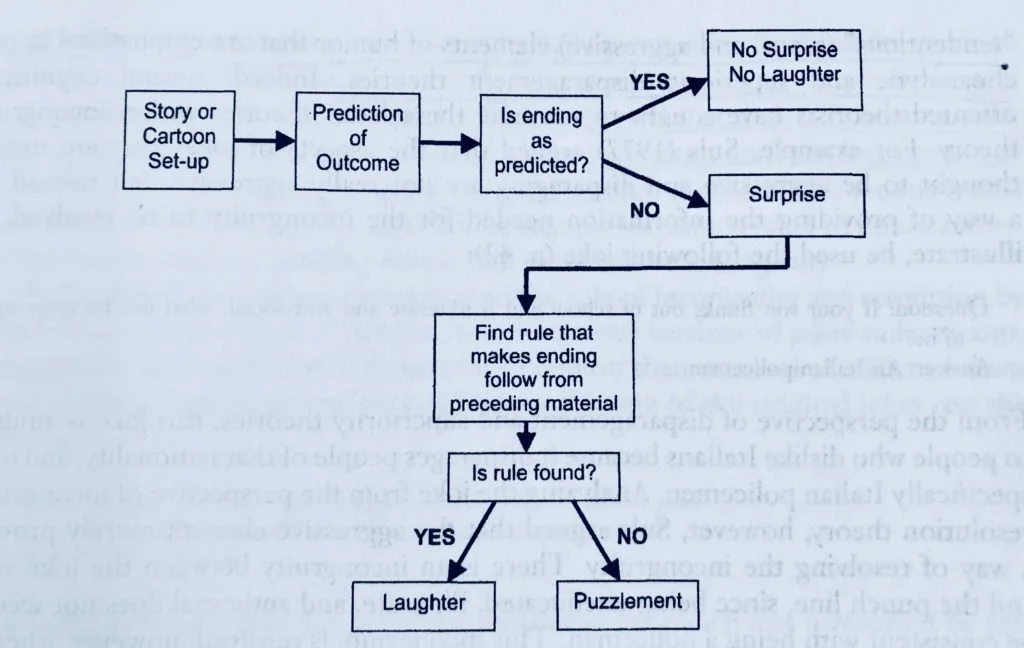
The Incongruity-Resolution Model by Jerry Suls (1972), adapted by Rod A. Martin in The Psychology of Humor: An Integrative Approach
When we understand a joke and find it funny enough to laugh, our brains' emotional and reward centers trigger the release of dopamine, serotonin, and endorphins.
Laughing is pleasurable, mood-boosting, and stress-relieving, which is probably why we look for ways to prolong the moment. Repeating the punchline that made us laugh allows us to extend and savor the positive feelings of laughter.
Reason #2: Repeating the joke is a communication signal to the joker.

"Business people sharing a laugh in office" by Direct Media is part of the public domain.
Joke repetition is also an example of communication. When we repeat the funny thing someone said that got us 😂, we are telling the joker a few things:
"I understand the joke."
In language, repeating a specific word or phrase is called the "echo effect." It helps you communicate that you're on the same page as the speaker.
"We share the same sense of humor."
When you repeat back the joke, you are participating in the humorous moment. You are telling the speaker that you two share the same values and cultural basis for not only understanding the joke, but finding it funny. You are communicating that you're part of the in-group.
"Keep making me laugh."
Echoing back a joke to the speaker is also a way we communicate that we want them to continue down their humorous path.
Reason #3: Echoing the joke creates feelings of safety, comfort, and social connectedness.

"A group of people riding on the back of a motorcycle. Laughing belly laugh smiling, emotions." by Pixabay is part of the public domain.
Humans were laughing long before we could speak. In fact, we're not alone in our ha-ha's — at least 65 animal species use laughter as a social tool, usually to communicate that they want to play.
Within humans, laughter can signal social connection, safety, and comfort with a others. As social species, we rely on each other for survival and laughing can serve as tool for bonding. That's likely why we are 30x more likely to laugh in social settings than in solitary ones. Laughing is a highly social phenomenon.
Repeating back a joke is an example of mimicry, which psychologists consider to be a powerful "social glue" that bonds us with other people. By mirroring back a funny moment, we can signal to the group that we are actively participating in the shared feelings of safety that laughter provides.
Curious about how the world works?
Today You Should Know is a free, weekly email newsletter designed to help you learn something new every Friday.
Subscribe today 👇
Check out some other curious questions:



Sources
Coolidge, A. A., Montagnolo, C., & Attardo, S. (2023). Comedic convergence: Humor responses to verbal irony in text messages. Language Sciences, 99, 101566. https://doi.org/10.1016/j.langsci.2023.101566
Edwards, S. (2010, June 28). Humor, Laughter, and Those Aha Moments. On The Brain. https://hms.harvard.edu/news/humor-laughter-those-aha-moments
Handel, S. (2026, April 21). The Echo Effect: How Repeating People’s Words Improves Social Interaction. The Emotion Machine. https://www.theemotionmachine.com/the-echo-effect-how-repeating-peoples-words-improves-social-interaction/
Hay, J. (2001). The pragmatics of humor support. Humor, 14(1), 55–82. https://doi.org/10.1515/humr.14.1.55
Johnson, D. (2021, May 17). From apes to birds, there are 65 animal species that “laugh.” Ars Technica. https://arstechnica.com/science/2021/05/from-apes-to-birds-there-are-65-animal-species-that-laugh/
Mauersberger, H., Kastendieck, T., Hetmann, A., Schöll, A., & Hess, U. (2022). The different shades of laughter: When do we laugh and when do we mimic other’s laughter? Philosophical Transactions of the Royal Society B, 377(1863). https://doi.org/10.1098/rstb.2021.0188
Prichard, C., Rousse-Malpat, A., & Girard, H. (2025). Humor convergence based on humor type: A quantitative study of L2 humor responses. HUMOR. https://doi.org/10.1515/humor-2024-0087
Priego-Valverde, B. (2018). Sharing a laugh at others: Humorous convergence in French conversation. The European Journal of Humour Research, 6(3), 68–93. https://doi.org/10.7592/ejhr2018.6.3.priego
Scott, S. K., Cai, C. Q., & Billing, A. (2022). Robert Provine: The critical human importance of laughter, connections and contagion. Philosophical Transactions of the Royal Society B, 377(1863). https://doi.org/10.1098/rstb.2021.0178
Scott, S., & Lenherr, C. (2025, May 18). The Brain Behind Laughter. Neuroverse. https://www.neuroversepod.com/post/the-brain-behind-laughter
Su, Y., & Hou, Y. (2024). Psychological mechanism and cognitive basis of humorous speech. Environment and Social Psychology, 9(7), 6212. https://doi.org/10.59429/esp.v9i7.6212

We Americans sure do like American things.