
Why does a shuttlecock turn when you hit it?
The short answer
A shuttlecock turns when you hit it because most of the mass sits near the compact cork, while the wide skirt catches most of the aerodynamic resistance. That offset creates a torque that flips it cork-forward within about 20 milliseconds of impact.
The long answer
The sport of badminton is unique in a lot of ways. It is the fastest racket sport, with the shuttlecock reaching over 200 mph (~322 km/h) upon impact (yes, that's faster than tennis). It also consistently ranks in the top five most popular participatory sports in the world — in 2004, it was second to soccer/football.

But the thing that distinguishes badminton the most is its feather-adorned, conical-shaped shuttlecock, which quickly flips each time you hit it. Let's get into the physics that explains this high-speed, flip-flop behavior.
What is a shuttlecock?
A shuttlecock is the feathered projectile that badminton players hit over the net, aiming to land it in their opponent's court boundaries. Weighing roughly five grams, the shuttlecock is made out of 16 goose feathers (or plastic ones) planted into a cork.
Its name comes from "shuttle," referring to its back-and-forth movement across the net, and "cock," referring to its resemblance to a rooster.
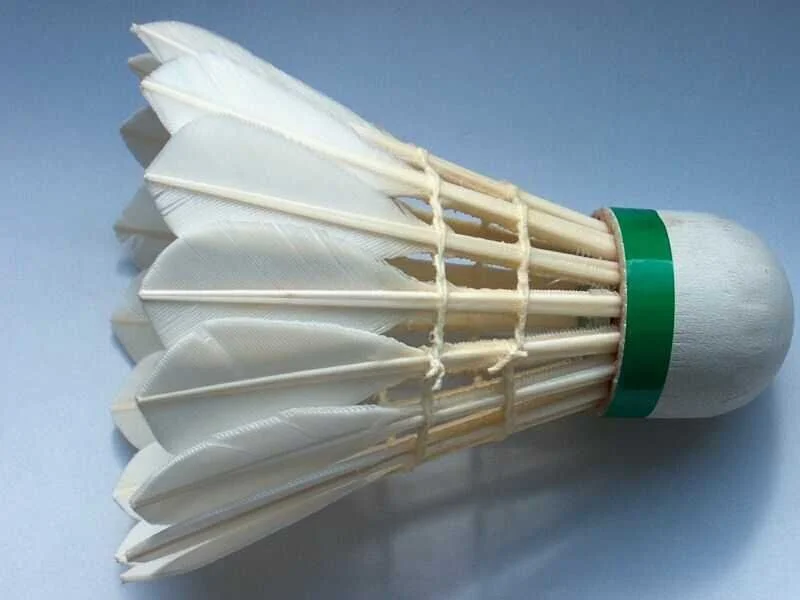
"Volant badminton" is licensed under CC BY-SA 2.5.
While it can reach incredible speeds immediately after impact with the racket, a shuttlecock's skirt creates a large amount of drag, or aerodynamic resistance, causing it to rapidly slow its speed.
Why does a shuttlecock turn when you hit it?
When a badminton racket hits a shuttlecock, it may initially start flying backwards, tilted, or sideways. But in ~20ms (0.02 seconds), the shuttlecock turns with the cork facing forward.
The shuttlecock's conical shape is what causes it to flip rapidly upon impact. But what about this shape contributes to the flip?

High-speed photography of a shuttlecock after an impact with a racket. The line represents 50cm. The shuttlecock flips in about 20ms.
Source: New Journal of Physics (modified)
A shuttlecock has two distinct parts: the cork and the skirt. The cork is small and heavy, which means that most of the shuttlecock's weight is near the cork. The skirt is much larger in surface area, so most of the drag occurs on the skirt as the shuttlecock moves.
Two key points shape how a shuttlecock moves: the center of mass and the center of pressure.
The center of mass, the average position of all mass of an object, is located very near its cork since that's where most of the shuttlecock's weight is concentrated. However, the center of pressure, the point where the net aerodynamic force effectively acts on the object, is located closer to the skirt because that is where it catches and deflects the air.
A key thing to note here is that the center of mass and center of pressure are not located in the same location, with the center of mass being about 3.4 cm in front of the center of pressure. This difference is what makes the shuttlecock rotate in flight.
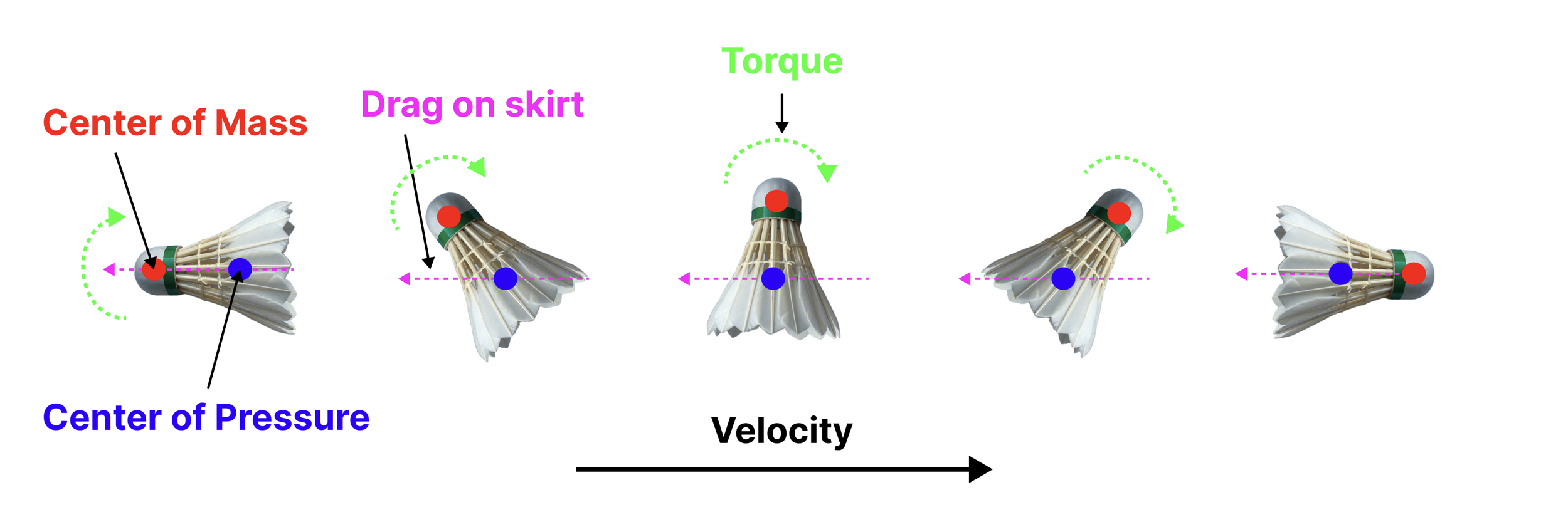
When the shuttlecock is facing skirt-forward, air pushes hard on the skirt. Because the center of pressure (on the skirt) and the center of mass (near the cork) are offset, this creates a twisting force, or torque, that rotates the shuttlecock until the cork is pointing forward.
This flip happens incredibly fast. After a 1 ms contact with the racket, the shuttlecock flips in about 20 ms. Then there's about an 80 ms period where the shuttlecock oscillates before setting into stable flight. Blink and you'll miss it!
🧠 Bonus brain points
Who invented the sport of badminton?
Badminton is a sport with ancient origins. Hitting shuttlecocks and keeping them in air has been a pastime for people all around the world for at least 2,000 years.
There is evidence of various forms of badminton being playing in China, Japan, Greece, North American indigenous tribes, India, Siam, and more. It's gone by different names, like "battledore and shuttlecock" in Europe or "hanetsuki" in Japan. And it's been played with different materials, like bundles of corn husk with feathers in the Zuni game "Po-ke-an."
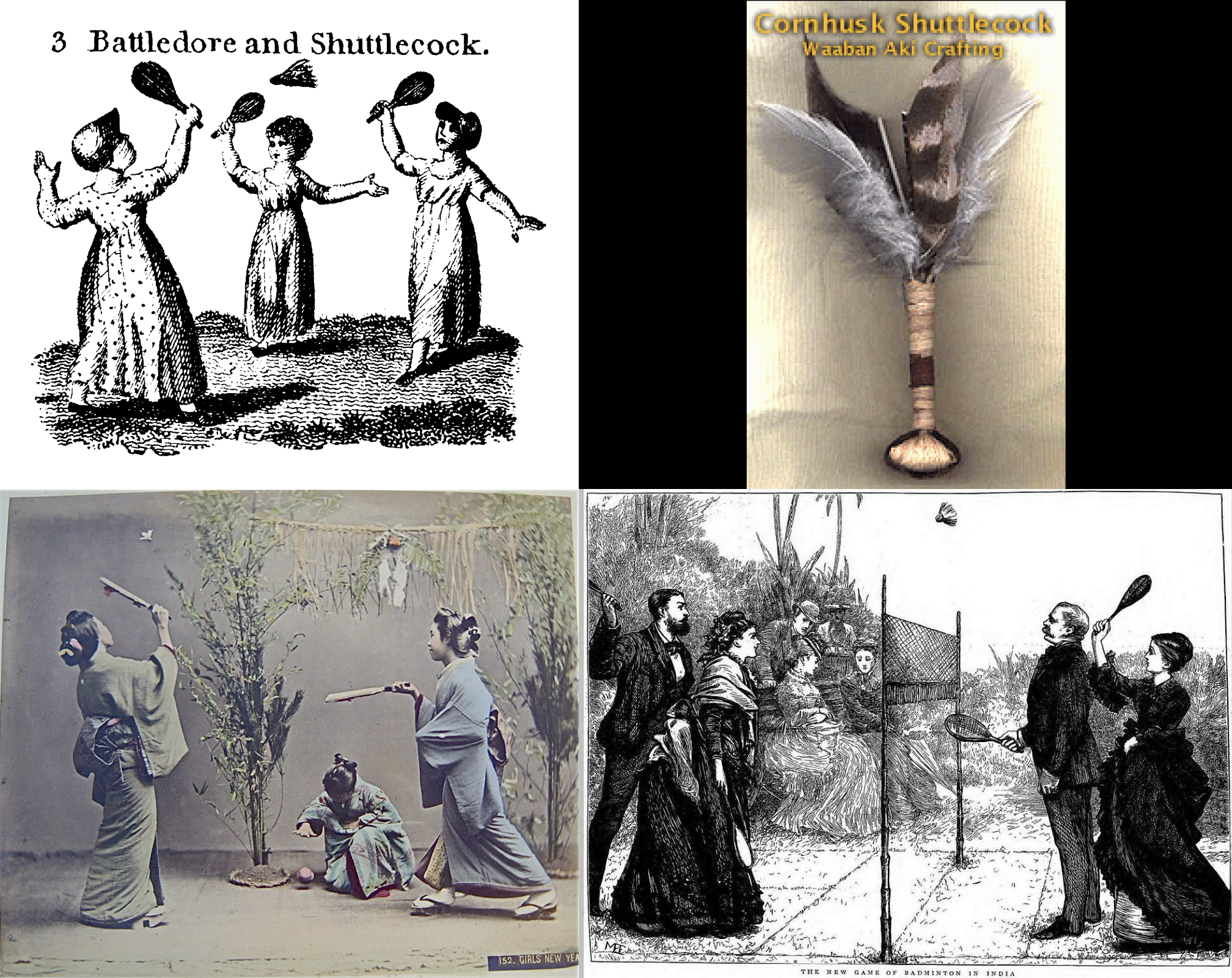
Various forms of modern badminton have been played all around the world for thousands of years.
Top left: "Battledore - Youthful Sports" by Darton and Harvey is part of the public domain (1804). Top right: "Cornhusk Shuttlecock" Source: NativeTech. Bottom left: "Kusakabe Kimbei 152 Girls" by Kusakabe Kimbei is part of the public domain. Bottom right: "Badminton India" by Mary Ellen Edwards is part of the public domain (1874).
The contemporary badminton most people play today was formalized in the 1860s by British army officers during the British occupation of India. Originally called "Poona" in reference to its place of origin in present-day Pune, the players introduced a net to divide a court.
The game later made its way to Badminton House, the country estate of the Duke of Beaufort in Gloucestershire, England, where it was further popularized and eventually took on the name we use today.
Curious about how the world works?
Today You Should Know is a free, weekly email newsletter designed to help you learn something new every Friday.
Subscribe today 👇
Check out some other curious questions:

Sources
Biswas, S. (2022, January 3). Poona: Where Badminton was Invented. PeepulTree Live History India. https://www.livehistoryindia.com/story/places/poona-where-badminton-was-invented
Brunei-Japan Friendship Association-UBD Chapter. (2013, July 16). Traditional Japanese Game: Hanetsuki. Brunei-Japan Friendship Association-UBD Chapter. https://bjfaubd.wordpress.com/2013/07/16/traditional-japanese-game-hanetsuki/
Clement, B. (2004, July 23). Badminton second to soccer in participation worldwide. ESPN. https://www.espn.com/olympics/summer04/badminton/news/story?id=1845228
Cohen, C., Texier, B. D., Quéré, D., & Clanet, C. (2015). The physics of badminton. New Journal of Physics, 17(6), 063001. https://doi.org/10.1088/1367-2630/17/6/063001
Driscoll, E. (2014, December 26). Birdie In Flight: The Science of Badminton. YouTube. https://www.youtube.com/watch?v=Y4B1SoFKnBo
Kaushik, V. (2017). Unique Flight Features of Shuttlecock. International Research Journal of Engineering and Technology, 4(12), 521–525. https://doi.org/https://www.worldbadminton.com/reference/research/documents/Unique_Flight_Features_of_Shuttlecock.pdf
Kloss, K. (2024, February 26). Move Over, Pickleball. It’s Badminton’s Turn To Be the Trendy Racket Game. theSkimm. https://www.theskimm.com/fitness/what-is-badminton
Prindle, T. (n.d.). Cornhusk Shuttlecock Game. NativeTech. http://www.nativetech.org/games/shuttlecock.html
Wikimedia Foundation, Inc. (2025, October 27). 1911 Encyclopædia Britannica/Battledore and Shuttlecock. Wikisource. https://en.wikisource.org/wiki/1911_Encyclop%C3%A6dia_Britannica/Battledore_and_Shuttlecock



We Americans sure do like American things.