Are humans affected by the Moon?
The short answer
While science hasn't found convincing evidence linking the lunar cycle to mental health or menstruation, there is evidence that moonlight disrupts sleep around a full moon, possibly through an innate circalunar rhythm.
The long answer
The Moon: Earth's little sidekick, the conductor of tides, and ... the secret chaos agent affecting humans?
Humans and the Moon have had a suspicious relationship for thousands of years. If you’ve ever said, “It must be a full moon,” to explain erratic behavior, you're not alone: the word "lunatic" derives from the Latin term for moon.
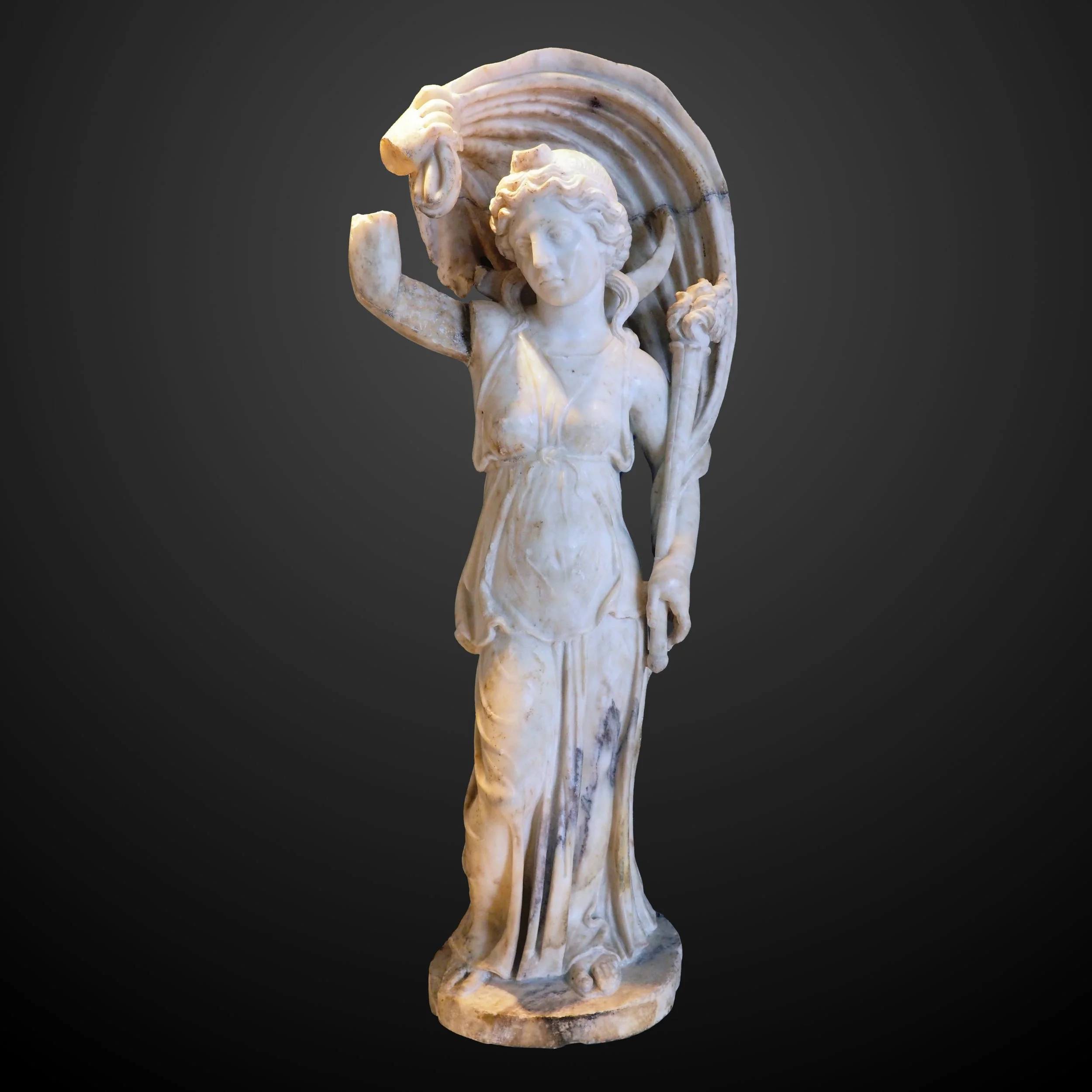
Statue of Luna, the Greek goddess of the moon.
"Luna-MAHG MF 1317-P8050445-gradient" by Rama licensed under CC BY-SA 3.0 FR.
In fact, Greek philosopher Aristotle believed that the Moon's tidal pulls must be influencing human brains, which he considered the "moistest" organ. This belief carried throughout history with tales of humans turning into werewolves and vampires when exposed to moonlight.
Even today, a lot of people attribute outlandish behavior and medical incidents to the Moon. I, for one, have always been curious about why the 29.5-day lunar month seems to line up so closely with the average human menstrual cycle length.
But before we get into what science has been able to confirm or deny with the Moon's influence on humans, let's first do a crash course on how the Moon affects Earth.
How does the Moon affect Earth?
The two biggest lunar effects are the Moon's gravitational pull and moonlight.
Gravity
The Moon, a rock roughly 1/4 the diameter of Earth, is our planet's only natural satellite. As the Moon orbits Earth, it exerts a gravitational pull which shifts the Earth's mass, distorting everything into a ever-so-slight elliptical shape (most noticeably with tides).
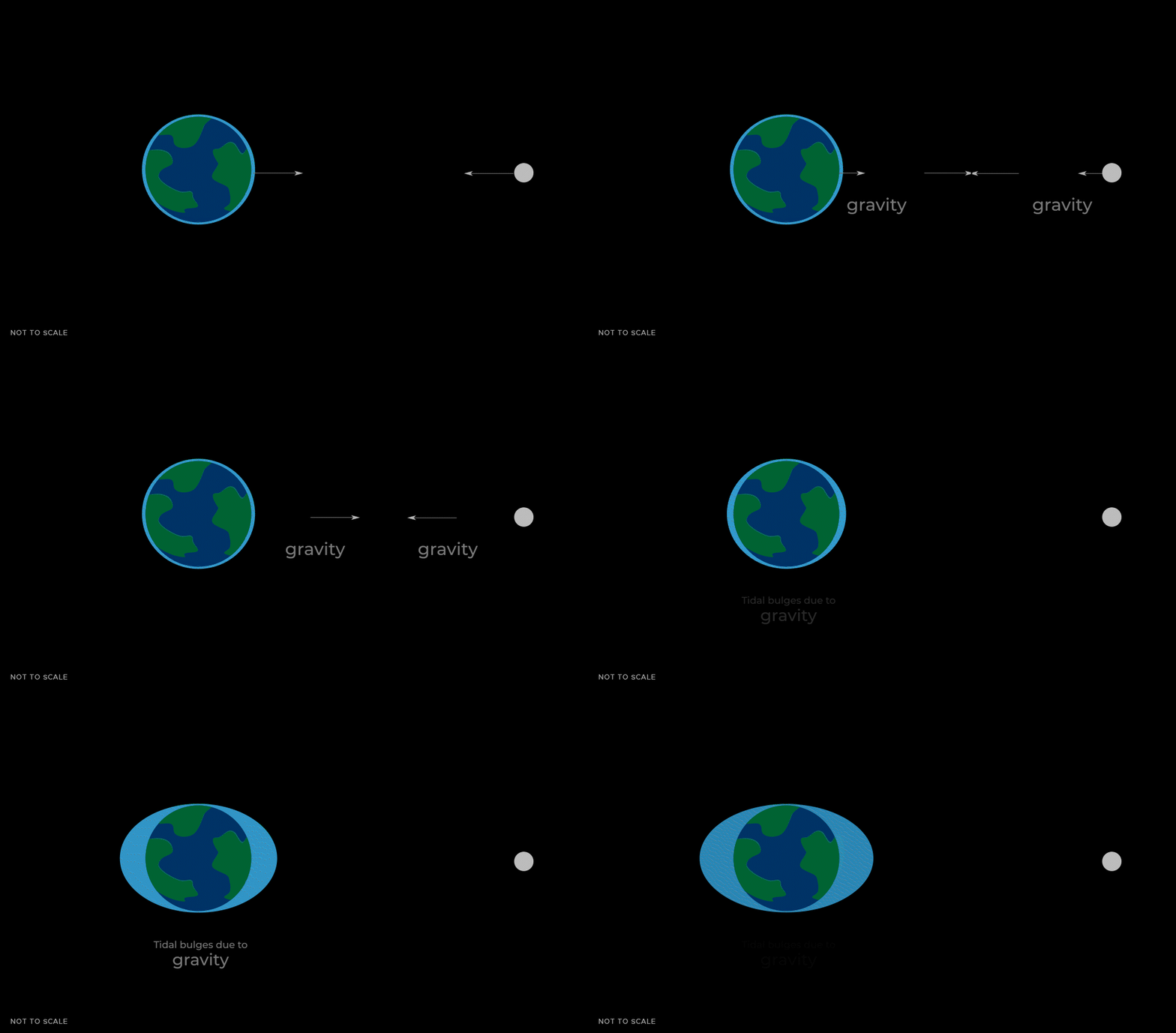
The Moon's gravity pulls on the oceans, causing high and low tides.
Source: NASA/Vi Nguyen
A gravitational pull that's able to warp the shape of something as massive as our planet's oceans sounds impressively strong. And it is ... until you compare it to the gravity of Earth.
A Newton (N) is a unit of force, specifically how much force is required to accelerate a one kilogram mass one meter per second per second. One N is roughly equivalent to the weight of a 100-gram object (0.22 lbs) here on Earth, so a very light amount of force.
On Earth, gravitational acceleration is ~9.8 m/s² (or ~9.8 N per kilogram of mass), so a person with a mass of 97 kg (~214 lbs) experiences about 950 N of gravitational force. That same person will experience just 0.04 N from the Moon's gravitational pull. In other words, the Earth's gravity is about 200,000x stronger than that of the Moon.
We’ll get into the impact on humans in the next section. But for now, the important point is this: even though humans are up to 60% water, the Moon’s pull on us is negligible. And unlike oceans, we aren’t open bodies of water with room to slosh around.
Moonlight
The Moon also provides us with a source of nocturnal light (and inspiration for great tunes). As the Moon orbits around the Earth, it reflects sunlight. Depending on where the Moon is in its orbit, this reflection can illuminate the Earth during our nighttime.
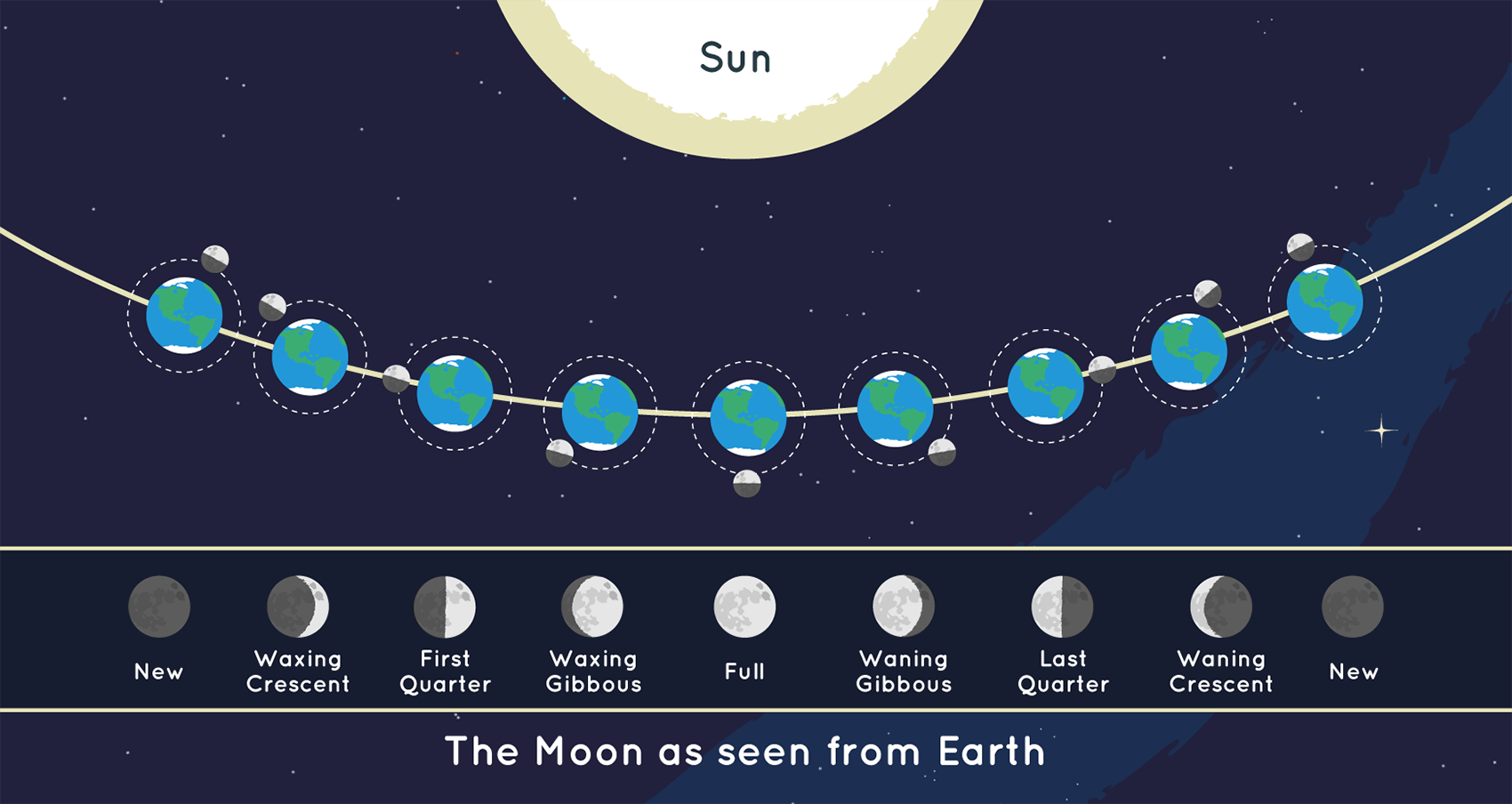
Side note: The reason why a full moon can happen even when the moon appears to be blocked by the Earth is because the Moon's orbit is slightly tilted. Check out this diagram if you were confused like me.
Source: NASA/JPL-Caltech
The brightest moonlight happens during a full moon, and the darkest during a new moon. A waxing crescent happens when the Moon is going from new-to-full, and vice versa for a waning crescent.
One common misconception about the Moon is that its light phases line up with the gravitational effect of its orbit, i.e. that a full moon must mean the Moon's gravitational pull is at its strongest.
But the Moon's orbit is elliptical and rotating, so the closest point in the Moon’s orbit does not stay fixed. Over time, the Moon’s oval-shaped path slowly shifts around Earth.
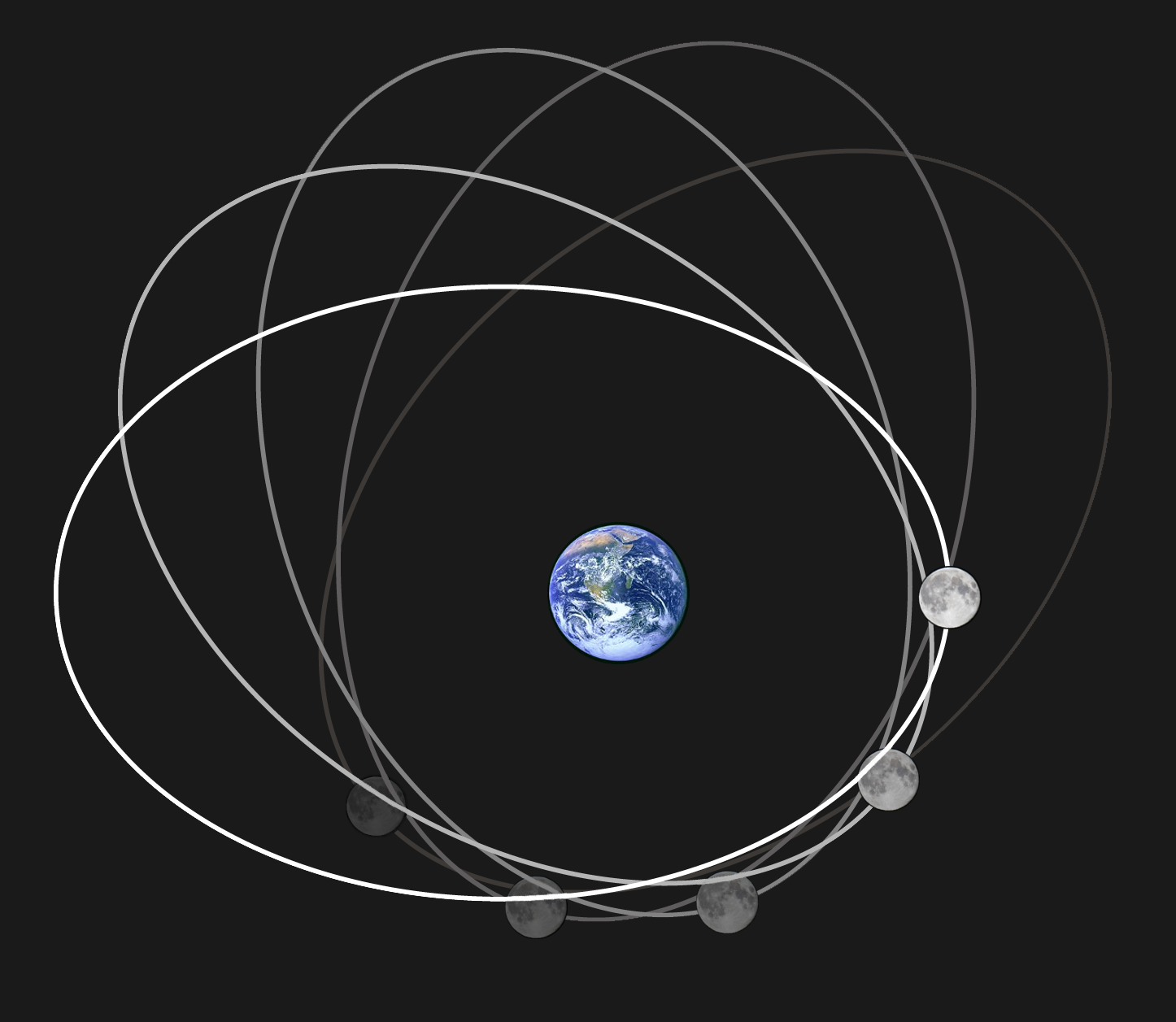
The Moon’s orbit around the Earth is elliptical, so its distance constantly changes, while its phases (full, new, etc.) follow a separate cycle. Bottom line: A full moon doesn’t necessarily occur when the Moon is closest to Earth.
"Moon apsidal precession" by Rfassbind is part of the public domain.
So the Moon can be closest to Earth during a full moon, a new moon, or any phase in between. A full moon only tells us how much of the Moon’s sunlit side we can see. It does not tell us how close the Moon is to Earth.
How are humans affected by the Moon?
The Moon clearly has an effect on Earth with its consequential gravitational pull and phases of moonlight. But does that affect humans? Recall two key points I mentioned above:
The Moon's gravitational pull is negligible when compared to the effect of Earth's gravity on us.
The Moon's light phases do not match its gravitational pull (i.e. how close it is to Earth).
So if the Moon is impacting humans, it seems unlikely that its gravitational pull has anything to do with it. But it seems there might be a relationship between moonlight and human behavior.
There have been dozens of studies and meta-analyses on how the moon may be affecting humans. Let's dig into what science has to say about the Moon affecting (and not affecting) humans:
😴 Sleep
A full moon is really bright. Under a clear sky, full-moon nights are 12 times brighter than first or last quarter-moon nights. (Story time: I once wore sunglasses to sleep on a backpacking trip because of the moonlight. 😎)
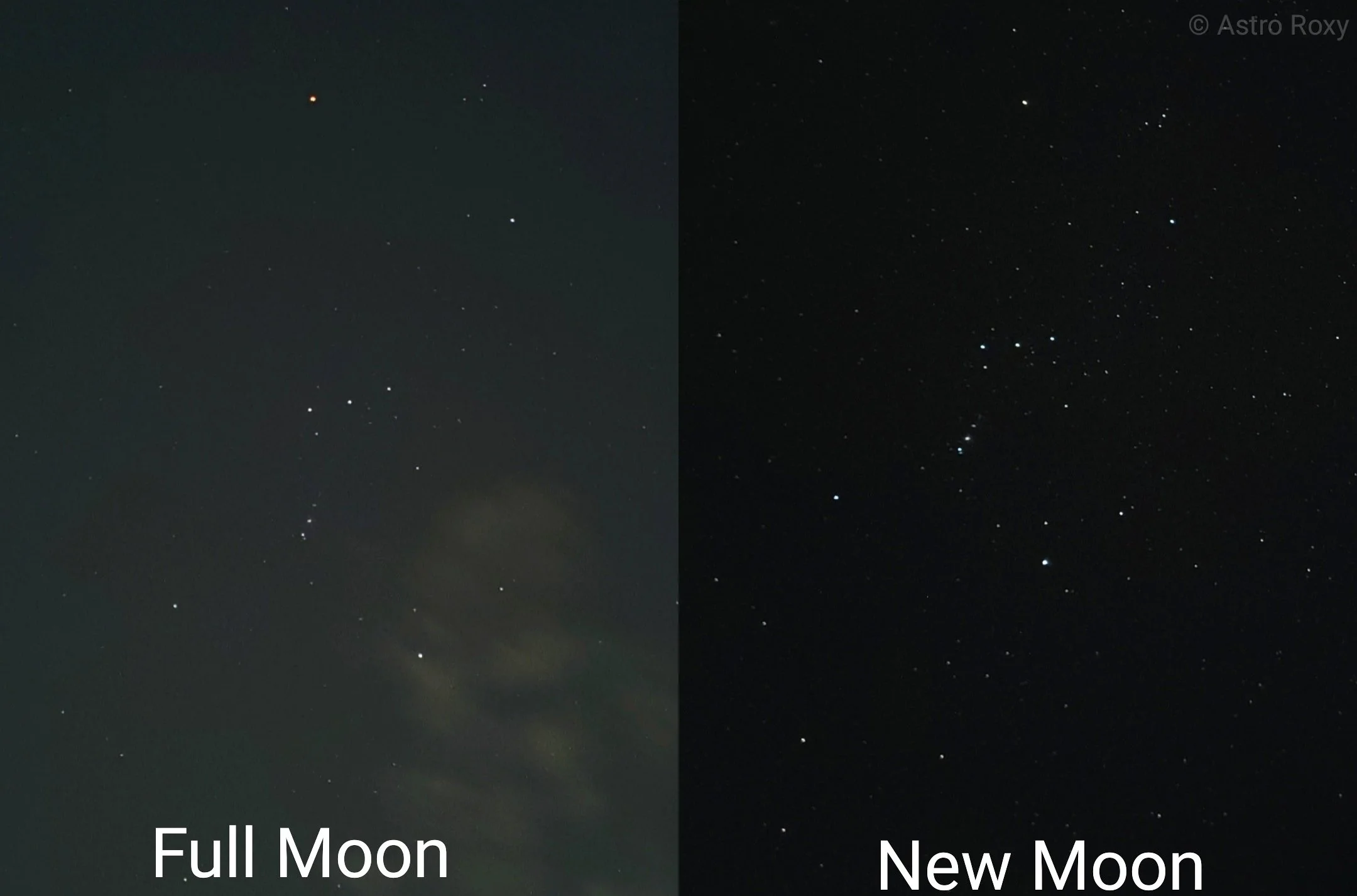
Photographs of the Orion constellation taken during a full moon and new moon. Source: Reddit
The full moon can make it difficult to fall asleep and stay asleep because it's harder to sleep around bright lights. Interestingly, there has been evidence that humans may have an innate circalunar rhythm, in addition to our circadian rhythm.
A 2013 study tracked 33 volunteers in a sleep lab with no moonlight exposure and found that on full-moon nights they took about 5 minutes longer to fall asleep, slept 20 fewer minutes overall, and had 30% less REM sleep. Even without the brightness of the full moon, people sleep less and lower quality during this phase.
This finding of a possible circalunar rhythm was further substantiated with a 2021 study comparing the sleep patterns of three rural indigenous communities in Argentina against those of college students in Seattle. Both groups, regardless of geography or access to electricity, slept less and went to bed later in the days leading up to a full moon.
Many scientists think that humans have an innate adaptation from our ancestors who likely used moonlight to extend their activity time and sleep less. So if you find yourself having trouble sleeping on full-moon nights despite eyemasks, the Moon might be to blame.
🧠 Psychological disorders
“It is the very error of the moon. She comes more near the earth than she was wont. And makes men mad.”
People still attribute a lot of odd behavior to the Moon. In fact, a small 1995 study found that 43% of people believed the Moon made humans more prone to unusual behaviors, with mental health professionals being more likely to hold this belief.
The evidence is mixed on whether the Moon impacts our mental health. A very small 2017 study on 17 people with bipolar disorder found that, in some participants, cycles between depression and mania appeared to sync with the lunar cycle. It's theorized that the worse sleep experienced by bipolar individuals during a full moon may function as a positive feedback loop once a manic episode has begun.
However, in general the Moon has not been found to play a role in mental well-being: A large 2019 study analyzing data from 10 years of psychiatric wards' patient records found no evidence that the Moon impacted behavior. And a 1985 meta-analysis of 37 "lunar-lunacy" studies concluded there was no correlation between the Moon and incidents such as crime, suicides and mental hospital admissions.
🩸 Menstruation
Fun fact: The words "menses" and "moon" both originate from the Latin word mensis meaning "month." The connection between menstruation and the lunar cycle is ancient and understandable: The lunar month lasts about 29.5 days, and the average menstrual cycle is about 29 days.
Despite how related they may seem, science has not found that our cycles line up with the Moon's. A massive 2016 analysis from the period-tracking app Clue looked at 7.5 million menstrual cycles from 1.5 million people and found no correlation with the lunar cycle.
There's no clear answer for why these two cycles are so similar in length — it may simply be coincidence. And this phenomenon is unique to humans: Our closest primate relatives, chimpanzees, have menstrual cycles that average around 37 days.
Curious about how the world works?
Today You Should Know is a free, weekly email newsletter designed to help you learn something new every Friday.
Subscribe today 👇
Check out some other curious questions:
Sources
Arkowitz, H., & Lilienfeld, S. (2009, February 1). Lunacy and the Full Moon. Scientific American. https://www.scientificamerican.com/article/lunacy-and-the-full-moon/
Cleveland Clinic. (2022, October 20). Does the Moon Affect Humans?. Cleveland Clinic. https://health.clevelandclinic.org/moon-effects-on-humans
Grande, T. (2018, October 19). Does the Full Moon Affect Human Behavior?. YouTube. https://www.youtube.com/watch?v=jZt5DmE7gEk
Green, H. (2020, January 12). What Actually Happens on the Full Moon? | 8 Full-Moon Myths & Facts. YouTube. https://www.youtube.com/watch?v=9cGNu8yKBkE
NASA. (2026, February 12). Moon Phases. NASA. https://science.nasa.gov/moon/moon-phases/
Royal Museums Greenwich. (n.d.). Can the Moon affect our health?. Royal Museums Greenwich. https://www.rmg.co.uk/stories/space-astronomy/can-moon-affect-our-health-behaviour
Vogel, T. (2026, February 12). Tides. NASA. https://science.nasa.gov/moon/tides/
Zimecki, M. (2006). The lunar cycle: Effects on human and animal behavior and physiology. Postepy Hig Med Dosw. https://pubmed.ncbi.nlm.nih.gov/16407788/
Zimmer, K. (2024, July 6). Can the moon influence human health? Surprising new research suggests it might. National Geographic. https://www.nationalgeographic.com/science/article/moon-bodies-health-sleep-menstruation



We Americans sure do like American things.