
The short answer
"Black Friday" has meant bad news for centuries, from school exams to financial crashes. In the early 1960s, Philadelphia police used it for the post-Thanksgiving shopping chaos, and retailers later spun it into a "red to black" profit story.
The long answer
As a professional emailer, I've written hundreds (and sent millions) of Black Friday emails. Your inbox is likely flooded with emails right now. Please excuse the noise. My fellow email marketers and I are simply doing our jobs. 🫡
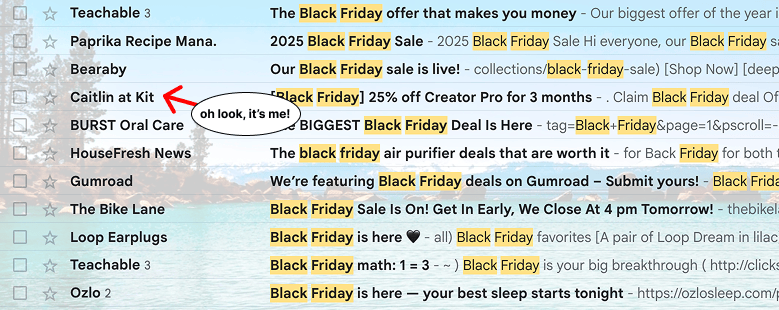
A small collection of Black Friday emails I've received (and sent).
But this is a special Black Friday email. We're about to go into the history of this over-the-top day of consumerism.
You've probably heard that "Black Friday" got its name from retail stores operating at a loss the whole year (in the red) and then supposedly turning a profit (into the black) when holiday shopping kicked off after Thanksgiving.
Frankly, that's bonkers from a business perspective. And, as we'll uncover, it's retail propaganda. So let's dive into the true origin of Black Friday.
When was the first recorded use of the term "Black Friday"?
If "Black" Friday sounds rather bleak, you're right. As far as I could tell, the term "Black Friday" has almost exclusively been used throughout history to describe not-so-great events.
The earliest evidence of "Black Friday" is from 1610. Researchers at the Oxford English Dictionary found that some schools used the term to describe a Friday with an exam. A dreary day, indeed.
Other Black Fridays have included December 6, 1745, when London panicked over news that Charles Edward Stuart, pretender to the throne, and his rebel army were marching on the city. The term "Black Friday" has also been used to describe financial panics, such as May 11, 1866 when the London banking house Overend, Gurney, & Co. failed.
In U.S. history, "Black Friday" was first used to describe the gold market crash of September 24, 1869.
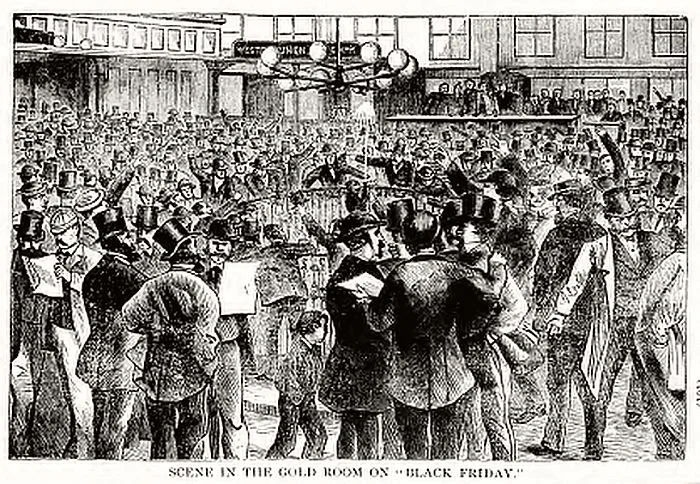
"Gold room scene on Black Friday" by Henry Davenport Northrop is part of the public domain.
Two of the most ruthless Wall Street forces, Jay Gould and Jim Fisk, sought to buy up as much gold as they could, drive up the price, and then sell for huge profits. When President Grant learned of the conspiracy, he ordered $4 million-worth of federal gold to be sold, resulting in a huge crash. This sent the stock market tumbling and caused financial pain for months.
But that first American Black Friday occurred in September, so it begs the question...
When was "Black Friday" first used to describe the day after Thanksgiving?
The earliest known use of "Black Friday" for the day after Thanksgiving comes from a trade magazine lamenting about absenteeism. In the November 1951 edition of Factory Management and Maintenance, there is a column about how to deal with people calling in sick after the Thanksgiving holiday:
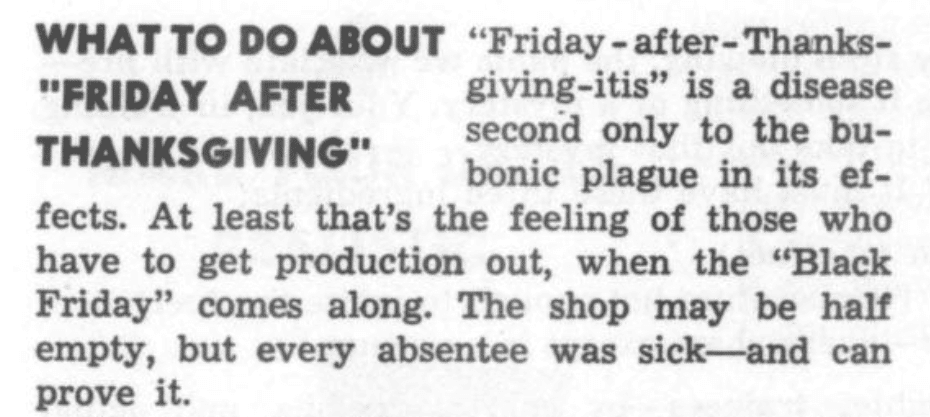
November 1951 issue of Factory Management and Maintenance, Volume 109, Number 11 (p.137)
In case you're curious, the "standard" approach to this problem was to simply withhold pay from employees absent the day before or after Thanksgiving. But since you can't deny pay to those "legitimately ill," the columnist suggests simply giving all employees the extra day off.
When was "Black Friday" first used to describe the shopping event?
By the early 1960s, Philadelphia police officers started to call the day after Thanksgiving "Black Friday" because of the logistical nightmare that ensued on the city's busiest shopping streets.
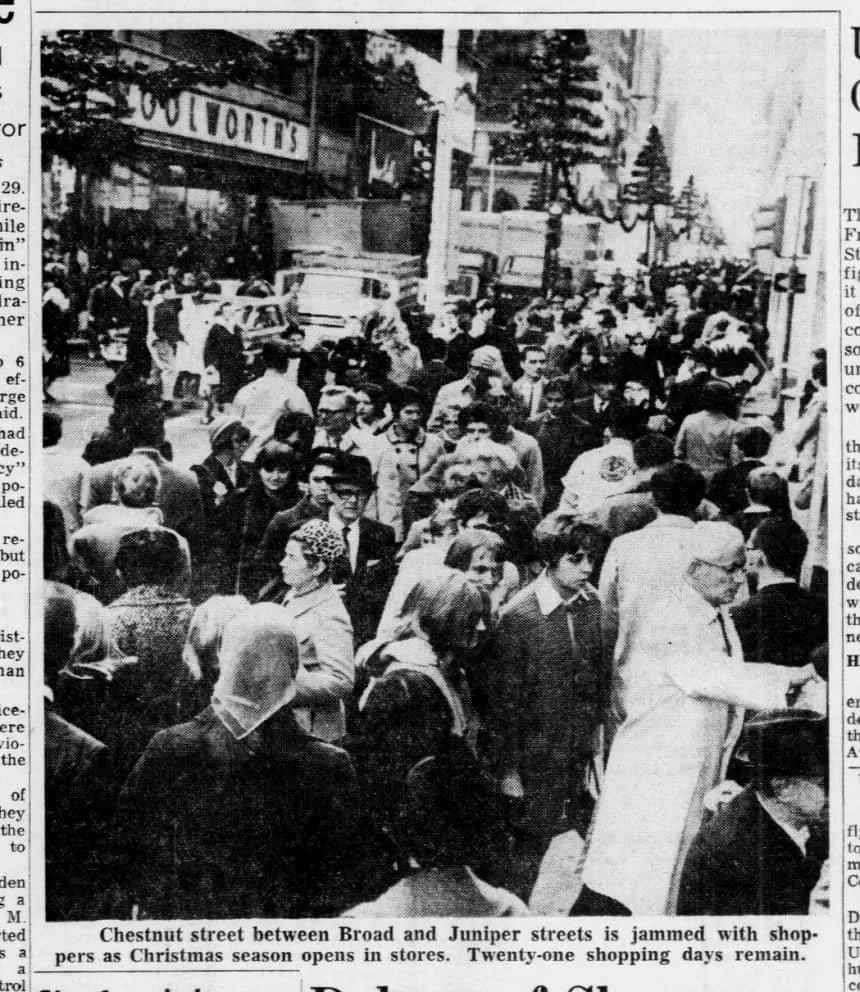
A photograph of the shopping mayhem from the November 30, 1968 edition of the Philadelphia Inquirer.
Not only did the day after Thanksgiving kick off Christmas present shopping, but it also fell a day before the annual Army-Navy football game. So police officers, bus drivers, and cab drivers had to deal with hordes of suburban shoppers and football tourists, often working extra long hours to handle the crowds and traffic.
Understandably this day became known as "Black Friday" at the police department because it was such a headache to deal with.
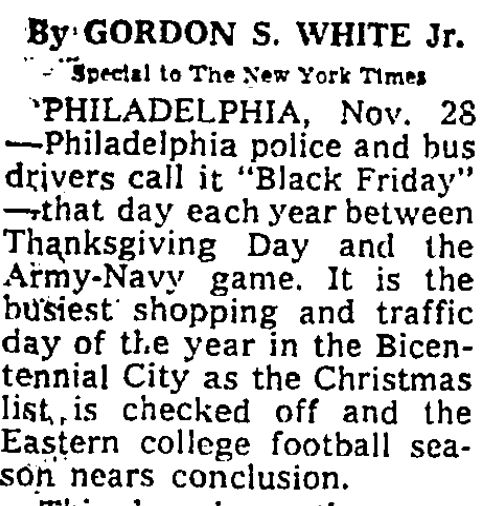
New York Times, November 29, 1975. Source: ProQuest
But, of course, it wasn't a bad day for the storeowners. They considered it one of their most profitable days of the year, and they weren't too happy about the police giving it such a negative label. Worried that hearing "Black Friday" would deter customers from coming downtown, the city's merchants sought help from one of the country's most experienced municipal PR executives, Abe S. Rosen.
Pulling out a classic tool from the PR toolbox, Rosen suggested putting a positive spin on it and start calling the day "Big Friday" instead. Of course that didn't take off. By the late '80s, the use of "Black Friday" was common nationwide.
So retailers again tried to reinvent Black Friday and obscure its true negative origins. A story was circulated that "Black Friday" was not named so because of the chaotic traffic conditions but because of the profits reaped by stores, allegedly, taking retailers from "red to black." Or so the propaganda goes...
Curious about how the world works?
Today You Should Know is a free, weekly email newsletter designed to help you learn something new every Friday.
Subscribe today 👇
Check out some other curious questions:



Sources
AGFinancial. (n.d.). Where Did the Name “Black Friday” Come From? AGFinancial. https://www.agfinancial.org/resources/article/where-did-the-name-black-friday-come-from
Oxford University Press. (n.d.). Black Friday, n., 4. In Oxford English dictionary. Retrieved November 23, 2026, from https://doi.org/10.1093/OED/7545140734
Pressler, M. (2026, November 17). Black Friday. Britannica. https://www.britannica.com/video/origin-history-Black-Friday-Thanksgiving-United-States/-293072
Pruitt, S. (2026, September 9). What’s the Real History of Black Friday? History.com. https://www.history.com/articles/black-friday-thanksgiving-origins-history
Taylor-Blake, B. (2009, August 5). "Black Friday" (day after Thanksgiving), 1951. The American Dialect Society. https://listserv.linguistlist.org/pipermail/ads-l/2009-August/092018.html
Taylor-Blake, B. (2011, May 5). Black Friday (day after Thanksgiving), 1961. The American Dialect Society. https://listserv.linguistlist.org/pipermail/ads-l/2011-May/109292.html
Zimmer, B. (2011, November 25). The Origins of “Black Friday.” Thinkmap Visual Thesaurus. https://www.visualthesaurus.com/cm/wordroutes/the-origins-of-black-friday/


We Americans sure do like American things.