
Why is orange hair called red?
The short answer
Orange hair is called red because the word orange didn’t enter English until the fruit did, which was after the term redhead was already established.
The long answer
About 2% of the world's population has red hair, which means that ~40 people subscribed to this newsletter are redheads. Hello, redheaded nerds! 🧑🦰
But "redheads" don't really have truly red hair. Their hair color more closely resembles orange, right?

"Woman red hair looking at sky (Unsplash)" (modified) by Tyler McRobert is part of the public domain.
The reason we describe orange hair as "red hair" has to do with the history of language.
Where did the word red come from?
The English word red comes from the Proto-Indo-European root *reudh-, meaning "red" or "ruddy."
Proto-Indo-European is an ancient, unrecorded language that linguists believe all Indo-European languages derive from. This theoretical parent language is reconstructed by comparing Indo-European languages, like Hindi, English, French, Irish, and Armenian, to name a few.
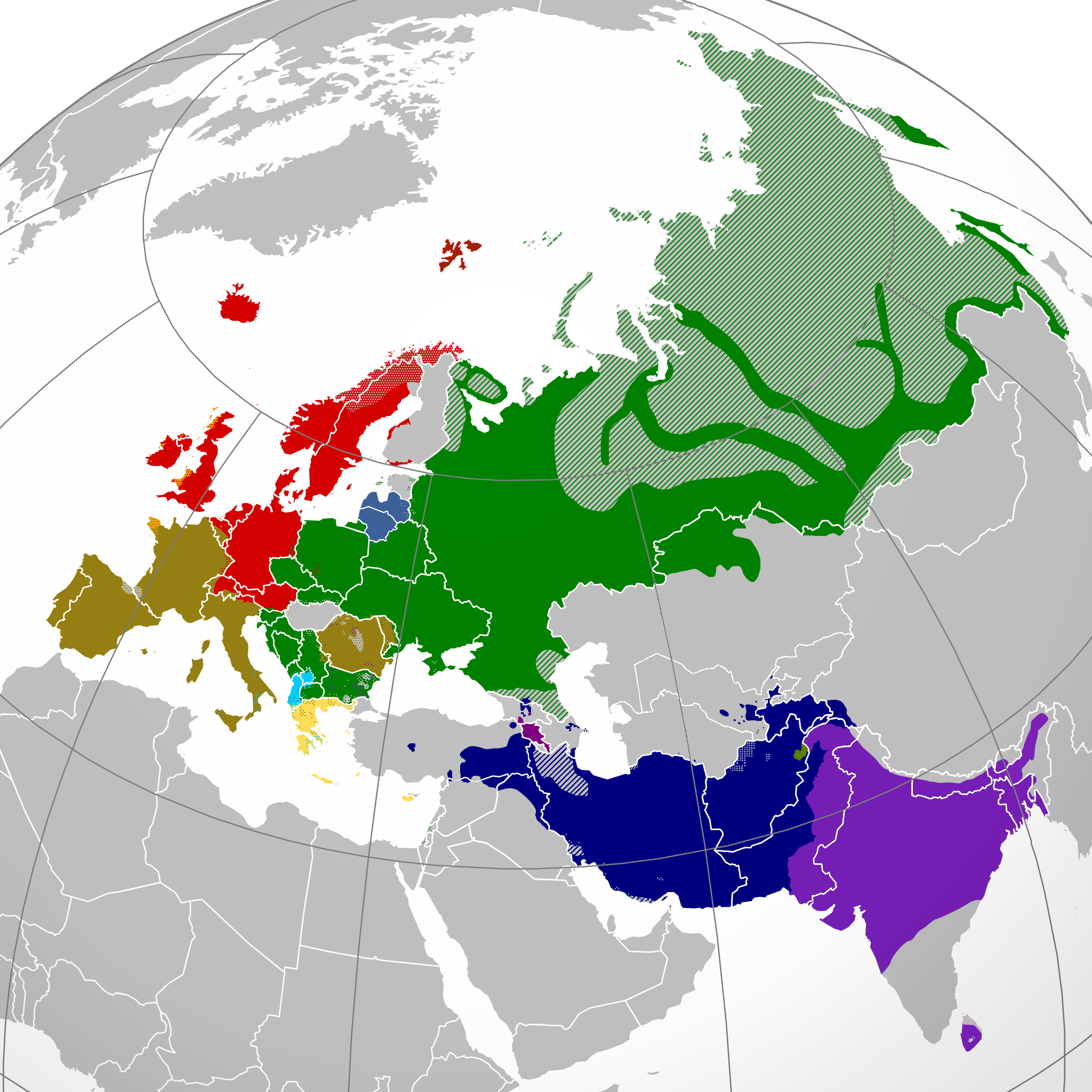
The approximate present-day distribution of the native speakers of the eight branches of the Indo-European language family within Europe and Asia.
"Indo-European Language Family Branches in Eurasia" by Bill Williams is licensed under CC BY-SA 4.0.
Red is one of the earliest color terms with a clearly reconstructable Proto-Indo-European root. This fits a broader pattern in language development. After black and white, red is typically the next color a language names, possibly because of its association with blood.
Where did the word orange come from?
I'll cut right to the chase: the fruit came first.
The fruit originates from a region encompassing Southern China, Northeast India, and Myanmar, where the orange tree was called nāraṅga in Sanskrit. This later became nāranj in Arabic, and auranja in Old French. The word orange appears in English in the late 1200s or early 1300s, after the fruit reached England through trade.
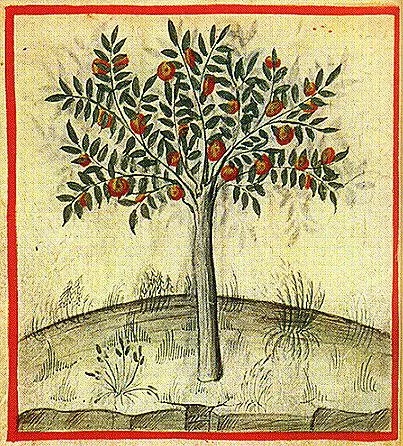
14th century illustration of an orange tree found in a medieval medicinal handbook.
"Tacuin Orange08" from the Tacuinum of Rouen is part of the public domain.
But it's not until the 1540s that orange appears as an adjective used to define "a reddish-yellow color like that of a ripe orange." Before this point, the fall color was likely described as "yellowish-red" and "reddish-yellow," or with words like citrine and saffron.
Where did the word redhead come from?
Decades before English speakers were talking about oranges, let alone orange as a color, redheads got their name...literally.
Starting in the mid-13th century, "Redhead" appears in medieval England as a last name (or surname, for my friends across the pond). During this time, English last names often derived from physical characteristics, occupations, or location-based features. For example, "Armstrong" described someone with strong arms, "Taylor" described someone who worked as a tailor, and "Ford" described someone who lived near a river crossing.
"Redhead" likely originated as a last name used to describe someone with red hair. Because orange as a color hadn't yet appeared in English, red was the closest available description. By 1510 (again, before orange is used as a color), the word appears in print as redd hede, explicitly referring to a person with red hair.
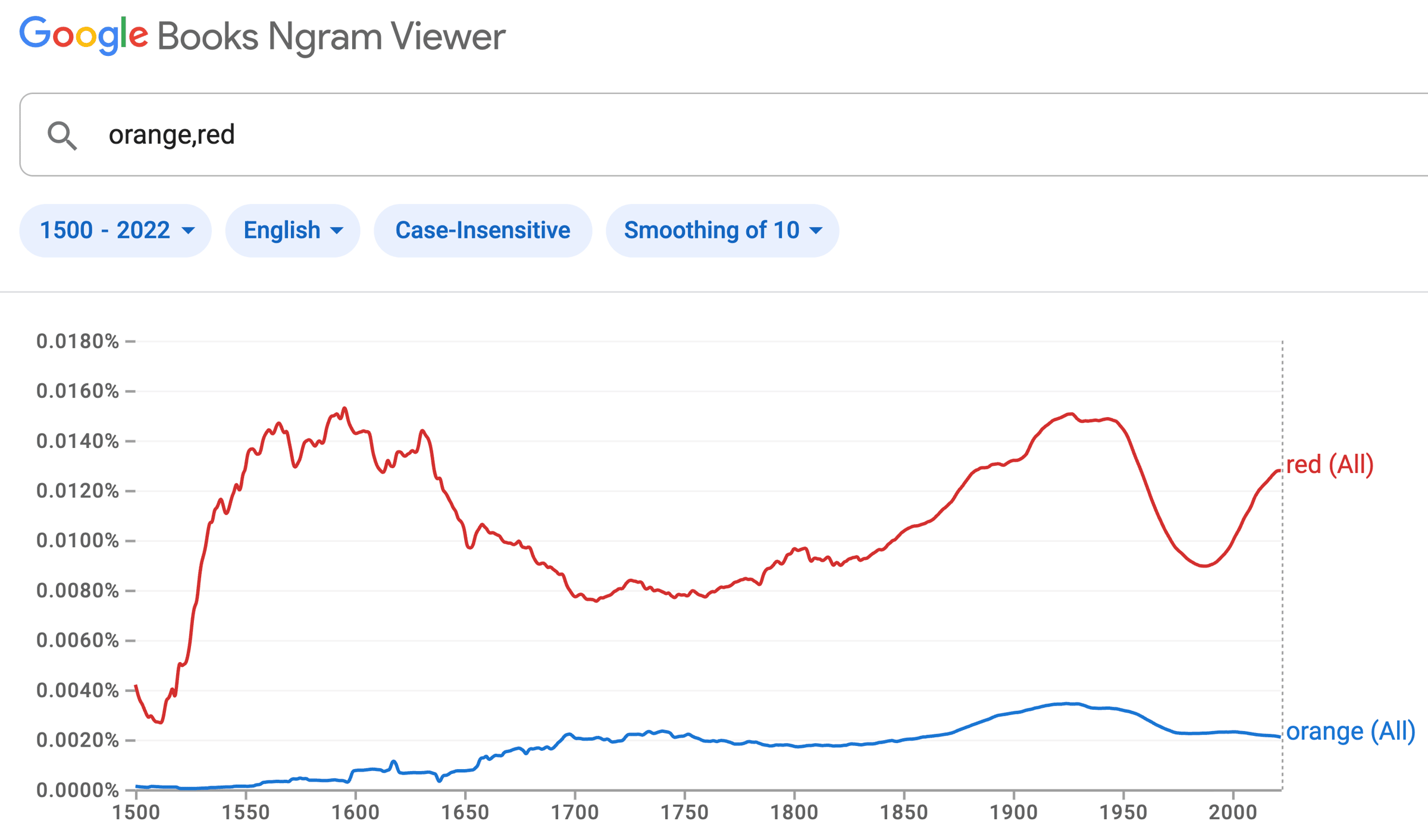
Graph showing how frequently "orange" and "red" have appeared in English books from 1500-2022.
While orange showed up too late in the English language for "orangehead" to be widely adopted, other languages use more logical descriptions:
The Irish language has two words to describe red: dearg describes vibrant red, whereas rua describes red hair.
In Spanish, redheads are nicknamed canelo/canela meaning "cinnamon."
In ancient Greek, redheads were called pyrrhos meaning "flame-colored."
🧠 Bonus brain points
Why are redheads called gingers?
We really don't know why redheads got nicknamed with the (sometimes derogatory) term ginger.
According to the Oxford English Dictionary, ginger as a way to describe someone with red hair first shows up in a 1823 British slang dictionary. But the exact reason why ginger was chosen to describe the orange colored hair remains a mystery.
It's possible that ginger was truly referring to the bold, spicy root we still use today, but that brownish-gold color would make more sense to describe "strawberry blondes." Or ginger could have been mistaken for another spice root, turmeric, which has a much more true orange hue.
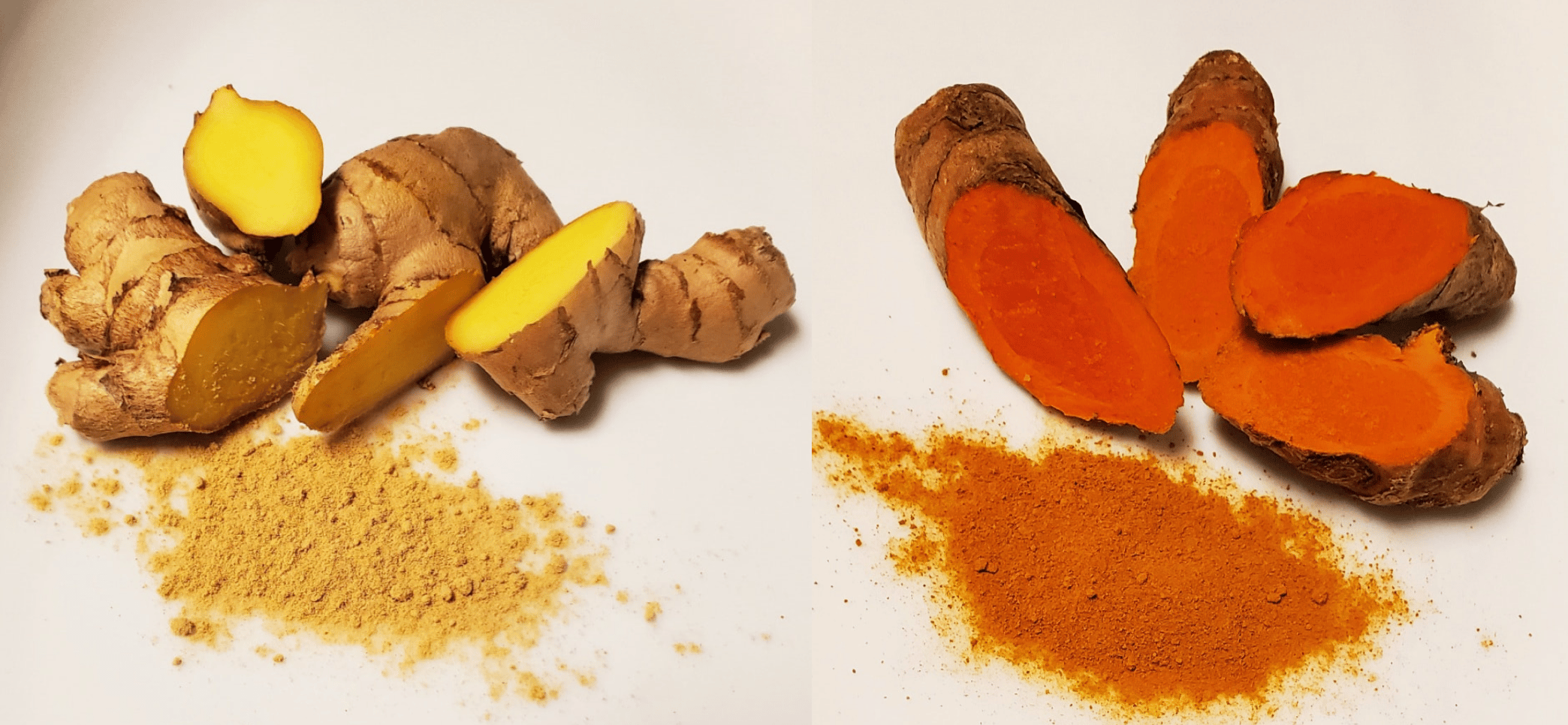
Left: Fresh and powdered ginger. Right: Fresh and powdered turmeric.
Source: Whole Health Everyday
Some people have speculated that the slang term might be linked to Zingiber officinale var. rubrum, commonly known as "red ginger." Red ginger, found in Southeast Asia, has a reddish-brown color, which gets us closer to the "red" of red hair.

Red ginger. Source: eBay (If you're curious, you can apparently buy it on eBay! I love eBay.)
Coincidentally, the term ginger for redheads shows up in the early 1800s overlapping with the era of British colonial rule in Malaya (later Malaysia), when exposure to red ginger may have influenced later slang.
Curious about how the world works?
Today You Should Know is a free, weekly email newsletter designed to help you learn something new every Friday.
Subscribe today 👇
Check out some other curious questions:



Sources
Cowgill, W. (2026, January 14). Indo-European languages. Britannica. https://www.britannica.com/topic/Indo-European-languages
Hollandbeck, A. (2019, February 28). In a Word: A Fruit, a Place, a Color, and a Symbol: Orange. The Saturday Evening Post. https://www.saturdayeveningpost.com/2019/02/in-a-word-a-fruit-a-place-a-color-and-a-symbol-orange/
McCulloch, G. (2012, October 7). Why don’t we say “orangehead” instead of “redhead”? All Things Linguistic. https://allthingslinguistic.com/post/33117530568/why-dont-we-say-orangehead-instead-of
MyHeritage Ltd. (2024, July 31). Red Head. MyHeritage. https://lastnames.myheritage.com/
Online Etymology Dictionary. (n.d.-a). orange. etymonline. https://www.etymonline.com/word/orange
Online Etymology Dictionary. (n.d.-b). red. etymonline. https://www.etymonline.com/word/red
Online Etymology Dictionary. (n.d.-c). redhead. etymonline. https://www.etymonline.com/word/redhead
Online Etymology Dictionary. (n.d.-d). *reudh-. etymonline. https://www.etymonline.com/word/*reudh-
Oxford University Press. (n.d.). ginger. Oxford English Dictionary. https://www.oed.com/dictionary/ginger_n
Zhang, S., Kou, X., Zhao, H., Mak, K.-K., Balijepalli, M. K., & Pichika, M. R. (2022). Zingiber officinale var. Rubrum: Red ginger’s medicinal uses. Molecules, 27(3), 775. https://doi.org/10.3390/molecules27030775

.jpg)


We Americans sure do like American things.