
How do record players work?
The short answer
Record players work by dragging a needle through grooves in a spinning vinyl record, where tiny vibrations are converted into electrical signals, amplified, and turned back into sound by speakers.
The long answer
In high school, I decided to buy an old record player at a garage sale because I loved music. But while I was enthusiastic, I was ignorant. I thought vinyl records were pronounced "vinn-uhl," which gave my parents a laugh.

As a teenager, I spent so many hours at Amoeba Records that I was mistaken for an employee on more than one occasion.
Of course, it's perfectly okay to not know something. All that does is give us a chance to learn, which I imagine is why you subscribed to this newsletter! Okay, enough sappy "I love learning" talk. Let's set the record straight on how record players work:
How do vinyl records work?
Sound is the vibration of particles moving across a medium, like air, in waves. You know that Beach Boys song "Good Vibrations"? It's very meta. They're creating vibrations about vibrations.
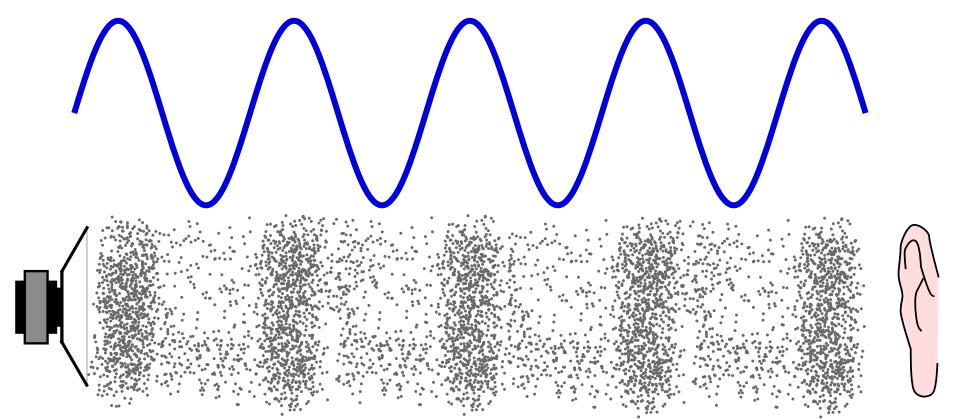
Diagram showing physical manifestation of a sound wave through air from a speaker to a human ear.
"CPT-sound-physical-manifestation" by Pluke is part of the public domain.
In the late 1800s, we figured out how to physically record these sound vibrations into an impressionable medium. Enter Thomas Edison's phonograph, the first device that could record and play back sound.
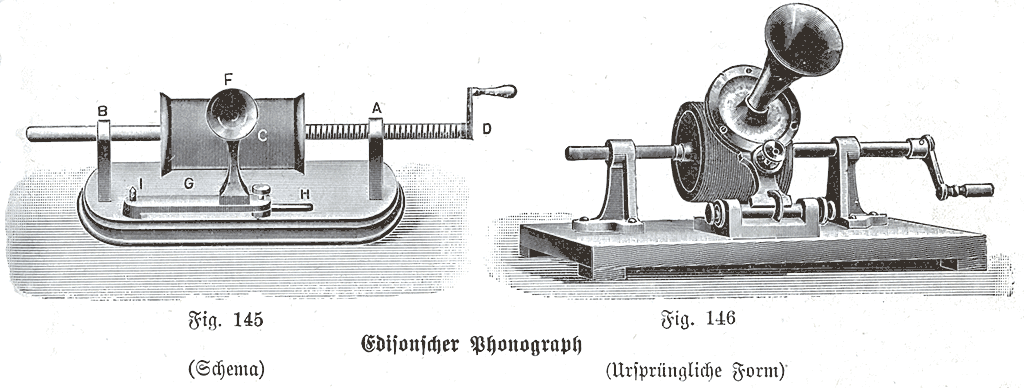
Fun fact: "Put a sock in it," the phrase used to tell someone to be quiet, likely came from the phonograph. The only way to turn down the volume was literally to stuff a sock in the horn.
"Edisonscher Phonograph" is part of the public domain.
The phonograph worked liked this: A hand crank rotated a cylinder wrapped in tinfoil while a needle pressed against it. While you cranked the handle, you yelled whatever you wanted to record into a mouthpiece. This created vibrations that etched grooves into the foil.
Then you could rewind the cylinder to drag the needle along the newly formed groove to replicate the vibrations. By placing a horn at the end of the needle, you could amplify the recorded sound.
🔈 Watch a demonstration of the phonograph here:
The fundamental mechanics of record players haven't changed all that much from early phonographs. Technically you don't even need a record player to play records. By running a needle in the groove, or even a money bill, you can pick up good vibrations.
But if you insist on using a record player to play your records, here's how it all works:
Step #1: The record spins and drags the needle (stylus) along the groove.

Close-up of a stylus running through the grooves of a vinyl record, captured with an electron microscope.
Source: Applied Science
The stylus, or needle, is the smallest piece of a record player made from diamond or another hard material. As the record spins, the stylus rides the spiraling grooves, picking up vibrations.
Today’s records also allow for stereo sound: the left wall of the groove carries the left channel, and the right wall carries the right channel.
Step #2: The vibrations picked up from the stylus move a magnet between two coils.
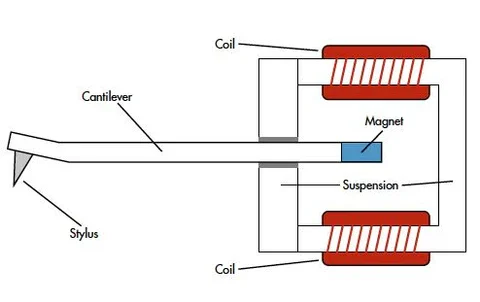
Record player cartridge diagram.
Source: The Revolver Club
The stylus will be housed in the cartridge, which has everything we need to turn the mechanical energy of the sound's vibrations into electrical energy.
The stylus is at one end of a rod called a cantilever. At the other end of the cantilever is a tiny magnet placed between two electrical coils. As the stylus vibrates, it moves the magnet within or between these coils.
Step #3: The magnet's movement creates electrical signals in the left and right channels.
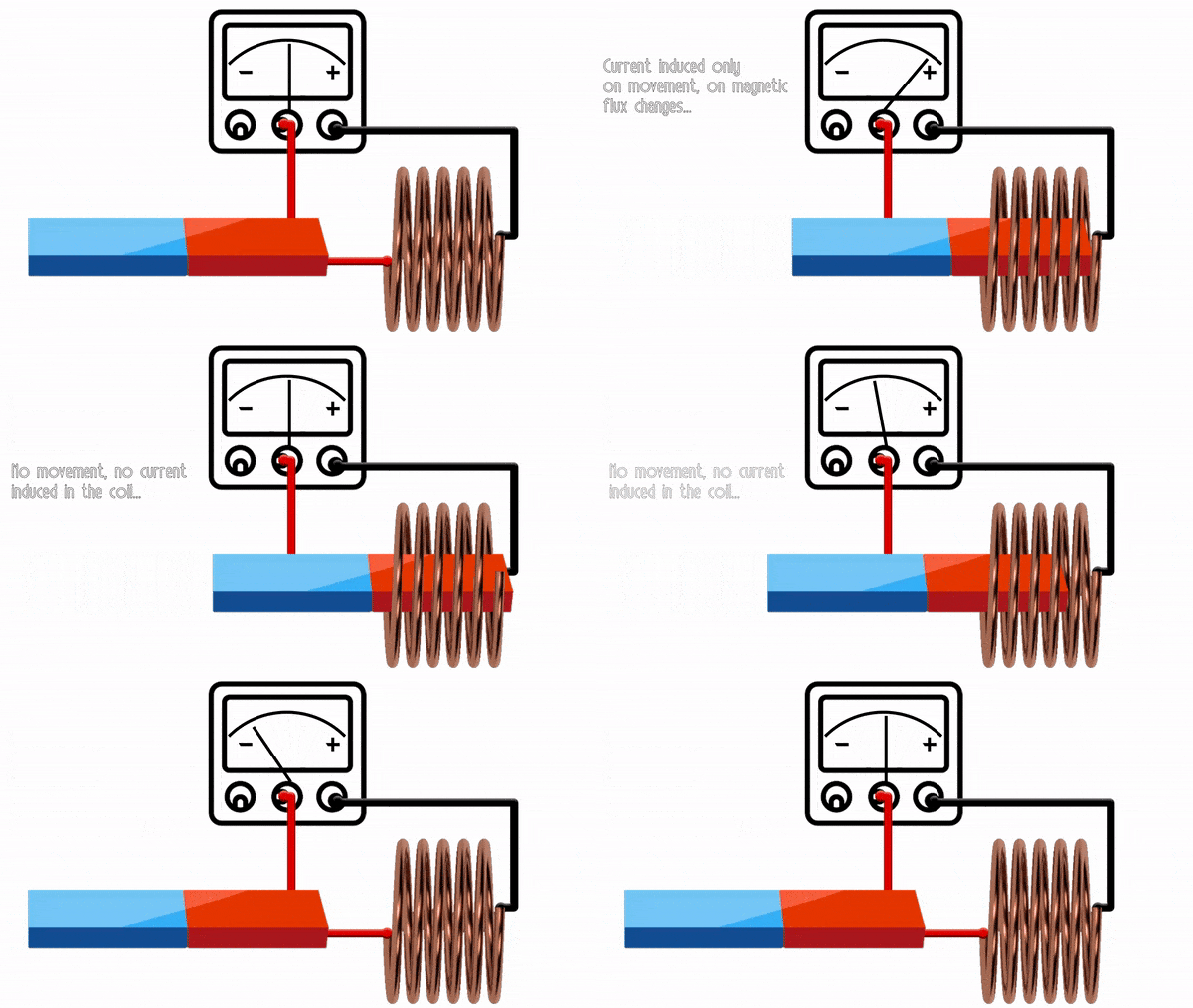
A magnet creates an electrical current as it moves.
Source: Mr. Naga Physics
As the magnet shifts position near the metal coils, the magnetic field passing through those coils changes. This causes the electrons already present in the coils to move slightly back and forth, creating a tiny electrical signal in the coil. That’s how a record's physical vibrations get converted into electricity.
Step #4: The electrical signals travel up the tonearm to the preamplifier.
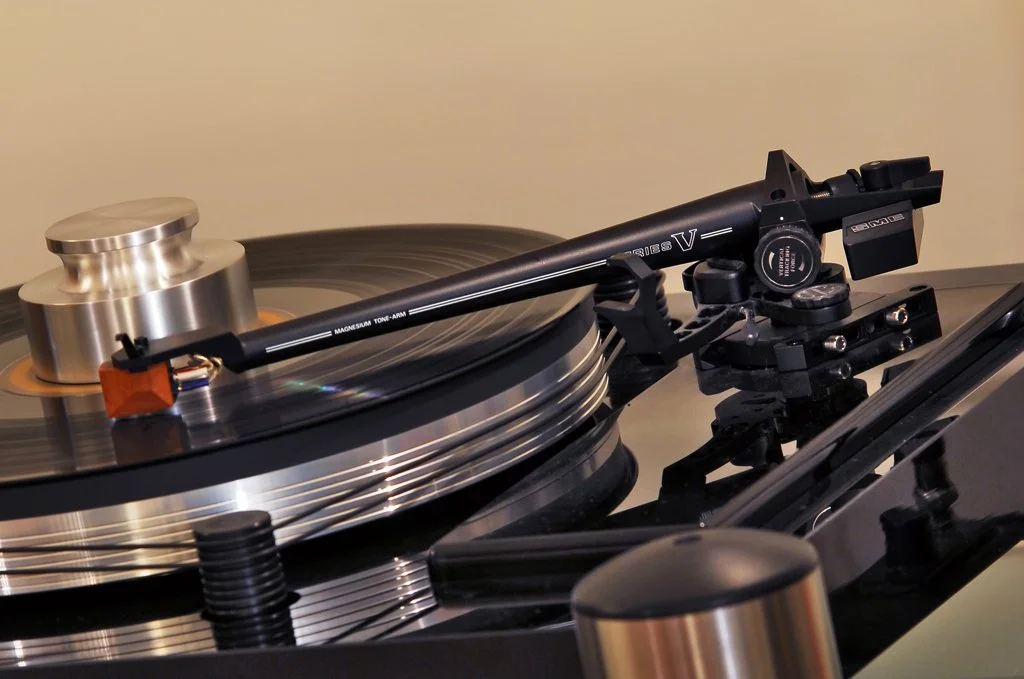
Tonearm of a record player.
"SME V" by Spoohoo is licensed under CC BY-SA 3.0.
The electrical signals from the left and right coils travel up the tonearm of the record player until it reaches the preamplifier. A preamplifier solves for two problems:
The signal is too small: Since the signal from the record player cartridge is extremely small (only a few millivolts), it needs a boost for further amplification. The preamp multiplies the incoming voltage, creating a larger form of the same waveform.
The frequencies need rebalancing: When records are cut, the bass (low) frequencies are intentionally reduced and treble (high) frequencies are boosted. This is to make the grooves easier to cut. But to restore the intended sound quality, a preamp rebalances these frequencies in a process called equalization.
The preamplifier then sends the corrected electrical signal to the main amplifier.
Step #5: The signals reach the main amplifier, separate into left and right channels, and convert back to sound in the speakers.
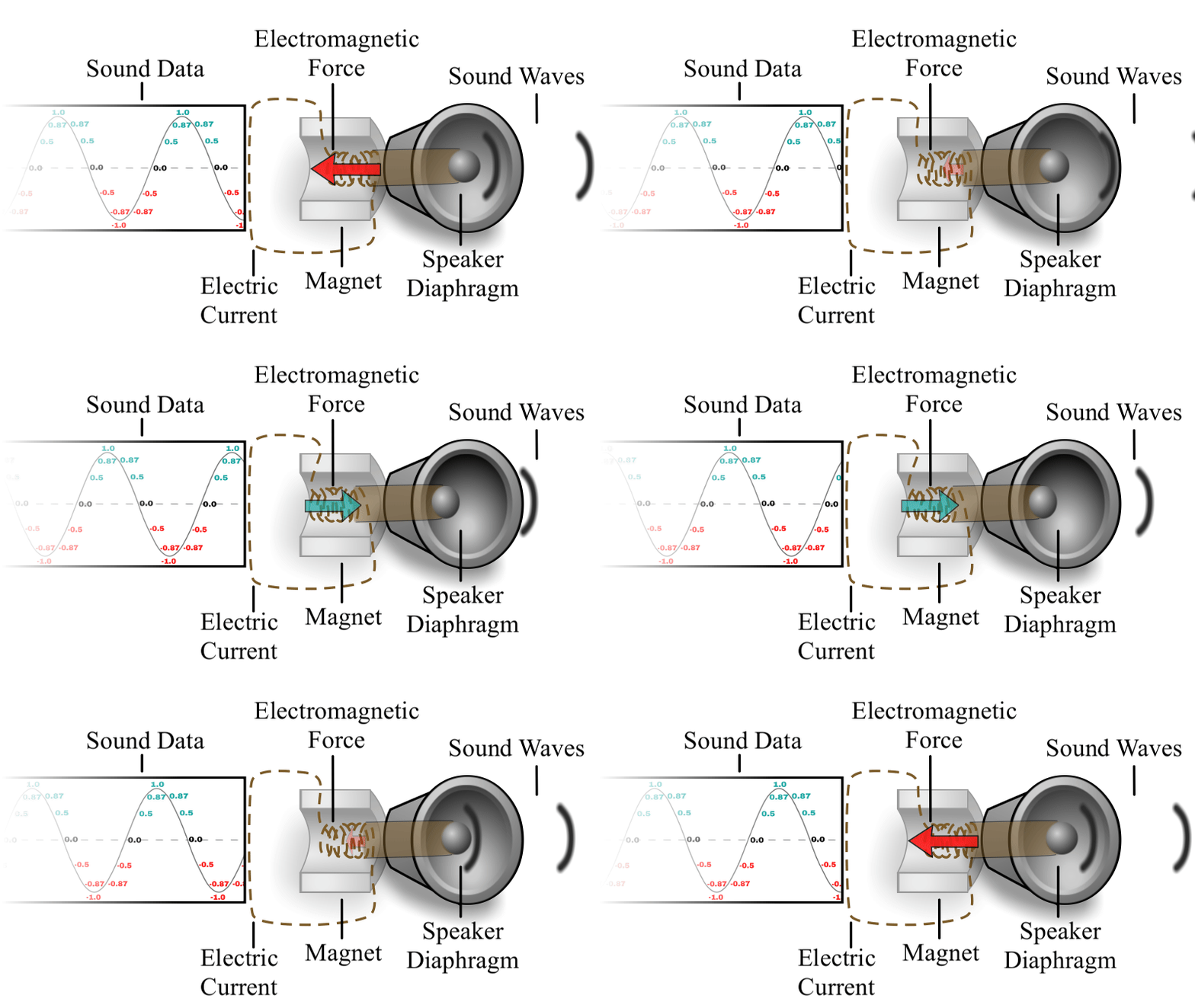
"Sound wave animation" by KyleThayer is part of the public domain.
Once the signals reach the main amplifier, the sound is — you guessed it — amplified. This is also when the left and right signals are sent to their corresponding speakers.
Finally, the electrical signals get converted back into physical movement so we can hear the sounds. A speaker's diaphragm rapidly moves back and forth to vibrate air molecules, which we interpret as music.
Curious about how the world works?
Today You Should Know is a free, weekly email newsletter designed to help you learn something new every Friday.
Subscribe today 👇
Check out some other curious questions:


Sources
Bower, M. (2009, December 7). How Record Players Work. HowStuffWorks. https://electronics.howstuffworks.com/record-player.htm
Destiny Entertainments Ltd. (n.d.). What Is a Record Player Preamp. ElectroMarket. https://electromarket.co.uk/guide/home-audio/what-is-a-record-player-preamp
Mabery, D. (2022, April 16). How Record Players Work: The Science Behind That Beautiful Sound, Simplified. Dalton Mabery. https://www.dltn.io/posts/how-record-players-work-the-science-behind-that-beautiful-sound-simplified
New, J. (2015, November 12). How Record Players Work. YouTube. https://www.youtube.com/watch?v=eJFuRnolwWk



We Americans sure do like American things.