
What does "feels like" temperature mean?
The short answer
“Feels like” temperature reflects how wind and humidity change how cold or hot the air feels to the human body. Wind chill increases heat loss in cold conditions, while the heat index reflects how humidity interferes with sweating in hot weather.
The long answer
There's temperature. And then there's "feels like" temperature. I had no clue they could be so different until I spent a hot, humid summer in Washington, D.C.:
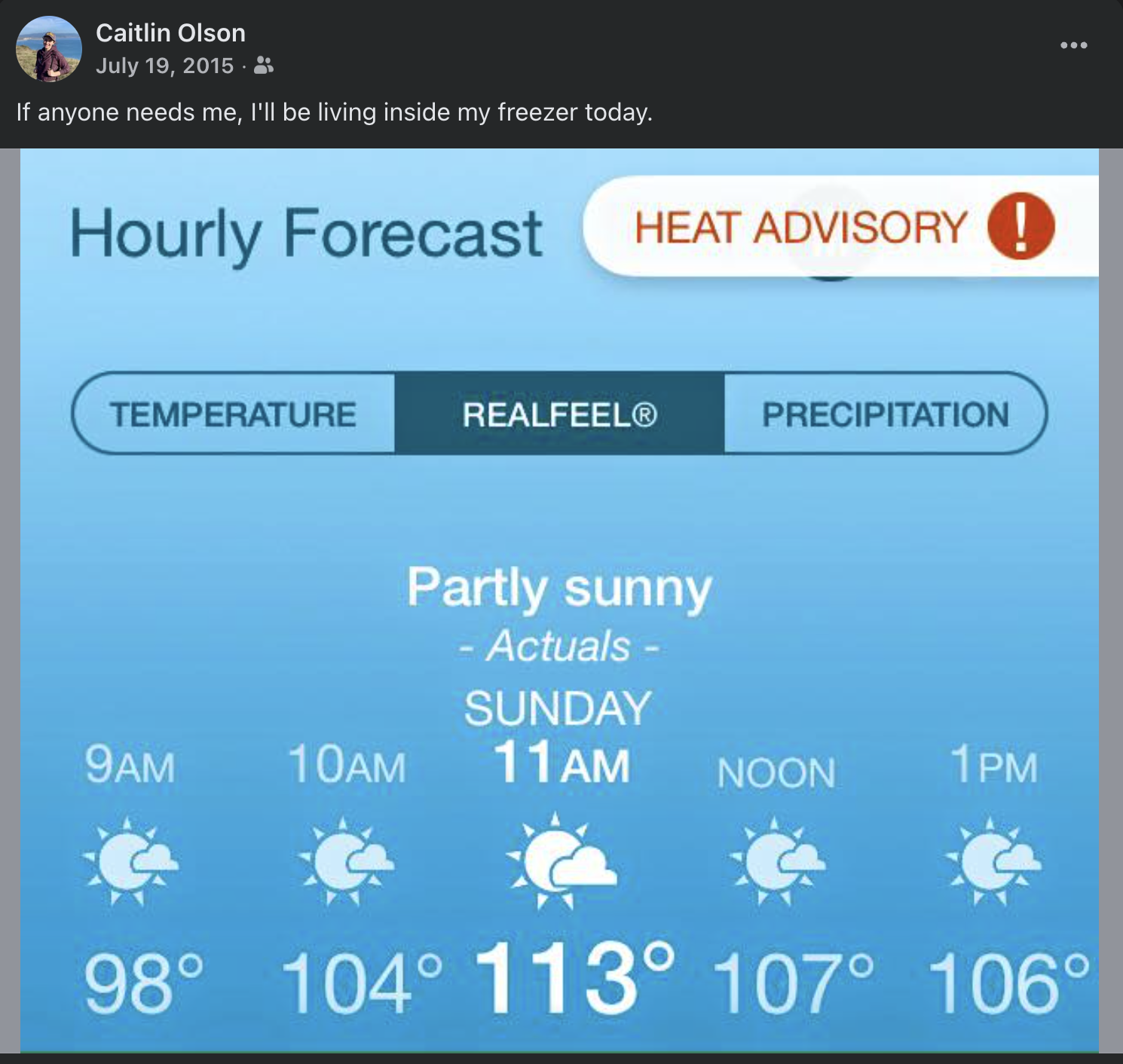
That's a high of 45°C for my non-American friends.
"Feels like" temperature, otherwise known as apparent temperature, is an estimate of how hot or cold the temperature will feel to the human body. On hot days, the "feels like" temperature might be several degrees hotter, and on cold days, it might be way lower.
"Feels like" temperature has to do with the impact of wind and humidity on our perception of cold and hot days.
🥶 What is wind chill?
On cold days, meteorologists use wind chill to determine the "feels like" temperature. The basic principle is this: Wind makes us feel colder because it's removing our body heat's layer of warm air and replacing it with cooler air.
Our bodies naturally radiate heat, creating a layer of insulation known as the boundary layer. On a cold but windless day, this layer keeps us from rapidly losing body heat.
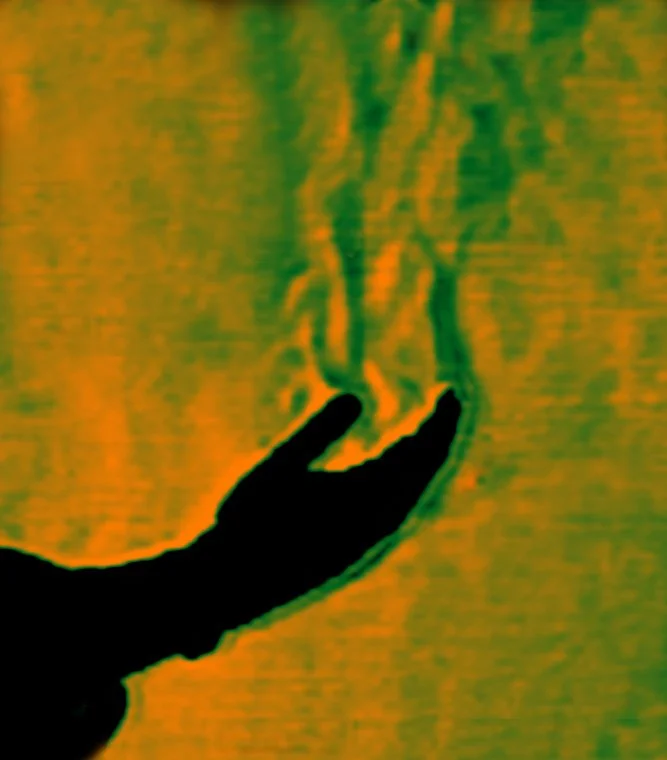
This image shows warm air rising from a human hand, with the green border highlighting the boundary layer.
"Thermal-plume-from-human-hand" by Gary Settles is licensed under CC BY-SA 3.0.
Wind blows. More specifically, it blows away this boundary layer. This leads your body to lose more heat as it tries to warm the new cold air, which wind blows away again. A vicious, chilly cycle that leaves you feeling much colder.
Meteorologists use mathematical calculations factoring in the true temperature and the wind speed to come up with a wind chill index:
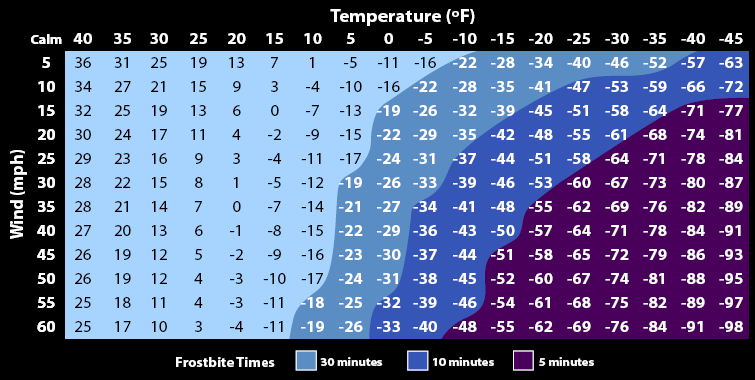
Fahrenheit version, with color code referencing how quickly you'd get frostbite.
"Wind chill" (modified) by National Weather Service is part of the public domain.
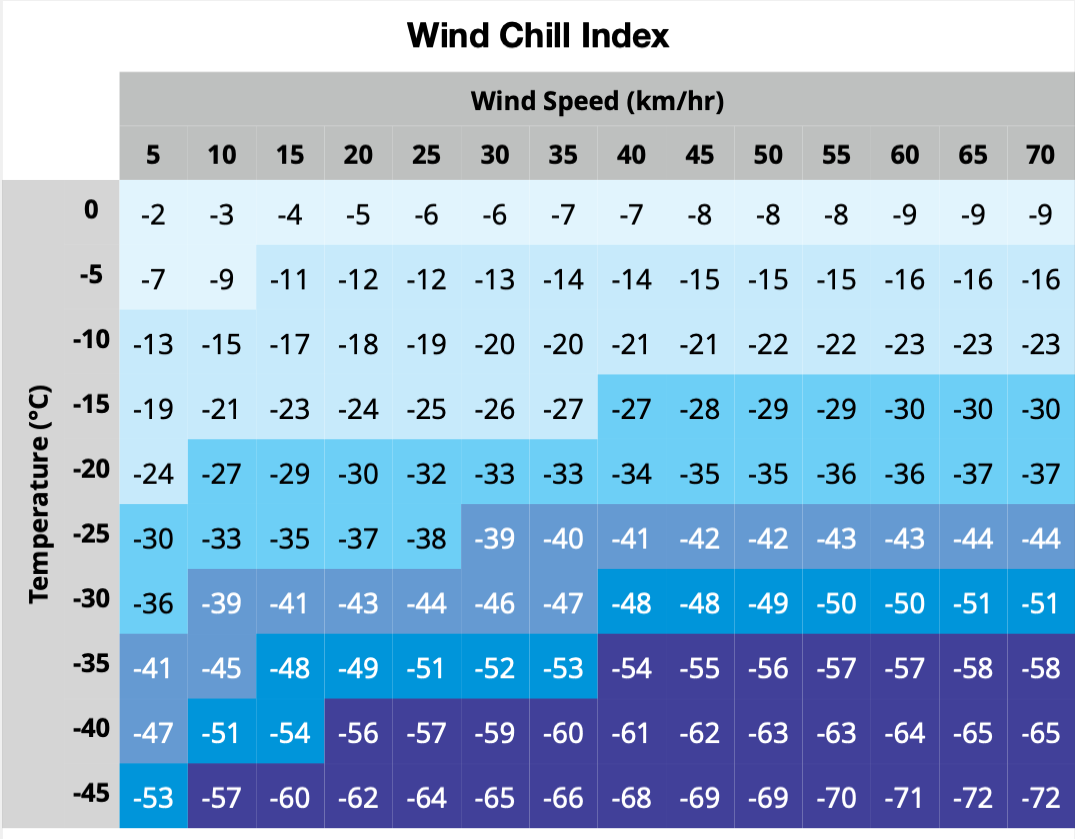
Celsius version (I couldn't trace the color code here, but suffice it to say, darker blue is colder).
"Table of Wind Chill Index Values" (modified) by Ecwiebe is part of the public domain.
🥵 What is the heat index?
I'm sure we've all heard the phrase, "It's not the heat that gets you; it's the humidity." And as clichè as it sounds, it's accurate.
The reason why humidity makes us feel so much warmer has to do with how we sweat. When we're hot, our bodies produce sweat to cool us down. But it's not enough to simply sweat; we need the sweat to evaporate for it to have a cooling effect.
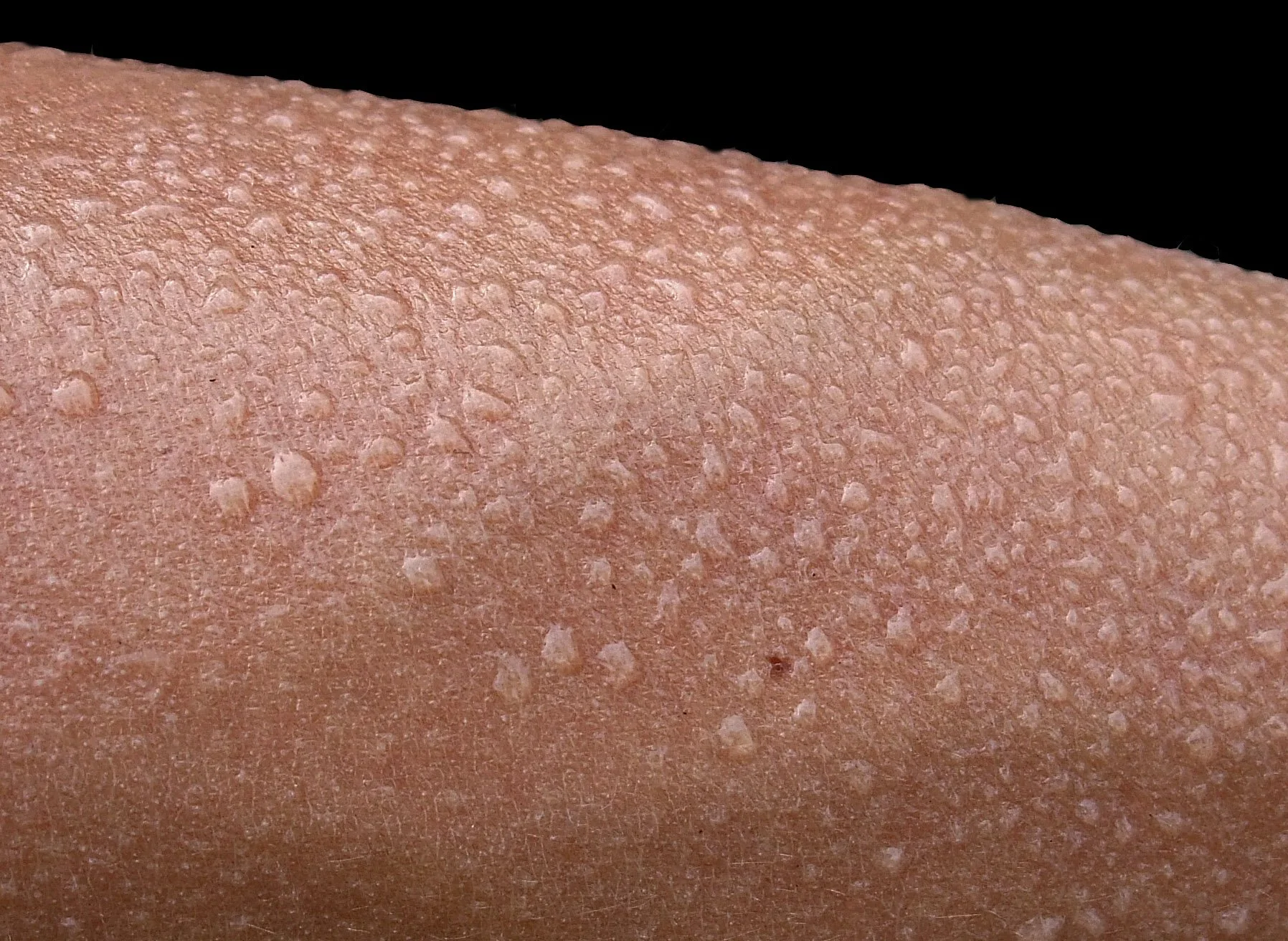
"TranspirationPerspirationCommonsFL" by Minghong is licensed under CC BY-SA 3.0.
We cool down because evaporation requires energy. More energy allows water molecules to move faster so they can escape into the air. Our body heat provides this energy, which reduces our skin temperature.
But on humid days, sweat evaporates more slowly. If the air is humid, it already has lots of water vapor in it, close to the point of saturation. This is why humidity makes it feel so much hotter — sweating is simply less effective at cooling us.
Meteorologists use mathematical calculations factoring in the true temperature and the relative humidity to come up with a heat index:
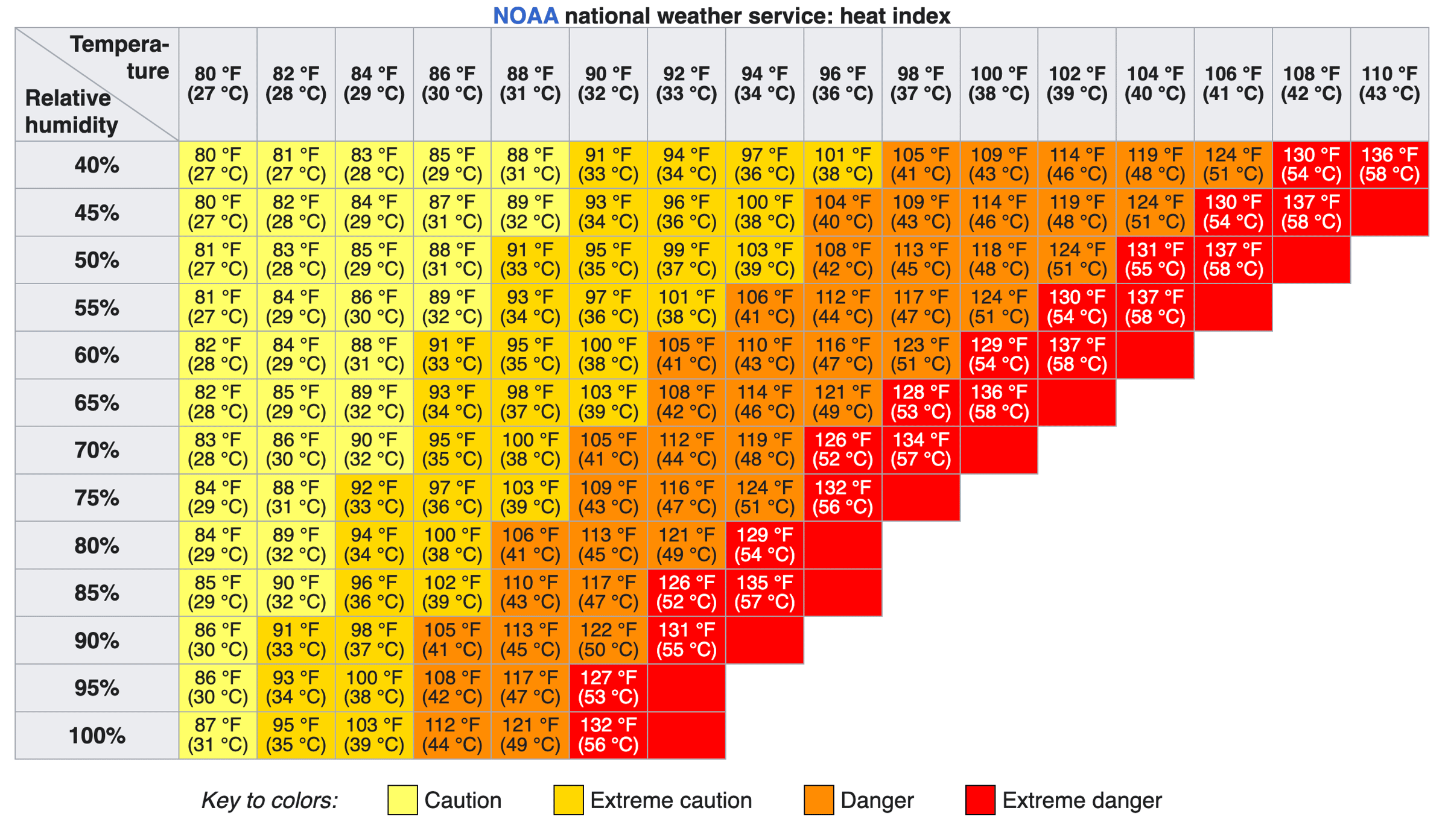
According to the heat index, if the air temperature is 90°F (32°C) and the relative humidity is 80%, the heat index is 113°F (45°C).
Source: NOAA
Interestingly, the heat index also explains why some hot days feel cooler. If the relative humidity is extremely low, it can speed up evaporation and make us feel cooler than the true temperature. For example, if the true temperature in Phoenix, Arizona is 100°F (38°C) and the relative humidity is 15%, the heat index is 96°F (36°C).
🧠 Bonus brain points
What is the wet-bulb globe temperature?
Along with "feels like" temperature, you may have also heard about the wet-bulb globe temperature (WBGT) on hot days. The heat index is helpful, but it doesn't take into account the impact from the sun (i.e. all figures assume you're in the shade.) If you're exposed to direct sunlight, it can feel up to +15°F (+9°C) hotter than the heat index suggests.
The wet-bulb globe temperature creates a more accurate "feels like" temperature by factoring in air temperature, humidity, wind speed, and solar radiation.
A black globe thermometer measures the radiant heat from the sun and surrounding environment.
A wet-bulb thermometer measures the cooling effect of evaporation.
A dry-bulb thermometer measures the air temperature in the shade.
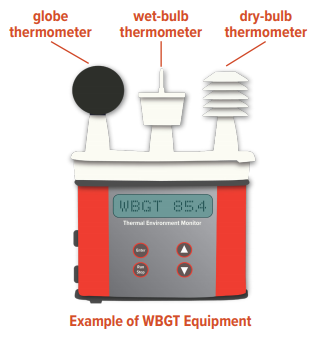
Source: NOAA
Curious about how the world works?
Today You Should Know is a free, weekly email newsletter designed to help you learn something new every Friday.
Subscribe today 👇
Check out some other curious questions:


Sources
Baisas, L. (2025, February 21). What is “feels-like” temperature? A meteorologist explains. Popular Science. https://www.popsci.com/environment/what-is-feels-like-temperature/
Davis, L. (2024, March 12). 11.8: Wind-Chill Factor. LibreTexts. https://phys.libretexts.org/Bookshelves/Conceptual_Physics/Body_Physics_-_Motion_to_Metabolism_(Davis)/11:_Body_Heat_and_The_Fight_for_Life/11.08:_Wind-Chill_Factor
Freudenrich, C. (2010, September 13). How Sweat Works. HowStuffWorks. https://health.howstuffworks.com/skin-care/information/anatomy/how-sweat-works3.htm
McAllum, K. (2020, August 19). How Sweat Works: Why We Sweat When We’re Hot, as Well as When We’re Not. Houston Methodist: On Health. https://www.houstonmethodist.org/blog/articles/2020/aug/how-sweat-works-why-we-sweat-when-we-are-hot-as-well-as-when-we-are-not/
National Oceanic and Atmospheric Administration. (2021, September 10). Wet Bulb Globe Temperature: How and when to use it. National Weather Service. https://www.weather.gov/news/211009-WBGT
National Oceanic and Atmospheric Administration. (2024, July 12). Understanding Wind Chill. National Weather Service. https://www.weather.gov/safety/cold-wind-chill-chart
National Oceanic and Atmospheric Administration. (2025, August 13). What is the heat index?. National Weather Service. https://www.weather.gov/ama/heatindex
Tonks, S. (2024, December 5). What Is Wind Chill And What Makes It So Dangerous?. The Weather Channel. https://weather.com/science/weather-explainers/news/2024-12-04-what-is-wind-chill-what-makes-it-so-dangerous



We Americans sure do like American things.