
Why do coconuts have water?
The short answer
Coconuts carry water because they’re designed to launch a seed with an immediately usable food reserve. This liquid endosperm supports early growth, while the meat provides sustained fuel as the seedling develops.
The long answer
Coconuts are an unusual fruit (yes, they are a fruit, not a nut).
If you cut open an orange or a mango or a blueberry, there's lots of water embedded in the fruit flesh. But you crack open a coconut, stick a straw in, and it's like a juice box.
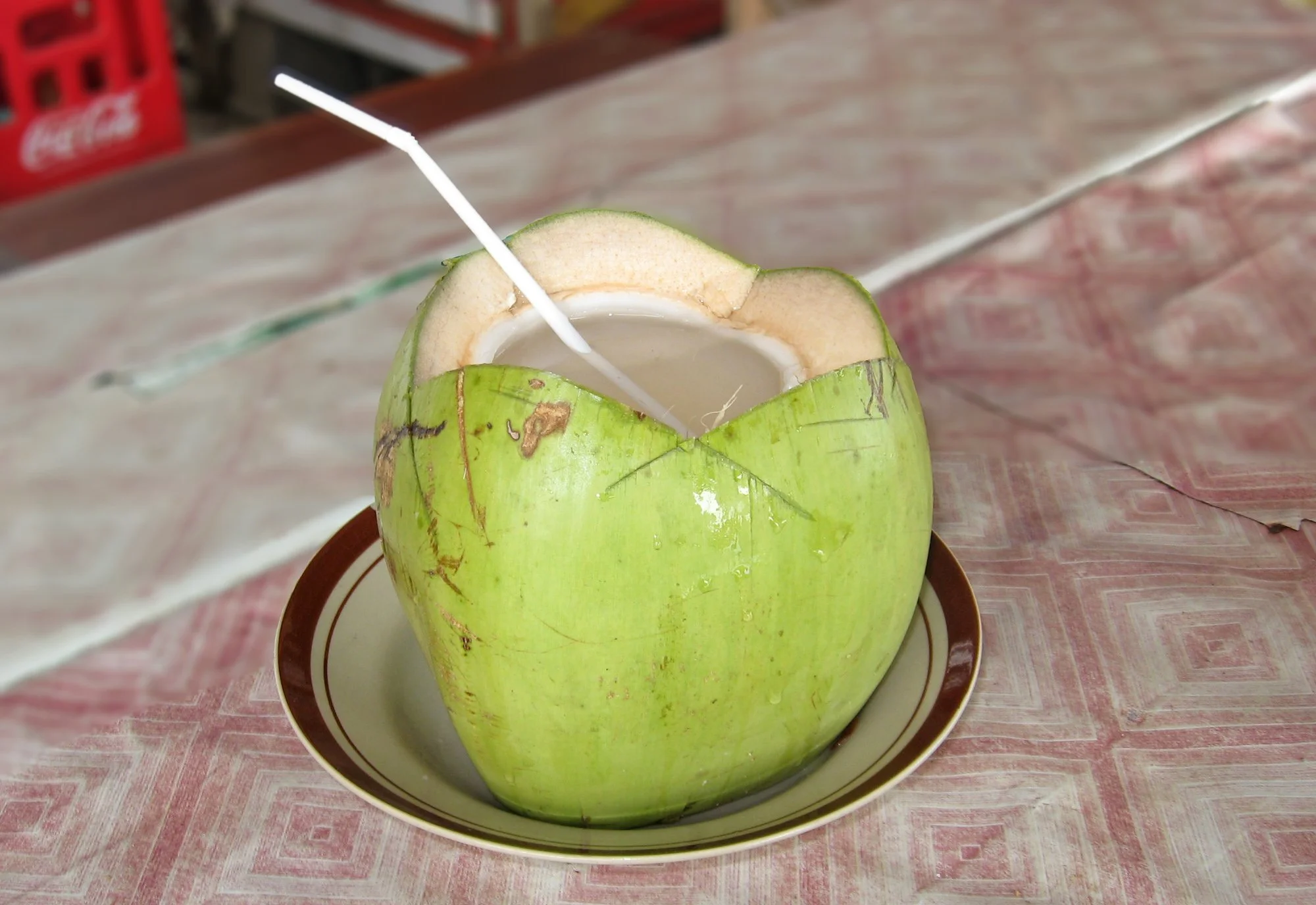
Fun fact: Coconut "juice boxes" were used as a transportable source of water, food, and fuel for ancient Polynesian sea voyages.
"Coconut Drink, Pangandaran" by Crisco 1492 is licensed under CC BY-SA 3.0.
Let's go nuts for coconuts and dig into why coconuts have water. First, what exactly is a coconut?
Coconuts fall into the fruity category of drupes, or stone fruit. Other drupes include apricots, olives, mangoes, cherries, and amlas. A coconut, like other drupes, has three layers:
Exocarp: The outer skin.
Mesocarp: The fibrous husk.
Endocarp: The hard interior shell that protects the seed (which contains the embryo).
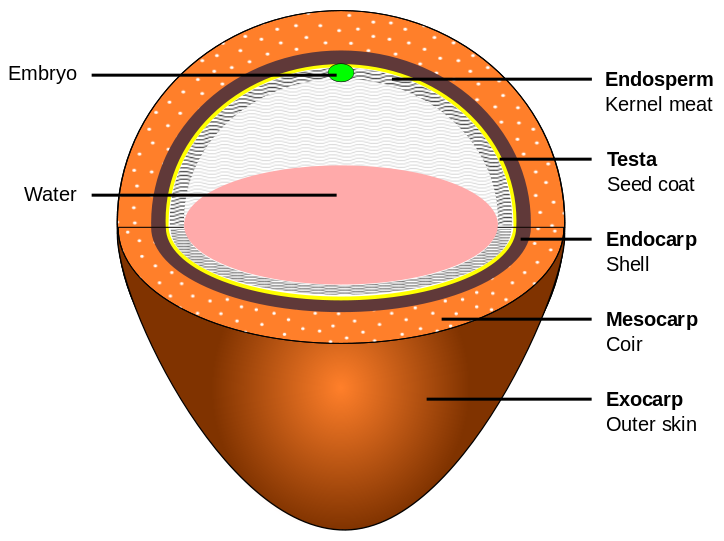
"Coconut layers" by Kerina yin is licensed under CC BY-SA 3.0.
Within the endocarp you'll find coconut water and coconut meat, liquid and solid endosperm that feed the embryo during germination. About two months after flowering, the endocarp starts to accumulate coconut water.
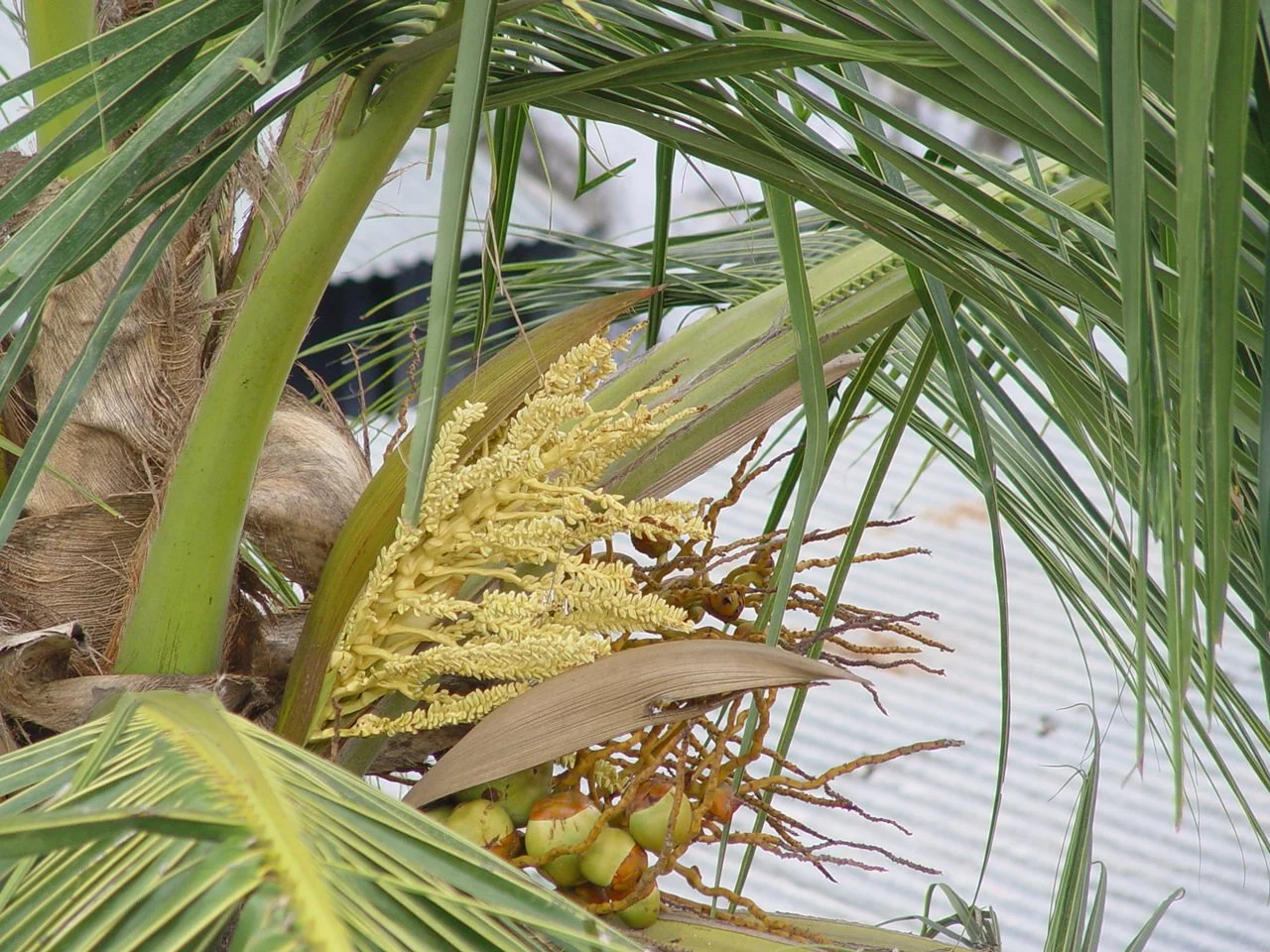
A coconut flower.
"தென்னை-உச்சி-தென்னம்பாலை-1" by Yasagan is licensed under CC BY-SA 3.0.
The water is drawn up from the ground by the palm's extensive root system (1-5 meters deep), along with the nutrients of the soil. It travels up the trunk, through the branches, and finally into the baby coconut. This liquid is highly nutritious and supports the growth of the embryo. At around six to eight months, a young coconut is full of water, up to 1 liter.

Green, young coconuts have the most water and least coconut meat.
Source: Coconut Information
But water is not the only thing you'll find in a coconut's cavity. As the coconut matures over the course of a year, most (but not all) of the liquid endosperm solidifies into the white, fatty kernel called coconut meat.
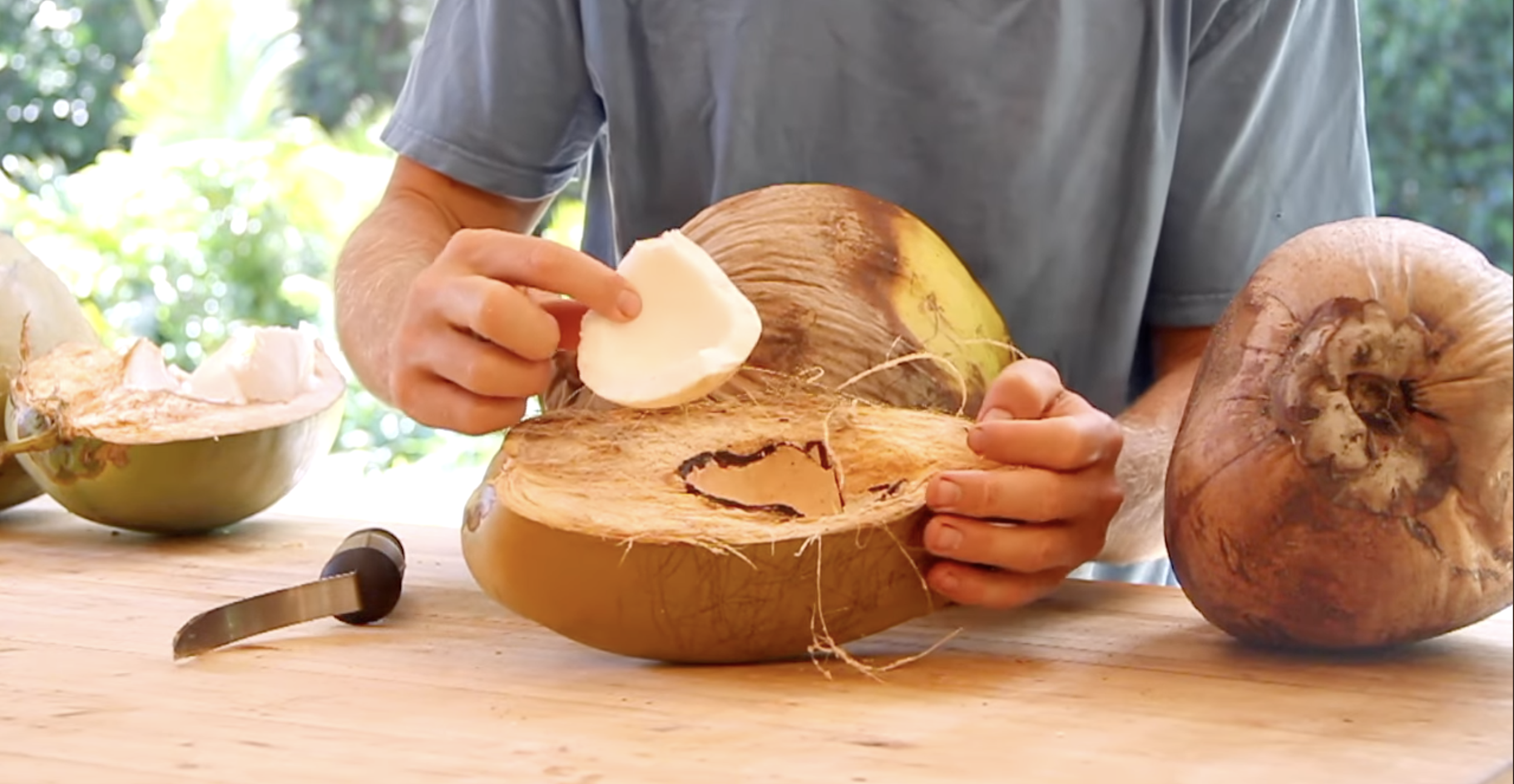
Brown, mature coconuts have the most coconut meat and least water.
Source: Coconut Information
Many other plants (like wheat or corn) develop fully solid endosperms. But not the coconut: even mature ones remain partially filled with coconut water.
So back to the original question: Why do coconuts have water?
Reason #1: Coconut water is rich in nutrients and easily accessible during germination
Coconut water is truly a growth serum. It's full of vitamins, minerals, amino acids, sugars, and plant hormones that stimulate cell division (cytokinins). In fact, some studies have found that formulated coconut water is comparable to commercial, synthetic fertilizers.
This liquid gold is critical in the coconut's germination phase, when the embryo develops into a seedling. During this process, coconut seedlings develop a haustorium, or sponge-like absorbent orb, that uses up both the coconut water and meat over time.

The development of coconut haustorium at different growth stages (DAS = Days after sowing.)
Source: The Pharma Innovation Journal
If there is not enough coconut water, the haustorium can't fully expand and the seedling fails to germinate. This liquid endosperm gets absorbed first, likely because it’s immediately available and easier to use than the solid endosperm.
In other words, the seedling relies on both: the quick-access liquid endosperm and the longer-lasting energy stored in the solid endosperm.
Reason #2: Coconut water helps the embryo germinate on sandy beaches.
Unlike other fruits that rely on animals to disperse their seeds, coconuts spread along coastlines mainly by floating in sea water for long stretches. A wild coconut can remain viable for germination for ~110 days in the ocean, floating for up to 3,000 mi (4,800 km). We actually don't know exactly where coconuts originate from because they have been embarking on ocean voyages for thousands of years.
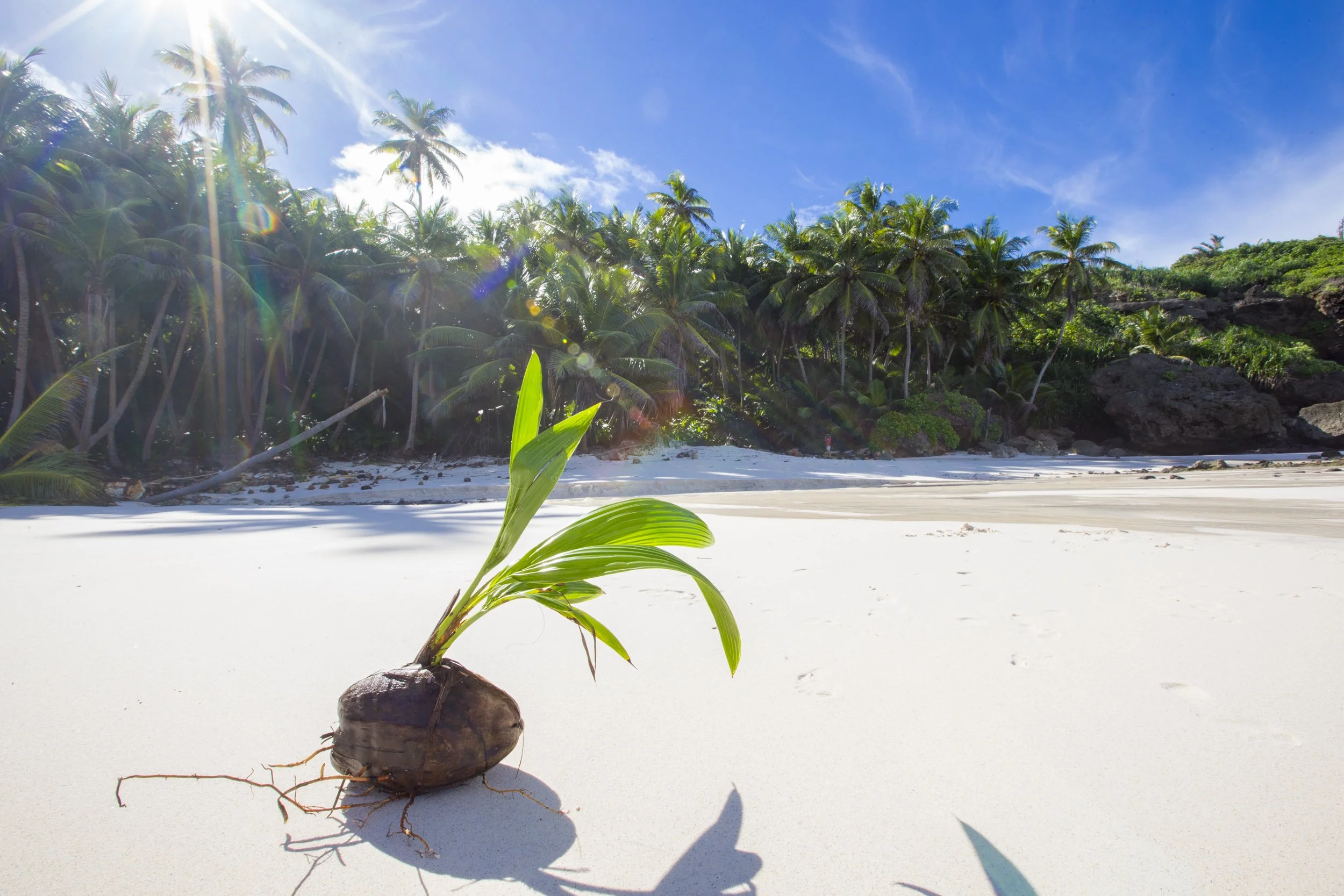
Coconut seedling germinating on a sandy beach.
"Dolly Beach, Christmas Island" by ChrisBrayPhotography is licensed under CC BY-SA 4.0.
Coconuts have evolved specific traits to help them survive these extensive sea voyages and later germinate on sandy beaches. For example, they are buoyant because of their fibrous husk, nearly empty cavity, and waterproof exterior.
When they finally land on a beach, the reserve of coconut water gives them a better shot at surviving before its root system is deep enough to reach fresh water and its leaves are able to push out of the shell and into the sunlight.
Curious about how the world works?
Today You Should Know is a free, weekly email newsletter designed to help you learn something new every Friday.
Subscribe today 👇
Check out some other curious questions:



Sources
Adoyo, G. (2025, April 1). How do coconuts get their water?. The Conversation. https://theconversation.com/how-do-coconuts-get-their-water-252673
Beveridge, F. C., Kalaipandian, S., Yang, C., & Adkins, S. W. (2022). Fruit Biology of Coconut (Cocos nucifera L.). Plants, 11(23), 3293. https://doi.org/10.3390/plants11233293
Buah, J. N., & Agu-Asare, P. (2014). Coconut water from fresh and dry fruits as an alternative to BAP in the in vitro culture of dwarf cavendish banana. Journal of Biological Sciences, 14(8), 521–526. https://doi.org/10.3923/jbs.2014.521.526
Menon, K. P. V., & Pandalai, K. M. (1960). The Coconut Palm: A Monograph. Indian Central Coconut Committee. https://ia800802.us.archive.org/29/items/in.ernet.dli.2015.125122/2015.125122.The-Coconut-Plam_text.pd
Shayanthavi, S., Kapilan, R., & Wickramasinghe, I. (2025, May 16). A comprehensive review of coconut liquid endosperm (Cocos nucifera L.): Composition, physicochemical characteristics, antimicrobial and antioxidant properties, and applications in microbial and Tissue Culture Media. Journal of Science of the University of Kelaniya. https://josuk.sljol.info/articles/10.4038/josuk.v18i1.8119
Yong, J. W., Ge, L., Ng, Y. F., & Tan, S. N. (2009). The Chemical Composition and Biological Properties of Coconut (Cocos nucifera L.) Water. Molecules, 14(12), 5144–5164. https://doi.org/10.3390/molecules14125144



We Americans sure do like American things.