
The short answer
Alcohol feels warming because ethanol lowers the activation threshold of heat-sensitive receptors, fooling your nervous system into thinking you’re overheating. Your body then attempts to cool itself by dilating blood vessels and sending warm blood to the skin’s surface.
The long answer
Normally, a beverage needs to be warm to make you feel warm — but not alcohol. Whether it's a burning sensation from taking a shot or a more gentle feeling of heat as you sip a glass of wine, alcohol makes you feel warm. Why is that?
Reason #1: Alcohol alters the nerve receptors that detect heat.
Alcohol tricks our bodies into feeling warm. As you swallow ethanol, it binds with a specific protein in your sensory neurons called TRPV1.
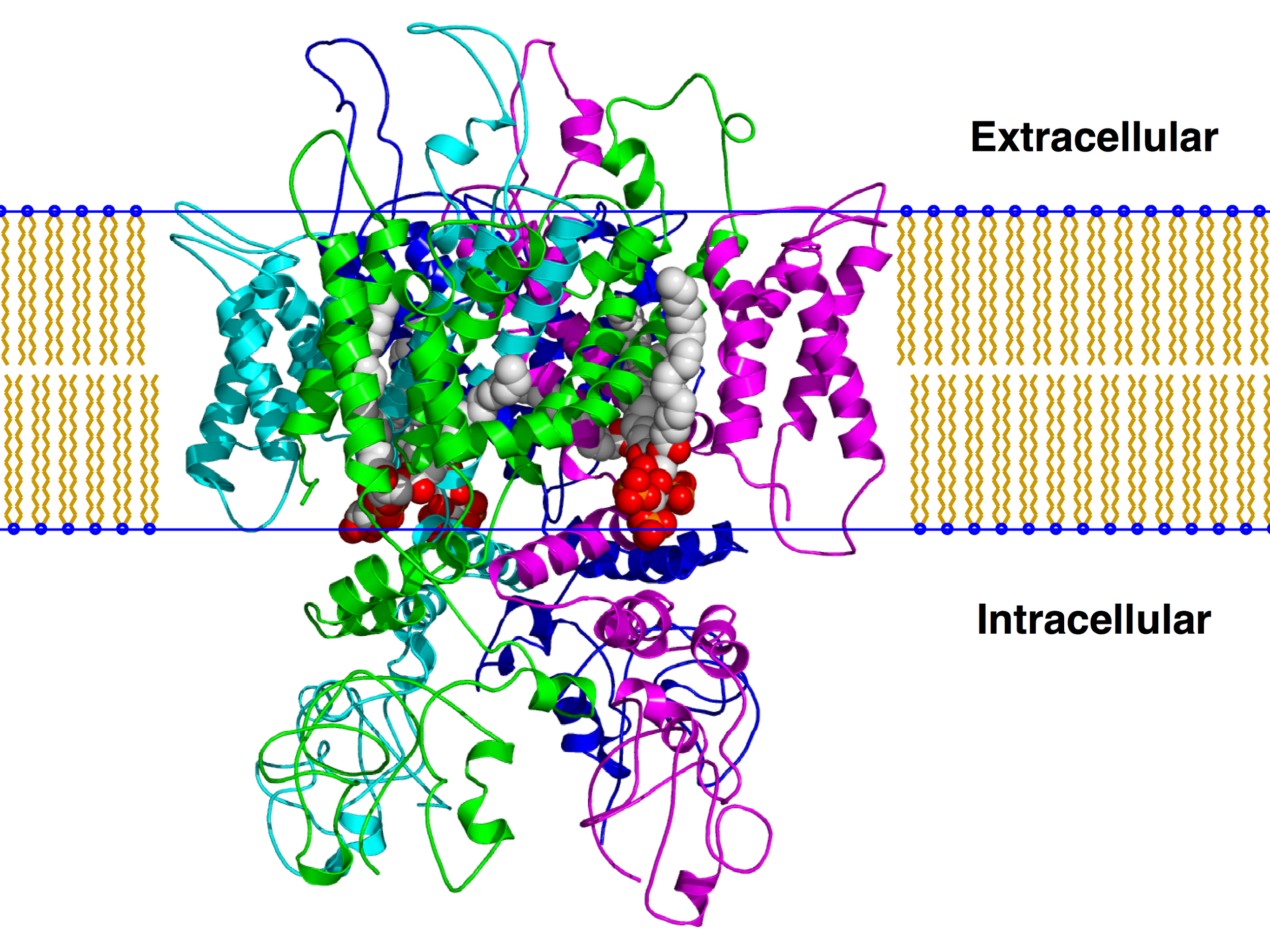
A model of the TRPV1 ion channel.
"Trpv1 pip2 bilayer" by Boghog2 is part of the public domain.
TRPV1 is a heat-activated ion channel that usually only opens at temperatures above 109°F (43°C). But ethanol drops this heat threshold to roughly 93°F (34°C), or below your normal body temperature. In other words, alcohol causes your sensory neurons to start a false alarm that you're overheating.
Interestingly, TRPV1 is the same protein responsible for the burning sensation we feel when we eat hot peppers. In both cases, your body is tricked into thinking you're overheating and so you feel a burning sensation in your throat, esophagus, and stomach.
Reason #2: Alcohol causes more blood to flow to your skin.
When your body thinks it's overheating, it cools itself by widening blood vessels near the skin, in a process called vasodilation.
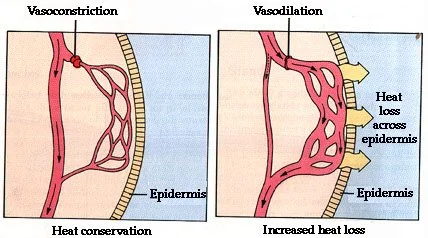
Source: PhysioWeb
Vasodilation is the widening of blood vessels to allow more blood flow near the surface of your skin. The extra blood flow makes your skin feel warmer and causes you to look flushed when you've been drinking.
Does alcohol actually make you warmer?
So alcohol makes you feel warmer, but does it actually increase your body temperature?
No. Alcohol lowers your temperature by tricking your body into thinking it's overheating.
When you're cold, your body conserves heat by constricting blood vessels near the surface of your skin — this is why your fingers and toes often feel coldest first. But when alcohol triggers vasodilation to cool your "overheated" body, your core temperature drops.
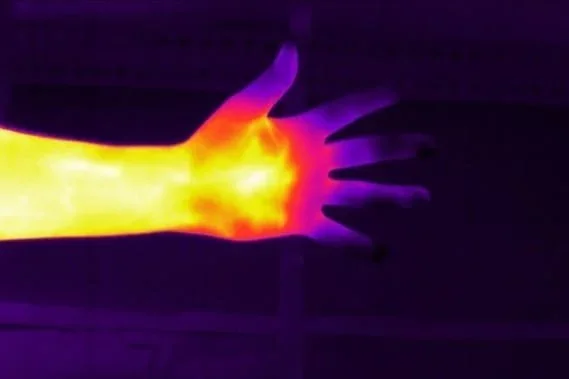
Thermal image of a person's hand on a cold day. Source: Reddit
Researchers have measured this effect with a 1995 cold-water immersion experiment. Two groups of healthy male volunteers were randomly assigned to drink either one liter of a 6.3% ABV alcoholic beverage or a non-alcoholic placebo. Then both groups were immersed in 68°F (20 °C) water for one hour. The group that drank alcohol experienced a -52% lower drop in average body temperature than the placebo group.
Besides causing heat loss through vasodilation, alcohol suppresses other natural responses to the cold, like shivering and feeling the need to put on warm clothes. Because of this temperature-reducing effect, alcohol is a well-known risk factor for hypothermia despite making you feel warm in the moment.
🧠 Bonus brain points
Did Saint Bernard rescue dogs used to carry brandy?
The idea of alpine rescue dogs carrying little barrels of brandy around their necks to warm up avalanche victims is more myth than fact. The rumor got started in 1820 after Edwin Landseer painted this image portraying two dogs, one with a brandy barrel, rescuing a man trapped in the snow.
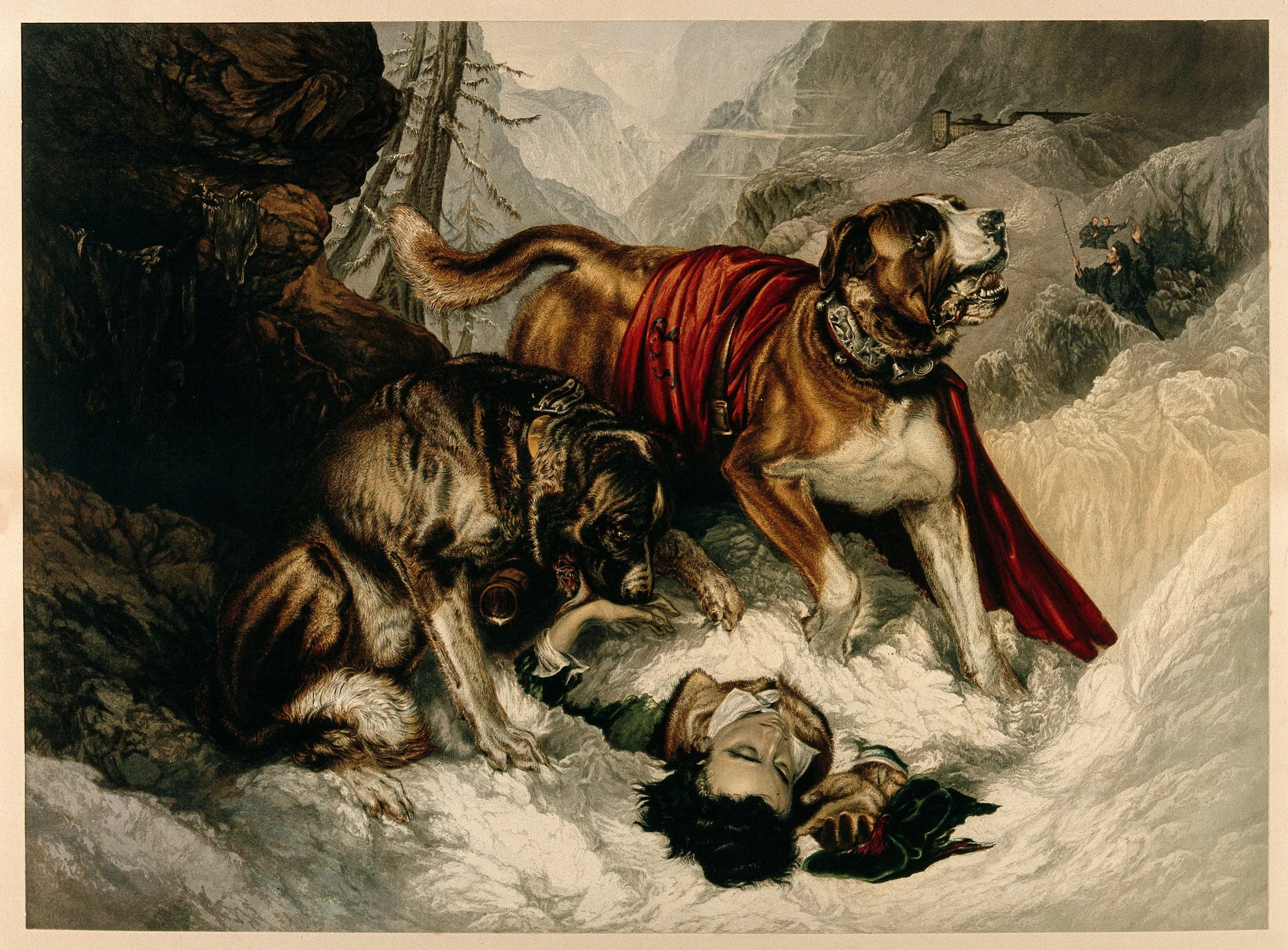
While these rescue dogs often carried food and water for victims, the monks of the Great St. Bernard's Hospice (where the dogs historically served as rescue animals) have refuted the notion that the dogs carried alcohol.
Curious about how the world works?
Today You Should Know is a free, weekly email newsletter designed to help you learn something new every Friday.
Subscribe today 👇
Check out some other curious questions:
Sources
Lacoste, K. (2024, July 2). Unveiling the Mystery: What’s in the St Bernard Barrel? Petful. https://www.petful.com/working-dogs/st-bernard-barrel/
Roeggla, G., Roeggla, M., Binder, M., Roeggla, H., Muellner, M., & Wagner, A. (1995). Effect of alcohol on body core temperature during cold‐water immersion. International Journal of Clinical Practice, 49(5), 239–240. https://doi.org/10.1111/j.1742-1241.1995.tb09965.x
SciShow. (2014, March 25). Does Alcohol Really Keep You Warm?. YouTube. https://www.youtube.com/watch?v=qBlERzJGdrs
Srivastava, S. (2026, January 11). Fact check: Does alcohol really keep you warm during winters?. The Week. https://www.theweek.in/news/health/2026/01/11/fact-check-does-alcohol-really-keep-you-warm-during-winters.html
Trevisani, M., Gazzieri, D., Benvenuti, F., Campi, B., Dinh, Q. T., Groneberg, D. A., Rigoni, M., Emonds-Alt, X., Creminon, C., Fischer, A., Geppetti, P., & Harrison, S. (2004). Ethanol causes inflammation in the airways by a neurogenic and TRPV1-dependent mechanism. The Journal of Pharmacology and Experimental Therapeutics, 309(3), 1167–1173. https://doi.org/10.1124/jpet.103.064162
Yoda, T., Crawshaw, L. I., Saito, K., Nakamura, M., Nagashima, K., & Kanosue, K. (2008). Effects of alcohol on autonomic responses and thermal sensation during cold exposure in humans. Alcohol, 42(3), 207–212. https://doi.org/10.1016/j.alcohol.2008.01.006



We Americans sure do like American things.