
Why do we zone out?
The short answer
When we zone out, brain regions that process external stimuli decouple from our introspective default mode network, causing our mind to wander without us realizing. Zoning out gives the brain a chance to rest, reflect, and solve problems.
The long answer
As you begin reading this article, you're probably at least somewhat focused on reading these words — 👋 hello!
But by the time you get halfway (okay, even a quarter of the way) through, it's likely your mind may drift. In fact, researchers estimate we spend up to 13% of our waking time zoning out, oblivious to the world around us.
What is zoning out?

"Woman with Headphones Listening to Music" by Karola G is part of the public domain.
When we zone out, we unconsciously lose awareness of the outside world and begin to think about something totally unrelated. At some point, we become aware we've drifted off and refocus our attention back to the person we were listening to, the show we were watching, or the newsletter we were reading.
Zoning out is a mild form of dissociation that may offer cognitive rest. Psychologically, it gives your brain opportunities to introspect while getting a break from external stimuli.
How does the brain zone out?
A leading theory that explains zoning out is the "decoupling hypothesis." Essentially, your brain decides that nothing dangerous, difficult, or important is happening and cuts the connection between your external and internal worlds.
When we zone out, brain regions responsible for taking in the outside world stop communicating with other parts of the brain. Our sensorimotor network (SMN), which processes sensory input and movement, becomes functionally disconnected from our default mode network (DMN), which is active during introspective thinking.

Source: Neurology (modified)
We literally stop registering what's going on around us: Normally our pupils dilate in response to changes to our environment, such as light or movement. But once our mind starts to wander, our pupils no longer respond to these external changes. Instead, they dilate independently from our surroundings.
Why do we zone out?
The goal of zoning out may be to make it easier for your brain to focus on internal thoughts, like recalling memories or planning for the future. Zoning out has several benefits:
✅ Mental break: When your mind drifts, your brain gets a break from collecting and analyzing external stimuli, which can be quite taxing. Zoning out is a recharge for your brain.
✅ Creativity boost: Researchers have also found that zoning out makes us better at creative problem-solving. A 2012 study asked 145 people to come up with as many uses for daily objects like clothes hangers or toothbrushes for two minutes. The group was split into four segments and given instructions to repeat the exercise instantly, take a break, complete a hard memory task, or complete a dull task to trigger zoning out before repeating.
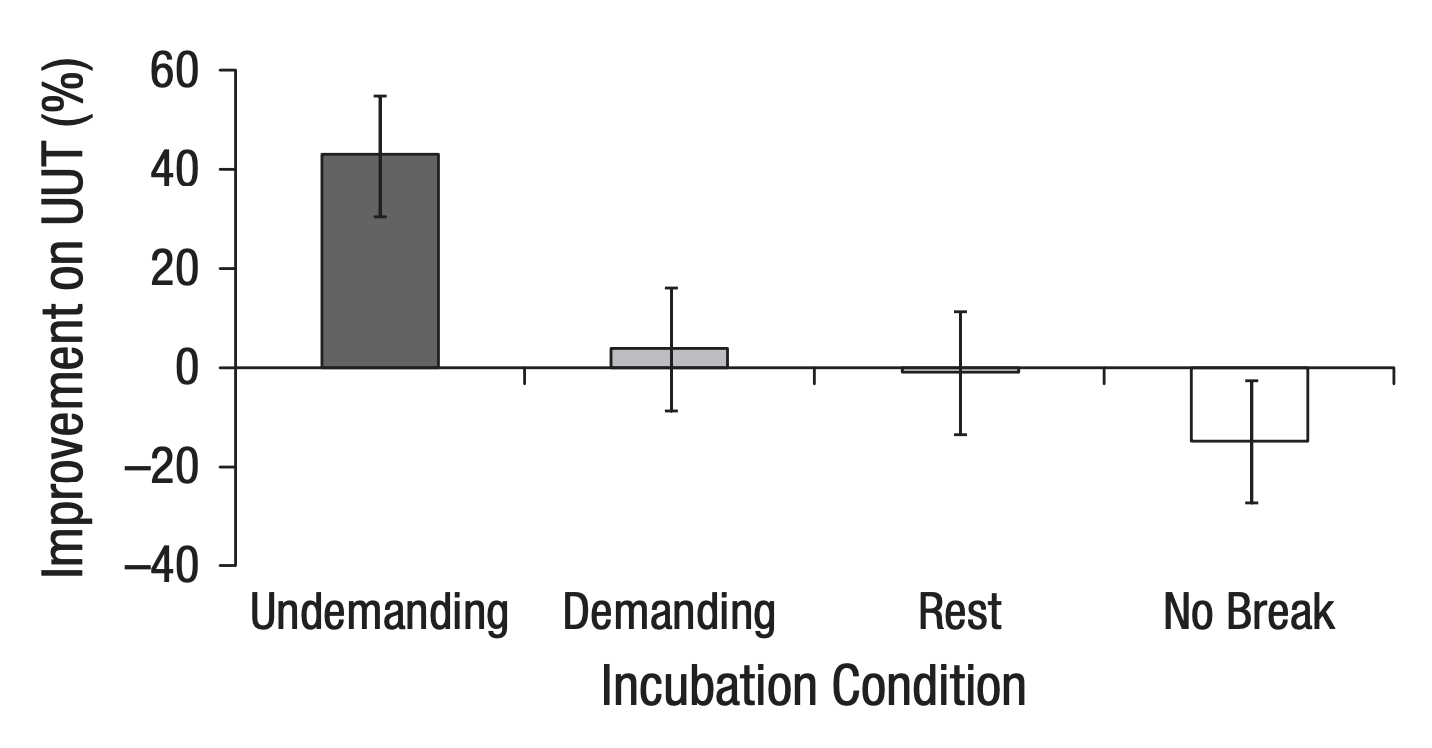
Source: Sage Journals
The group that was given the boring task came up with 41% more solutions to the problem than their first round, while the other groups showed no significant improvements.
✅ Coping mechanism: Zoning out gives your brain a break from the outside world. This can be especially soothing when you're going through a stressful experience, which is why zoning out is considered to be a coping mechanism.
But while zoning out provides a lot of brain benefits, it can also pose some risks:
❌ More errors or accidents: Zoning out can cause us to make more accidents during critical tasks that require focus, like driving.
❌ Decreased productivity or learning: While zoning out can help us with creative problem-solving, it hinders our ability to focus on the task at hand. This can impact productivity and learning.
❌ Social and emotional disconnect: Zoning out excessively mid-conversation can impact our ability to connect with people. And if zoning out is frequent coping mechanism in stressful situations, it can prevent our development to actively work through difficult emotions.
What causes people to zone out a lot?
Zoning out is perfectly normal and healthy, but we may experience it more frequently in our lives for a variety of reasons.
Reason #1: When you are stressed, anxious, or depressed
Because zoning out provides your brain with a cognitive break, we're more likely to do it when we're experiencing intense stress or difficult emotions. It's your brain's way of disconnecting to help soothe you during or after a traumatic event or high-stress period. For similar reasons, individuals undergoing extreme stress, anxiety, or depression may also experience derealization, which is when you feel detached from the world around you.
Reason #2: When you're sleep deprived

"A tired man" by Akshay Gupta is part of the public domain.
Not getting enough sleep also makes focus more difficult and zoning out more likely. Even one night of sleep deprivation can increase symptoms of dissociation and impact our ability to stop unwanted thoughts.
Reason #3: When you have lower working memory capacity and a task is demanding
Working memory capacity (WMC) is our ability to temporarily hold information for immediate use and considered essential for learning and problem-solving. When individuals have lower WMC, they may find it difficult to focus on demanding tasks, like reading difficult texts, and experience more mind-wandering.
There are a variety of reasons one may have lower WMC:
Age: Young children and elderly adults have been documented to have lower WMC.
Diseases and disorders affecting cognition: A variety of conditions can impair brain function and contribute to reduced WMC, including ADHD, Parkinson's disease, Huntington's disease, Alzheimer's disease, and even a recent COVID infection.
Brain damage: Individuals who have experienced a traumatic brain injury, a stroke, or alcohol-related brain damage may show reduced working memory capacity.
Reason #4: When you have higher working memory capacity and a task is simple
Conversely, individuals with high WMC can also experience increased zoning out, but specifically when the task is tedious. While people with higher WMC can effectively focus on demanding tasks, they require less focus on simpler tasks and report more frequent zoning out.
Curious about how the world works?
Today You Should Know is a free, weekly email newsletter designed to help you learn something new every Friday.
Subscribe today 👇
Check out some other curious questions:



Sources
(2010). Age Structure, 2006 - Early Working Years by Census Division (15 - 34 Years). https://doi.org/10.4095/301302
Arnsten, A. F. (1998). The biology of being frazzled. Science, 280(5370), 1711–1712. https://doi.org/10.1126/science.280.5370.1711
Association for Psychological Science. (2012, October 11). More than Just ‘Zoning Out’ – Psychological Science Examines the Cognitive Processes Underlying Mind Wandering. Association for Psychological Science. https://www.psychologicalscience.org/news/releases/more-than-just-zoning-out-psychological-science-examines-the-cognitive-processes-underlying-mind-wandering.html
Barshay, J. (2018, February 12). Researchers can predict when a student’s mind is wandering. What should we do about it? The Hechinger Report. https://hechingerreport.org/lessons-on-zoning-out/
Baseler, H. A., Aksoy, M., Salawu, A., Green, A., & Asghar, A. U. (2022). The Negative Impact of Covid-19 on Working Memory Revealed Using a Rapid Online Quiz. https://doi.org/10.1101/2022.05.20.22275380
Gordon, S., & Daly, K. (2025, October 22). 10 Causes of Zoning Out and Practical Tips to Overcome It. Health. https://www.health.com/why-do-i-zone-out-so-much-11733786
Janke van Holst, R., & Schilt, T. (2011). Drug-related decrease in neuropsychological functions of abstinent drug users. Current Drug Abuse Reviewse, 4(1), 42–56. https://doi.org/10.2174/1874473711104010042
Kane, M. J., & McVay, J. C. (2012). What mind wandering reveals about executive-control abilities and failures. Current Directions in Psychological Science, 21(5), 348–354. https://doi.org/10.1177/0963721412454875
Matta, A. (2019, November 20). What Causes Our Minds to Zone Out?. The Swaddle. https://www.theswaddle.com/what-causes-our-minds-to-zone-out
Park, D. C., Lautenschlager, G., Hedden, T., Davidson, N. S., Smith, A. D., & Smith, P. K. (2002). Models of visuospatial and verbal memory across the adult life span. Psychology and Aging, 17(2), 299–320. https://doi.org/10.1037//0882-7974.17.2.299
Pryor, J. (2021, March 25). What’s happening in your brain when you’re spacing out? MIT McGovern Institute. https://mcgovern.mit.edu/2021/03/25/whats-happening-in-your-brain-when-youre-spacing-out/
Schooler, J., Reichle, E., & Halpern, D. (2004). Zoning Out while Reading: Evidence for between Experience and Metaconsciousness. In Thinking and Seeing: Visual Metacognition in Adults and Children (pp. 203–222). essay, MIT Press. https://labs.psych.ucsb.edu/schooler/jonathan/sites/labs.psych.ucsb.edu.schooler.jonathan/files/pubs/zoning_out_while_reading.pdf
Schurer, T., Opitz, B., & Schubert, T. (2025, December 3). Working memory capacity but not prior knowledge impact on readers’ attention and text comprehension. Frontiers. https://www.frontiersin.org/journals/education/articles/10.3389/feduc.2020.00026/full
Sherrell, Z. (2023, August 15). Zoning out: Causes and when to seek help. Medical News Today. https://www.medicalnewstoday.com/articles/zoning-out
Wolchover, N. (2011, June 24). Why Do We Zone Out?. LiveScience. https://www.livescience.com/33357-why-we-zone-out.html

We Americans sure do like American things.